{"title":"An airborne CH4 sensor with temperature compensation based on a miniature optical structure for natural gas pipeline leakage analysis","authors":"Guolin Li, Haoran Yuan, Yingjie Zhao, Guangzhao Cui, Ruixiang Sun, Longju Li, Jianyu Gu, Wenxuan Zhao, Jinxu Yang","doi":"10.1016/j.saa.2025.126130","DOIUrl":null,"url":null,"abstract":"<div><div>Pipeline transport plays an important role in the exploration and transmission of natural gas. An airborne near-infrared (NIR) methane (CH<sub>4</sub>) sensor has been developed to analyze CH<sub>4</sub> leakage in the pipeline transport process based on the tunable diode laser absorption spectroscopy combined with wavelength modulation spectroscopy (WMS-TDLAS) technology relying on the high efficiency and convenience of unmanned aerial vehicles (UAVs). A laser diode in the form of an ultra-compact 8-pin package with a center wavelength of 1653.7 nm and an independently-designed miniature optical structure with an optical path length of 36 cm are adopted, which greatly reduces the size of the sensor. In order to improve the measurement accuracy, a temperature compensation link is designed to minimize the influence of temperature changes on the measured value. The original second harmonic signal is denoised by the variational mode decomposition algorithm optimized by Genghis Khan shark optimizer algorithm (GKSO-VMD), and the Bi-directional long short-term memory GKSO-BiLSTM algorithm is used for CH<sub>4</sub> concentration inversion. The measured and real concentration values of the sensor are closely related, with a correlation coefficient (R<sup>2</sup>) of 0.9996. The response time experiment demonstrates that the response time is approximately 6 s. The great stability of the sensor is confirmed by the long-term stability experiment. According to the Allan–Werle deviation, it is estimated that the sensor has a limit of detection (LoD) 613 ppb with an integration time of 230 s. Therefore, an effective analysis method is proposed for CH<sub>4</sub> leakage analysis during natural gas pipeline transport.</div></div>","PeriodicalId":433,"journal":{"name":"Spectrochimica Acta Part A: Molecular and Biomolecular Spectroscopy","volume":"337 ","pages":"Article 126130"},"PeriodicalIF":4.6000,"publicationDate":"2025-09-05","publicationTypes":"Journal Article","fieldsOfStudy":null,"isOpenAccess":false,"openAccessPdf":"","citationCount":"0","resultStr":null,"platform":"Semanticscholar","paperid":null,"PeriodicalName":"Spectrochimica Acta Part A: Molecular and Biomolecular Spectroscopy","FirstCategoryId":"92","ListUrlMain":"https://www.sciencedirect.com/science/article/pii/S1386142525004366","RegionNum":2,"RegionCategory":"化学","ArticlePicture":[],"TitleCN":null,"AbstractTextCN":null,"PMCID":null,"EPubDate":"2025/3/28 0:00:00","PubModel":"Epub","JCR":"Q1","JCRName":"SPECTROSCOPY","Score":null,"Total":0}
引用次数: 0
Abstract
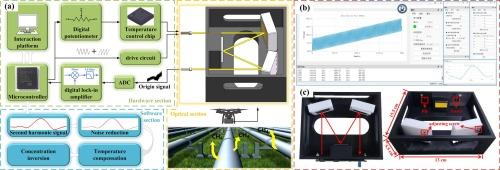
Pipeline transport plays an important role in the exploration and transmission of natural gas. An airborne near-infrared (NIR) methane (CH4) sensor has been developed to analyze CH4 leakage in the pipeline transport process based on the tunable diode laser absorption spectroscopy combined with wavelength modulation spectroscopy (WMS-TDLAS) technology relying on the high efficiency and convenience of unmanned aerial vehicles (UAVs). A laser diode in the form of an ultra-compact 8-pin package with a center wavelength of 1653.7 nm and an independently-designed miniature optical structure with an optical path length of 36 cm are adopted, which greatly reduces the size of the sensor. In order to improve the measurement accuracy, a temperature compensation link is designed to minimize the influence of temperature changes on the measured value. The original second harmonic signal is denoised by the variational mode decomposition algorithm optimized by Genghis Khan shark optimizer algorithm (GKSO-VMD), and the Bi-directional long short-term memory GKSO-BiLSTM algorithm is used for CH4 concentration inversion. The measured and real concentration values of the sensor are closely related, with a correlation coefficient (R2) of 0.9996. The response time experiment demonstrates that the response time is approximately 6 s. The great stability of the sensor is confirmed by the long-term stability experiment. According to the Allan–Werle deviation, it is estimated that the sensor has a limit of detection (LoD) 613 ppb with an integration time of 230 s. Therefore, an effective analysis method is proposed for CH4 leakage analysis during natural gas pipeline transport.
期刊介绍:
Spectrochimica Acta, Part A: Molecular and Biomolecular Spectroscopy (SAA) is an interdisciplinary journal which spans from basic to applied aspects of optical spectroscopy in chemistry, medicine, biology, and materials science.
The journal publishes original scientific papers that feature high-quality spectroscopic data and analysis. From the broad range of optical spectroscopies, the emphasis is on electronic, vibrational or rotational spectra of molecules, rather than on spectroscopy based on magnetic moments.
Criteria for publication in SAA are novelty, uniqueness, and outstanding quality. Routine applications of spectroscopic techniques and computational methods are not appropriate.
Topics of particular interest of Spectrochimica Acta Part A include, but are not limited to:
Spectroscopy and dynamics of bioanalytical, biomedical, environmental, and atmospheric sciences,
Novel experimental techniques or instrumentation for molecular spectroscopy,
Novel theoretical and computational methods,
Novel applications in photochemistry and photobiology,
Novel interpretational approaches as well as advances in data analysis based on electronic or vibrational spectroscopy.




 京公网安备 11010802042870号
京ICP备2023020795号-1
京公网安备 11010802042870号
京ICP备2023020795号-1

 分享
分享
 求助内容:
求助内容: 应助结果提醒方式:
 扫码关注我们
