A multifunctional Tb-MOF constructed with triphenylamine-based hexacarboxylate ligands for highly luminescent sensing toward antibiotics and salicylaldehydes
Zhihan Mao , Han Shi , Xuan Yu, Yuchen Liu, Fenglei Yang, Huiyan Liu, Haiying Wang
{"title":"A multifunctional Tb-MOF constructed with triphenylamine-based hexacarboxylate ligands for highly luminescent sensing toward antibiotics and salicylaldehydes","authors":"Zhihan Mao , Han Shi , Xuan Yu, Yuchen Liu, Fenglei Yang, Huiyan Liu, Haiying Wang","doi":"10.1016/j.saa.2025.126129","DOIUrl":null,"url":null,"abstract":"<div><div>Antibiotics and salicylaldehydes are major organic pollutants in the environment, and their efficient selection and sensitive detection are of great significance but also challenging. A multifunctional terbium-organic framework (<strong>Tb-MOF</strong>) with multiple π-conjugated rings and basic sites decorated nanoporous channels was constructed with triphenylamine-based hexacarboxylate ligands. Structure analysis of <strong>Tb-MOF</strong> revealed that the six carboxyl groups on the skeleton of ligand exhibit considerable degree of distortion and can be regarded as three triangular nodes, which further combined the binuclear [Tb<sub>2</sub>(COO)<sub>6</sub>(H<sub>2</sub>O)<sub>4</sub>] nodes to form a new (3,3,3,6)-connected 3D net. Importantly, <strong>Tb-MOF</strong> provided the first example of luminescent MOFs constructed from triphenylamine-based hexacarboxylate ligands with multi-responsive behavior toward antibiotics and salicylaldehydes. <strong>Tb-MOF</strong> demonstrated excellent performance on the selection and recognition of two antibiotics, metronidazole (MDZ) and dimetridazole (DTZ), with the detection limit (LOD) of 0.60 and 0.95 μM, respectively. More importantly, <strong>Tb-MO</strong>F can achieve highly sensitive detection of three aldehydes, salicylaldehyde (SA), 5-methylsalicylaldehyde (5-MeSA) and 5-chlorsalicylaldehyde (5-ClSA), with LODs up to 0.58, 0.59 and 0.48 μM, respectively. Regenerated experiments indicated that <strong>Tb-MO</strong>F can be employed for the efficient detection of MDZ and SA at least five times. Thus, <strong>Tb-MOF</strong> can be potentially explored as a promising sensor to simultaneously identify antibiotics and salicylaldehydes in chemical detection and biologic environments with ultra-sensitivity, low LODs and extraordinary recycling capacity.</div></div>","PeriodicalId":433,"journal":{"name":"Spectrochimica Acta Part A: Molecular and Biomolecular Spectroscopy","volume":"337 ","pages":"Article 126129"},"PeriodicalIF":4.6000,"publicationDate":"2025-09-05","publicationTypes":"Journal Article","fieldsOfStudy":null,"isOpenAccess":false,"openAccessPdf":"","citationCount":"0","resultStr":null,"platform":"Semanticscholar","paperid":null,"PeriodicalName":"Spectrochimica Acta Part A: Molecular and Biomolecular Spectroscopy","FirstCategoryId":"92","ListUrlMain":"https://www.sciencedirect.com/science/article/pii/S1386142525004354","RegionNum":2,"RegionCategory":"化学","ArticlePicture":[],"TitleCN":null,"AbstractTextCN":null,"PMCID":null,"EPubDate":"2025/3/28 0:00:00","PubModel":"Epub","JCR":"Q1","JCRName":"SPECTROSCOPY","Score":null,"Total":0}
引用次数: 0
Abstract
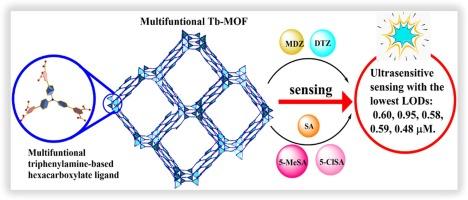
Antibiotics and salicylaldehydes are major organic pollutants in the environment, and their efficient selection and sensitive detection are of great significance but also challenging. A multifunctional terbium-organic framework (Tb-MOF) with multiple π-conjugated rings and basic sites decorated nanoporous channels was constructed with triphenylamine-based hexacarboxylate ligands. Structure analysis of Tb-MOF revealed that the six carboxyl groups on the skeleton of ligand exhibit considerable degree of distortion and can be regarded as three triangular nodes, which further combined the binuclear [Tb2(COO)6(H2O)4] nodes to form a new (3,3,3,6)-connected 3D net. Importantly, Tb-MOF provided the first example of luminescent MOFs constructed from triphenylamine-based hexacarboxylate ligands with multi-responsive behavior toward antibiotics and salicylaldehydes. Tb-MOF demonstrated excellent performance on the selection and recognition of two antibiotics, metronidazole (MDZ) and dimetridazole (DTZ), with the detection limit (LOD) of 0.60 and 0.95 μM, respectively. More importantly, Tb-MOF can achieve highly sensitive detection of three aldehydes, salicylaldehyde (SA), 5-methylsalicylaldehyde (5-MeSA) and 5-chlorsalicylaldehyde (5-ClSA), with LODs up to 0.58, 0.59 and 0.48 μM, respectively. Regenerated experiments indicated that Tb-MOF can be employed for the efficient detection of MDZ and SA at least five times. Thus, Tb-MOF can be potentially explored as a promising sensor to simultaneously identify antibiotics and salicylaldehydes in chemical detection and biologic environments with ultra-sensitivity, low LODs and extraordinary recycling capacity.
期刊介绍:
Spectrochimica Acta, Part A: Molecular and Biomolecular Spectroscopy (SAA) is an interdisciplinary journal which spans from basic to applied aspects of optical spectroscopy in chemistry, medicine, biology, and materials science.
The journal publishes original scientific papers that feature high-quality spectroscopic data and analysis. From the broad range of optical spectroscopies, the emphasis is on electronic, vibrational or rotational spectra of molecules, rather than on spectroscopy based on magnetic moments.
Criteria for publication in SAA are novelty, uniqueness, and outstanding quality. Routine applications of spectroscopic techniques and computational methods are not appropriate.
Topics of particular interest of Spectrochimica Acta Part A include, but are not limited to:
Spectroscopy and dynamics of bioanalytical, biomedical, environmental, and atmospheric sciences,
Novel experimental techniques or instrumentation for molecular spectroscopy,
Novel theoretical and computational methods,
Novel applications in photochemistry and photobiology,
Novel interpretational approaches as well as advances in data analysis based on electronic or vibrational spectroscopy.



 京公网安备 11010802042870号
京ICP备2023020795号-1
京公网安备 11010802042870号
京ICP备2023020795号-1

 分享
分享
 求助内容:
求助内容: 应助结果提醒方式:
 扫码关注我们
