{"title":"Unveiling the temperature-driven microkinetic processes of NH3 decomposition on the Co(111) surface","authors":"Tian Tang , Penghui Ren , Jinfei Chen , Heyuan Zhang , Wenyun Qiao , Linhan Yu , Xinbao Li , Xuesen Du","doi":"10.1016/j.ijhydene.2025.03.428","DOIUrl":null,"url":null,"abstract":"<div><div>The limited understanding of the reaction mechanism, particularly the unresolved debate on surface dynamics, hinders the advancement of catalytic ammonia (NH<sub>3</sub>) decomposition as a viable pathway for carbon-free hydrogen production. This study integrates spin-polarized DFT + U calculations with microkinetic simulations to investigate the microkinetic of NH<sub>3</sub> decomposition on the promising transition metal Co(111) surface. The results show that NH<sub>3</sub> decomposition on Co(111) exhibits temperature-dependent properties. The N∗<strong>−</strong>N∗ coupling (N∗ + N∗ → N<sub>2</sub>∗) is identified as the rate-limiting step across all temperatures, despite being highly favorable both thermodynamically (ΔH = −0.85 eV) and kinetically (Ea = 0.23 eV). Below 750 K, NH<sub>3</sub> decomposition is limited by the second dehydrogenation step (NH<sub>2</sub>∗ + H∗ → NH∗ + 2H∗), due to its high activation energy (Ea = 2.27 eV) and strong NH<sub>3</sub> adsorption (Eads = 1.54 eV). As the temperature rises (750–1000 K), the reverse shift in the equilibrium of the third dehydrogenation step (NH∗ + 2H∗ → N∗ + 3H∗, ΔH = +0.59 eV) and H∗<strong>−</strong>H∗ coupling (H∗ + H∗ → N<sub>2</sub>∗, ΔH = +1.02/+1.05 eV) causes NH<sub>2</sub>∗ and NH∗ accumulation, reducing H<sub>2</sub> and N<sub>2</sub> production rates. This study aims to clarify the long-standing debate on rate-determining steps in NH<sub>3</sub> decomposition and provides theoretical insights for developing efficient Co-based catalysts.</div></div>","PeriodicalId":337,"journal":{"name":"International Journal of Hydrogen Energy","volume":"123 ","pages":"Pages 118-124"},"PeriodicalIF":8.3000,"publicationDate":"2025-04-02","publicationTypes":"Journal Article","fieldsOfStudy":null,"isOpenAccess":false,"openAccessPdf":"","citationCount":"0","resultStr":null,"platform":"Semanticscholar","paperid":null,"PeriodicalName":"International Journal of Hydrogen Energy","FirstCategoryId":"5","ListUrlMain":"https://www.sciencedirect.com/science/article/pii/S0360319925015794","RegionNum":2,"RegionCategory":"工程技术","ArticlePicture":[],"TitleCN":null,"AbstractTextCN":null,"PMCID":null,"EPubDate":"","PubModel":"","JCR":"Q1","JCRName":"CHEMISTRY, PHYSICAL","Score":null,"Total":0}
引用次数: 0
Abstract
The limited understanding of the reaction mechanism, particularly the unresolved debate on surface dynamics, hinders the advancement of catalytic ammonia (NH3) decomposition as a viable pathway for carbon-free hydrogen production. This study integrates spin-polarized DFT + U calculations with microkinetic simulations to investigate the microkinetic of NH3 decomposition on the promising transition metal Co(111) surface. The results show that NH3 decomposition on Co(111) exhibits temperature-dependent properties. The N∗−N∗ coupling (N∗ + N∗ → N2∗) is identified as the rate-limiting step across all temperatures, despite being highly favorable both thermodynamically (ΔH = −0.85 eV) and kinetically (Ea = 0.23 eV). Below 750 K, NH3 decomposition is limited by the second dehydrogenation step (NH2∗ + H∗ → NH∗ + 2H∗), due to its high activation energy (Ea = 2.27 eV) and strong NH3 adsorption (Eads = 1.54 eV). As the temperature rises (750–1000 K), the reverse shift in the equilibrium of the third dehydrogenation step (NH∗ + 2H∗ → N∗ + 3H∗, ΔH = +0.59 eV) and H∗−H∗ coupling (H∗ + H∗ → N2∗, ΔH = +1.02/+1.05 eV) causes NH2∗ and NH∗ accumulation, reducing H2 and N2 production rates. This study aims to clarify the long-standing debate on rate-determining steps in NH3 decomposition and provides theoretical insights for developing efficient Co-based catalysts.
期刊介绍:
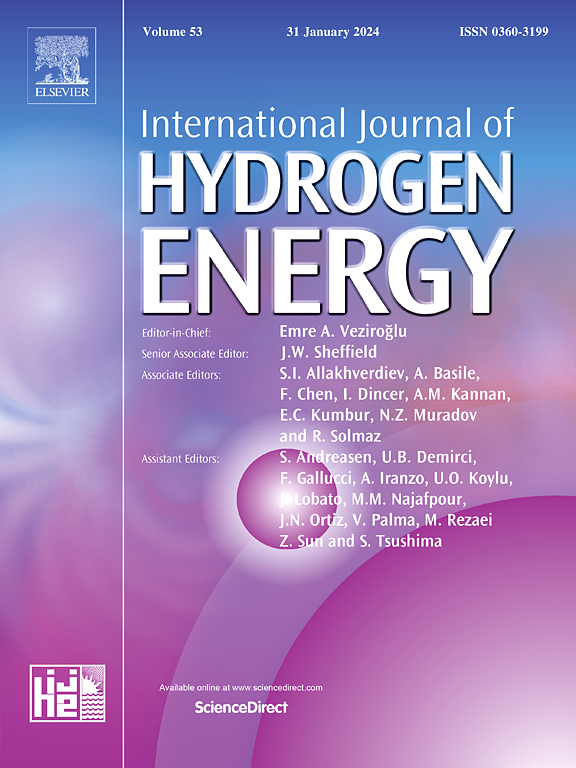
The objective of the International Journal of Hydrogen Energy is to facilitate the exchange of new ideas, technological advancements, and research findings in the field of Hydrogen Energy among scientists and engineers worldwide. This journal showcases original research, both analytical and experimental, covering various aspects of Hydrogen Energy. These include production, storage, transmission, utilization, enabling technologies, environmental impact, economic considerations, and global perspectives on hydrogen and its carriers such as NH3, CH4, alcohols, etc.
The utilization aspect encompasses various methods such as thermochemical (combustion), photochemical, electrochemical (fuel cells), and nuclear conversion of hydrogen, hydrogen isotopes, and hydrogen carriers into thermal, mechanical, and electrical energies. The applications of these energies can be found in transportation (including aerospace), industrial, commercial, and residential sectors.




 京公网安备 11010802042870号
京ICP备2023020795号-1
京公网安备 11010802042870号
京ICP备2023020795号-1

 分享
分享
 求助内容:
求助内容: 应助结果提醒方式:
 扫码关注我们
