{"title":"Experimental investigation on vented hydrogen explosion in synergetic application of hydrogen concentration and pipe length","authors":"Zhanggui Xu , Jiefan Zhang , Yun Zhang , Zihan Chu , Cunjuan Yu , Guoen Fu , Jianfu Xu , Wen Zhou , Haixia Zhao , Yanwu Yu , Penggang Jin , Weiguo Cao","doi":"10.1016/j.ijhydene.2025.03.357","DOIUrl":null,"url":null,"abstract":"<div><div>The combined effect of pipe length and hydrogen concentration may influence the energy output mechanism of vented hydrogen explosions. High-speed photography system and pressure acquisition device were utilized to collect data regarding vented hydrogen explosions under diverse conditions. Experimental results demonstrated that the coupling effects of hydrogen concentration and pipe length exhibited significant correlations in flame propagation and pressure dynamics. When the hydrogen concentration was 30 %, the flame area increased linearly from 952 cm<sup>2</sup> to 1834 cm<sup>2</sup> as the pipe length extended from 100 mm to 1000 mm. In contrast, at 50 % hydrogen concentration, the flame area reached its maximum value of 1340 cm<sup>2</sup> in a 500 mm-long pipe before diminishing with longer duct configurations. Pressure measurements revealed distinct constraint effects: Under 30 % hydrogen concentration, the internal overpressure escalated significantly from 0.54 MPa (100 mm) to 0.68 MPa (1000 mm). Distinctively, a secondary pressure peak emerged in 50 % hydrogen scenarios, indicating potential external explosion hazards. Mechanistic analysis suggested that for hydrogen-rich mixtures (50 %), limiting pipe length to 500 mm effectively controled flame area below 1340 cm<sup>2</sup>. Regarding near-stoichiometric conditions (30 %), maintaining pipe lengths shorter than 100 mm restricted internal overpressure below 0.54 MPa.</div></div>","PeriodicalId":337,"journal":{"name":"International Journal of Hydrogen Energy","volume":"123 ","pages":"Pages 89-99"},"PeriodicalIF":8.3000,"publicationDate":"2025-04-02","publicationTypes":"Journal Article","fieldsOfStudy":null,"isOpenAccess":false,"openAccessPdf":"","citationCount":"0","resultStr":null,"platform":"Semanticscholar","paperid":null,"PeriodicalName":"International Journal of Hydrogen Energy","FirstCategoryId":"5","ListUrlMain":"https://www.sciencedirect.com/science/article/pii/S0360319925015071","RegionNum":2,"RegionCategory":"工程技术","ArticlePicture":[],"TitleCN":null,"AbstractTextCN":null,"PMCID":null,"EPubDate":"","PubModel":"","JCR":"Q1","JCRName":"CHEMISTRY, PHYSICAL","Score":null,"Total":0}
引用次数: 0
Abstract
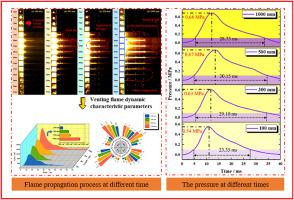
The combined effect of pipe length and hydrogen concentration may influence the energy output mechanism of vented hydrogen explosions. High-speed photography system and pressure acquisition device were utilized to collect data regarding vented hydrogen explosions under diverse conditions. Experimental results demonstrated that the coupling effects of hydrogen concentration and pipe length exhibited significant correlations in flame propagation and pressure dynamics. When the hydrogen concentration was 30 %, the flame area increased linearly from 952 cm2 to 1834 cm2 as the pipe length extended from 100 mm to 1000 mm. In contrast, at 50 % hydrogen concentration, the flame area reached its maximum value of 1340 cm2 in a 500 mm-long pipe before diminishing with longer duct configurations. Pressure measurements revealed distinct constraint effects: Under 30 % hydrogen concentration, the internal overpressure escalated significantly from 0.54 MPa (100 mm) to 0.68 MPa (1000 mm). Distinctively, a secondary pressure peak emerged in 50 % hydrogen scenarios, indicating potential external explosion hazards. Mechanistic analysis suggested that for hydrogen-rich mixtures (50 %), limiting pipe length to 500 mm effectively controled flame area below 1340 cm2. Regarding near-stoichiometric conditions (30 %), maintaining pipe lengths shorter than 100 mm restricted internal overpressure below 0.54 MPa.
期刊介绍:
The objective of the International Journal of Hydrogen Energy is to facilitate the exchange of new ideas, technological advancements, and research findings in the field of Hydrogen Energy among scientists and engineers worldwide. This journal showcases original research, both analytical and experimental, covering various aspects of Hydrogen Energy. These include production, storage, transmission, utilization, enabling technologies, environmental impact, economic considerations, and global perspectives on hydrogen and its carriers such as NH3, CH4, alcohols, etc.
The utilization aspect encompasses various methods such as thermochemical (combustion), photochemical, electrochemical (fuel cells), and nuclear conversion of hydrogen, hydrogen isotopes, and hydrogen carriers into thermal, mechanical, and electrical energies. The applications of these energies can be found in transportation (including aerospace), industrial, commercial, and residential sectors.



 京公网安备 11010802042870号
京ICP备2023020795号-1
京公网安备 11010802042870号
京ICP备2023020795号-1

 分享
分享
 求助内容:
求助内容: 应助结果提醒方式:
 扫码关注我们
