Rapid synthesis of carbon-supported CoS2/CoSe2 heterostructures by magnetic induction heating for efficient hydrogen evolution reaction in acidic media
Bingzhe Yu , John Tressel , Tianchen Cui , Dingjie Pan , Davida Briana DuBois , Colton Jones , Bryan Hou , Kiley Mayford , Qiming Liu , Frank Bridges , Shaowei Chen
{"title":"Rapid synthesis of carbon-supported CoS2/CoSe2 heterostructures by magnetic induction heating for efficient hydrogen evolution reaction in acidic media","authors":"Bingzhe Yu , John Tressel , Tianchen Cui , Dingjie Pan , Davida Briana DuBois , Colton Jones , Bryan Hou , Kiley Mayford , Qiming Liu , Frank Bridges , Shaowei Chen","doi":"10.1016/j.jpowsour.2025.236897","DOIUrl":null,"url":null,"abstract":"<div><div>Transition metal dichalcogenides have been recognized as promising alternative electrocatalysts to precious metal-based benchmarks for hydrogen evolution reaction (HER), owing to their unique structures, tunable electronic properties and low costs. However, the performance is generally compromised by the sluggish electron-transfer kinetics and limited electrical conductivity. Herein, nanocomposites consisting of CoS<sub>2</sub>/CoSe<sub>2</sub> heterostructures supported on N-doped carbon are prepared via magnetic induction heating at 200 A for only 10 s and display an apparent HER activity in 0.5 M H<sub>2</sub>SO<sub>4</sub>. Among the obtained CoS<sub>2</sub>/CoSe<sub>2</sub>/NC series, the sample with an S:Se atomic ratio of ca. 1:1 exhibits the best performance, requiring a low overpotential of −187 mV to reach the current density of 10 mA cm<sup>−2</sup>, with a low Tafel slope of 40.7 mV dec<sup>−1</sup>, markedly outperforming the CoS<sub>2</sub> and CoSe<sub>2</sub> counterparts. This is ascribed to the optimized electronic structure and enhanced electrical conductivity due to the formation of the CoS<sub>2</sub>/CoSe<sub>2</sub> heterostructures, as evidenced in microscopic and spectroscopic measurements. Consistent results are obtained in theoretical studies based on density functional theory calculations. Results from this work highlight the unique potential of heterostructured materials as viable catalysts for electrochemical energy technologies.</div></div>","PeriodicalId":377,"journal":{"name":"Journal of Power Sources","volume":"641 ","pages":"Article 236897"},"PeriodicalIF":7.9000,"publicationDate":"2025-03-31","publicationTypes":"Journal Article","fieldsOfStudy":null,"isOpenAccess":false,"openAccessPdf":"","citationCount":"0","resultStr":null,"platform":"Semanticscholar","paperid":null,"PeriodicalName":"Journal of Power Sources","FirstCategoryId":"5","ListUrlMain":"https://www.sciencedirect.com/science/article/pii/S0378775325007335","RegionNum":2,"RegionCategory":"工程技术","ArticlePicture":[],"TitleCN":null,"AbstractTextCN":null,"PMCID":null,"EPubDate":"","PubModel":"","JCR":"Q1","JCRName":"CHEMISTRY, PHYSICAL","Score":null,"Total":0}
引用次数: 0
Abstract
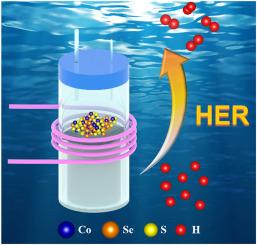
Transition metal dichalcogenides have been recognized as promising alternative electrocatalysts to precious metal-based benchmarks for hydrogen evolution reaction (HER), owing to their unique structures, tunable electronic properties and low costs. However, the performance is generally compromised by the sluggish electron-transfer kinetics and limited electrical conductivity. Herein, nanocomposites consisting of CoS2/CoSe2 heterostructures supported on N-doped carbon are prepared via magnetic induction heating at 200 A for only 10 s and display an apparent HER activity in 0.5 M H2SO4. Among the obtained CoS2/CoSe2/NC series, the sample with an S:Se atomic ratio of ca. 1:1 exhibits the best performance, requiring a low overpotential of −187 mV to reach the current density of 10 mA cm−2, with a low Tafel slope of 40.7 mV dec−1, markedly outperforming the CoS2 and CoSe2 counterparts. This is ascribed to the optimized electronic structure and enhanced electrical conductivity due to the formation of the CoS2/CoSe2 heterostructures, as evidenced in microscopic and spectroscopic measurements. Consistent results are obtained in theoretical studies based on density functional theory calculations. Results from this work highlight the unique potential of heterostructured materials as viable catalysts for electrochemical energy technologies.
期刊介绍:
The Journal of Power Sources is a publication catering to researchers and technologists interested in various aspects of the science, technology, and applications of electrochemical power sources. It covers original research and reviews on primary and secondary batteries, fuel cells, supercapacitors, and photo-electrochemical cells.
Topics considered include the research, development and applications of nanomaterials and novel componentry for these devices. Examples of applications of these electrochemical power sources include:
• Portable electronics
• Electric and Hybrid Electric Vehicles
• Uninterruptible Power Supply (UPS) systems
• Storage of renewable energy
• Satellites and deep space probes
• Boats and ships, drones and aircrafts
• Wearable energy storage systems



 京公网安备 11010802042870号
京ICP备2023020795号-1
京公网安备 11010802042870号
京ICP备2023020795号-1

 分享
分享
 求助内容:
求助内容: 应助结果提醒方式:
 扫码关注我们
