Dan Yu , Xingjun Li , Fan Zhou , Samuel Simon Araya , Simon Lennart Sahlin , Venkat R. Subramanian , Vincenzo Liso
{"title":"Online fault detection and isolation of PEMFC based on EIS and data-driven methods: Feasibility study and prospects","authors":"Dan Yu , Xingjun Li , Fan Zhou , Samuel Simon Araya , Simon Lennart Sahlin , Venkat R. Subramanian , Vincenzo Liso","doi":"10.1016/j.jpowsour.2025.236915","DOIUrl":null,"url":null,"abstract":"<div><div>Electrochemical impedance spectroscopy (EIS) can be useful for the mechanism analysis and diagnosis of proton-exchange membrane fuel cell (PEMFC) performance degradation. This review summarizes the potential of using EIS for real-time fault detection and isolation of the PEMFC by data-driven methods from the following aspects. First, the data-driven diagnosis strategy of PEMFC based on EIS is overviewed; the typical faults and EIS measurement for data collection are briefly introduced. Then, the application of EIS in the online data-driven diagnosis of PEMFC is analyzed and discussed, focusing on feature extraction from EIS, diagnosis models employing various machine learning methods, and the corresponding EIS features for each machine learning method. Finally, the feasibility of using EIS for online data-driven fault diagnosis of PEMFC is briefly summarized, and the research challenges and prospects are proposed. This review aims to provide inspiration and new insights for future research on online PEMFC diagnosis, prognostics, and health management.</div></div>","PeriodicalId":377,"journal":{"name":"Journal of Power Sources","volume":"641 ","pages":"Article 236915"},"PeriodicalIF":7.9000,"publicationDate":"2025-04-01","publicationTypes":"Journal Article","fieldsOfStudy":null,"isOpenAccess":false,"openAccessPdf":"","citationCount":"0","resultStr":null,"platform":"Semanticscholar","paperid":null,"PeriodicalName":"Journal of Power Sources","FirstCategoryId":"5","ListUrlMain":"https://www.sciencedirect.com/science/article/pii/S0378775325007517","RegionNum":2,"RegionCategory":"工程技术","ArticlePicture":[],"TitleCN":null,"AbstractTextCN":null,"PMCID":null,"EPubDate":"","PubModel":"","JCR":"Q1","JCRName":"CHEMISTRY, PHYSICAL","Score":null,"Total":0}
引用次数: 0
Abstract
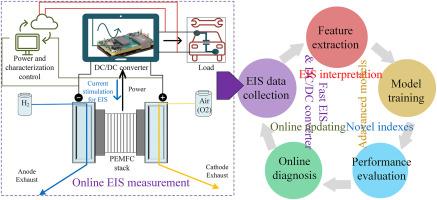
Electrochemical impedance spectroscopy (EIS) can be useful for the mechanism analysis and diagnosis of proton-exchange membrane fuel cell (PEMFC) performance degradation. This review summarizes the potential of using EIS for real-time fault detection and isolation of the PEMFC by data-driven methods from the following aspects. First, the data-driven diagnosis strategy of PEMFC based on EIS is overviewed; the typical faults and EIS measurement for data collection are briefly introduced. Then, the application of EIS in the online data-driven diagnosis of PEMFC is analyzed and discussed, focusing on feature extraction from EIS, diagnosis models employing various machine learning methods, and the corresponding EIS features for each machine learning method. Finally, the feasibility of using EIS for online data-driven fault diagnosis of PEMFC is briefly summarized, and the research challenges and prospects are proposed. This review aims to provide inspiration and new insights for future research on online PEMFC diagnosis, prognostics, and health management.
期刊介绍:
The Journal of Power Sources is a publication catering to researchers and technologists interested in various aspects of the science, technology, and applications of electrochemical power sources. It covers original research and reviews on primary and secondary batteries, fuel cells, supercapacitors, and photo-electrochemical cells.
Topics considered include the research, development and applications of nanomaterials and novel componentry for these devices. Examples of applications of these electrochemical power sources include:
• Portable electronics
• Electric and Hybrid Electric Vehicles
• Uninterruptible Power Supply (UPS) systems
• Storage of renewable energy
• Satellites and deep space probes
• Boats and ships, drones and aircrafts
• Wearable energy storage systems



 京公网安备 11010802042870号
京ICP备2023020795号-1
京公网安备 11010802042870号
京ICP备2023020795号-1

 分享
分享
 求助内容:
求助内容: 应助结果提醒方式:
 扫码关注我们
