Xiaodong Sun , Wenlong Liu , Ning Zhang , Yehong Du , Jianzong Man , Juncai Sun
{"title":"Chestnut shell-derived oxygen-rich porous carbon as a stable framework for dendrite-free Na metal anode","authors":"Xiaodong Sun , Wenlong Liu , Ning Zhang , Yehong Du , Jianzong Man , Juncai Sun","doi":"10.1016/j.jpowsour.2025.236920","DOIUrl":null,"url":null,"abstract":"<div><div>Metallic Na has a higher theoretical specific capacity (1165 mAh/g) and the lowest electrode potential (−2.71 vs. standard hydrogen electrode), which is conducive to the improvement of the energy density of Na secondary batteries. Nevertheless, dendrite growth and volume expansion caused by non-uniform Na deposition limit the development of Na metal anode. Here, the resource-rich and environmentally friendly chestnut shells are selected as the precursor, and oxygen-rich porous carbon is prepared by a one-step chemical activation method to solve the above issues. The high electronegativity of oxygen atom improves the polarity of the porous carbon, enhances the adsorption capacity of Na<sup>+</sup>, and reduces the Na nucleation barrier. Meanwhile, the massive polar sites facilitate the regulation of the distribution of Na<sup>+</sup> on the carbon framework and directs uniform Na deposition. The porous structure increases the specific surface area, reduces the local current density and inhibits dendrite growth. The density functional theory calculations indicate that the oxygen-containing polar functional group (C=O, C-OH, and C-O-C) increases the binding energy to Na<sup>+</sup>. Thus, the full cell with Na<sub>3</sub>V<sub>2</sub>(PO<sub>4</sub>)<sub>3</sub> cathode displays a high reversible capacity (88.6 mA h g<sup>−1</sup>) at 1C after 300 cycles. The results show that the application of chestnut shell-derived biocarbon materials on Na metal anode plays a positive role in achieving their commercialisation in battery systems.</div></div>","PeriodicalId":377,"journal":{"name":"Journal of Power Sources","volume":"641 ","pages":"Article 236920"},"PeriodicalIF":7.9000,"publicationDate":"2025-06-15","publicationTypes":"Journal Article","fieldsOfStudy":null,"isOpenAccess":false,"openAccessPdf":"","citationCount":"0","resultStr":null,"platform":"Semanticscholar","paperid":null,"PeriodicalName":"Journal of Power Sources","FirstCategoryId":"5","ListUrlMain":"https://www.sciencedirect.com/science/article/pii/S0378775325007566","RegionNum":2,"RegionCategory":"工程技术","ArticlePicture":[],"TitleCN":null,"AbstractTextCN":null,"PMCID":null,"EPubDate":"2025/4/2 0:00:00","PubModel":"Epub","JCR":"Q1","JCRName":"CHEMISTRY, PHYSICAL","Score":null,"Total":0}
引用次数: 0
Abstract
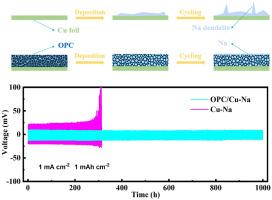
Metallic Na has a higher theoretical specific capacity (1165 mAh/g) and the lowest electrode potential (−2.71 vs. standard hydrogen electrode), which is conducive to the improvement of the energy density of Na secondary batteries. Nevertheless, dendrite growth and volume expansion caused by non-uniform Na deposition limit the development of Na metal anode. Here, the resource-rich and environmentally friendly chestnut shells are selected as the precursor, and oxygen-rich porous carbon is prepared by a one-step chemical activation method to solve the above issues. The high electronegativity of oxygen atom improves the polarity of the porous carbon, enhances the adsorption capacity of Na+, and reduces the Na nucleation barrier. Meanwhile, the massive polar sites facilitate the regulation of the distribution of Na+ on the carbon framework and directs uniform Na deposition. The porous structure increases the specific surface area, reduces the local current density and inhibits dendrite growth. The density functional theory calculations indicate that the oxygen-containing polar functional group (C=O, C-OH, and C-O-C) increases the binding energy to Na+. Thus, the full cell with Na3V2(PO4)3 cathode displays a high reversible capacity (88.6 mA h g−1) at 1C after 300 cycles. The results show that the application of chestnut shell-derived biocarbon materials on Na metal anode plays a positive role in achieving their commercialisation in battery systems.
金属Na具有较高的理论比容量(1165 mAh/g)和最低的电极电位(- 2.71 vs标准氢电极),有利于提高Na二次电池的能量密度。然而,不均匀的Na沉积导致的枝晶生长和体积膨胀限制了Na金属阳极的发展。本文选择资源丰富、环境友好的栗子壳作为前驱体,采用一步化学活化法制备富氧多孔碳,解决上述问题。氧原子的高电负性提高了多孔碳的极性,增强了对Na+的吸附能力,降低了Na成核势垒。同时,大量的极性位点有助于调节Na+在碳骨架上的分布,并指导Na的均匀沉积。多孔结构增加了比表面积,降低了局部电流密度,抑制了枝晶的生长。密度泛函理论计算表明,含氧极性官能团(C=O, C- oh和C-O-C)增加了Na+的结合能。因此,具有Na3V2(PO4)3阴极的完整电池在1C下循环300次后显示出高可逆容量(88.6 mA h g−1)。结果表明,板栗壳衍生生物碳材料在Na金属阳极上的应用对实现其在电池系统中的商业化具有积极作用。
期刊介绍:
The Journal of Power Sources is a publication catering to researchers and technologists interested in various aspects of the science, technology, and applications of electrochemical power sources. It covers original research and reviews on primary and secondary batteries, fuel cells, supercapacitors, and photo-electrochemical cells.
Topics considered include the research, development and applications of nanomaterials and novel componentry for these devices. Examples of applications of these electrochemical power sources include:
• Portable electronics
• Electric and Hybrid Electric Vehicles
• Uninterruptible Power Supply (UPS) systems
• Storage of renewable energy
• Satellites and deep space probes
• Boats and ships, drones and aircrafts
• Wearable energy storage systems



 京公网安备 11010802042870号
京ICP备2023020795号-1
京公网安备 11010802042870号
京ICP备2023020795号-1

 分享
分享
 求助内容:
求助内容: 应助结果提醒方式:
 扫码关注我们
