Electrochemical hydrogen storage in zeolite template carbon and its application in a proton/potassium hybrid ion hydrogel battery coupling with nickel-zinc co-doped Prussian blue analogues
Sheng Yang , Caiyun Xu , Qinlong Fan , Yuhui Wei , Deyu Qu , Xi Li , Zhizhong Xie , Haolin Tang , Junsheng Li , Dan Liu
{"title":"Electrochemical hydrogen storage in zeolite template carbon and its application in a proton/potassium hybrid ion hydrogel battery coupling with nickel-zinc co-doped Prussian blue analogues","authors":"Sheng Yang , Caiyun Xu , Qinlong Fan , Yuhui Wei , Deyu Qu , Xi Li , Zhizhong Xie , Haolin Tang , Junsheng Li , Dan Liu","doi":"10.1016/j.ijhydene.2025.03.390","DOIUrl":null,"url":null,"abstract":"<div><div>Carbon-based materials have been demonstrated to possess great potential as effective candidates for electrochemical hydrogen storage. Here, Zeolite templated carbon (ZTC) was synthesized via an impregnation method, employing zeolite NaY as the template and furfuryl alcohol/propylene as the carbon precursor. The performance of ZTC in hydrogen storage applications within an alkaline electrolyte environment was systematically examined. Meantime, an aqueous hybrid ion battery is developed using ZTC as the anode material and nickel-zinc-based Prussian blue analogue (PBA)as the cathode material. The battery operates at a voltage of 1.5 V with a capacity of 52.5 mAh g<sup>−1</sup> and demonstrates excellent rate performance and cycle stability. Moreover, a polyvinyl alcohol hydrogel electrolyte was also applied to this battery. With the same electrode materials, the hydrogel battery exhibits a slightly lower capacity than that of the battery with an aqueous solution electrolyte. However, the cyclic stability of the hydrogel battery becomes more prominent as the operating period increases.</div></div>","PeriodicalId":337,"journal":{"name":"International Journal of Hydrogen Energy","volume":"122 ","pages":"Pages 139-149"},"PeriodicalIF":8.3000,"publicationDate":"2025-04-25","publicationTypes":"Journal Article","fieldsOfStudy":null,"isOpenAccess":false,"openAccessPdf":"","citationCount":"0","resultStr":null,"platform":"Semanticscholar","paperid":null,"PeriodicalName":"International Journal of Hydrogen Energy","FirstCategoryId":"5","ListUrlMain":"https://www.sciencedirect.com/science/article/pii/S0360319925015423","RegionNum":2,"RegionCategory":"工程技术","ArticlePicture":[],"TitleCN":null,"AbstractTextCN":null,"PMCID":null,"EPubDate":"2025/4/2 0:00:00","PubModel":"Epub","JCR":"Q1","JCRName":"CHEMISTRY, PHYSICAL","Score":null,"Total":0}
引用次数: 0
Abstract
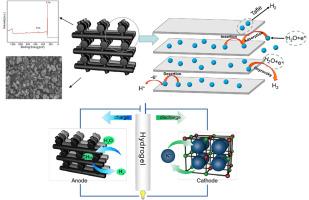
Carbon-based materials have been demonstrated to possess great potential as effective candidates for electrochemical hydrogen storage. Here, Zeolite templated carbon (ZTC) was synthesized via an impregnation method, employing zeolite NaY as the template and furfuryl alcohol/propylene as the carbon precursor. The performance of ZTC in hydrogen storage applications within an alkaline electrolyte environment was systematically examined. Meantime, an aqueous hybrid ion battery is developed using ZTC as the anode material and nickel-zinc-based Prussian blue analogue (PBA)as the cathode material. The battery operates at a voltage of 1.5 V with a capacity of 52.5 mAh g−1 and demonstrates excellent rate performance and cycle stability. Moreover, a polyvinyl alcohol hydrogel electrolyte was also applied to this battery. With the same electrode materials, the hydrogel battery exhibits a slightly lower capacity than that of the battery with an aqueous solution electrolyte. However, the cyclic stability of the hydrogel battery becomes more prominent as the operating period increases.
碳基材料作为电化学储氢的有效候选材料已被证明具有巨大的潜力。本文以NaY沸石为模板,糠醇/丙烯为碳前驱体,采用浸渍法制备了沸石模板炭(ZTC)。系统地研究了ZTC在碱性电解质环境下的储氢性能。同时,以ZTC为正极材料,以镍锌基普鲁士蓝类似物(PBA)为正极材料,研制了一种含水混合离子电池。该电池工作电压为1.5 V,容量为52.5 mAh g - 1,具有出色的倍率性能和循环稳定性。此外,聚乙烯醇水凝胶电解质也被应用于该电池。在相同的电极材料下,水凝胶电池的容量略低于水溶液电池的容量。然而,水凝胶电池的循环稳定性随着运行周期的增加而变得更加突出。
期刊介绍:
The objective of the International Journal of Hydrogen Energy is to facilitate the exchange of new ideas, technological advancements, and research findings in the field of Hydrogen Energy among scientists and engineers worldwide. This journal showcases original research, both analytical and experimental, covering various aspects of Hydrogen Energy. These include production, storage, transmission, utilization, enabling technologies, environmental impact, economic considerations, and global perspectives on hydrogen and its carriers such as NH3, CH4, alcohols, etc.
The utilization aspect encompasses various methods such as thermochemical (combustion), photochemical, electrochemical (fuel cells), and nuclear conversion of hydrogen, hydrogen isotopes, and hydrogen carriers into thermal, mechanical, and electrical energies. The applications of these energies can be found in transportation (including aerospace), industrial, commercial, and residential sectors.



 京公网安备 11010802042870号
京ICP备2023020795号-1
京公网安备 11010802042870号
京ICP备2023020795号-1

 分享
分享
 求助内容:
求助内容: 应助结果提醒方式:
 扫码关注我们
