{"title":"Fabricating sustainable electrodes for symmetric supercapacitors using lignosulfonate with two-step CO2 activation and plasma-assisted treatments","authors":"You-Ren Lin , Jian-Zhang Chen , Cindy Rusly , Hsun-Yi Chen , Feng-Cheng Chang","doi":"10.1016/j.jpowsour.2025.236887","DOIUrl":null,"url":null,"abstract":"<div><div>In this study, lignosulfonate (LS) is utilized as a precursor to prepare lignosulfonate-activated carbon (LSAC) through a two-step CO<sub>2</sub> physical activation process. The LSAC is then employed as an electrode material and is assembled with PVA/H<sub>2</sub>SO<sub>4</sub> gel electrolyte to fabricate supercapacitors. The experimental results reveal that the carbonization temperature, pre-oxidation treatment, and activation time considerably influence the pore characteristics of LSAC, thereby affecting its subsequent electrochemical performance. The optimal conditions, without pre-oxidation, carbonization at 700 °C, activation at 800 °C, and a 90 min activation time, LSAC achieves the highest specific surface area (1015.33 m<sup>2</sup>/g) and a carbon content of 83.110 %. The electrochemical testing demonstrates that the system attains the highest areal capacitance (646.78 mF/cm<sup>2</sup>) at a current of 0.25 mA, an energy density of 57.491 μWh/cm<sup>2</sup>, a power density of 0.0667 mW/cm<sup>2</sup>, and 99.13 % of capacitance retention after 4000 charge-discharge cycles. This research highlights the potential for LSAC to be applied in energy storage devices, thereby enhancing the recycling value of industrial lignin.</div></div>","PeriodicalId":377,"journal":{"name":"Journal of Power Sources","volume":"641 ","pages":"Article 236887"},"PeriodicalIF":7.9000,"publicationDate":"2025-06-15","publicationTypes":"Journal Article","fieldsOfStudy":null,"isOpenAccess":false,"openAccessPdf":"","citationCount":"0","resultStr":null,"platform":"Semanticscholar","paperid":null,"PeriodicalName":"Journal of Power Sources","FirstCategoryId":"5","ListUrlMain":"https://www.sciencedirect.com/science/article/pii/S0378775325007232","RegionNum":2,"RegionCategory":"工程技术","ArticlePicture":[],"TitleCN":null,"AbstractTextCN":null,"PMCID":null,"EPubDate":"2025/3/31 0:00:00","PubModel":"Epub","JCR":"Q1","JCRName":"CHEMISTRY, PHYSICAL","Score":null,"Total":0}
引用次数: 0
Abstract
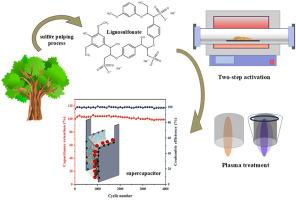
In this study, lignosulfonate (LS) is utilized as a precursor to prepare lignosulfonate-activated carbon (LSAC) through a two-step CO2 physical activation process. The LSAC is then employed as an electrode material and is assembled with PVA/H2SO4 gel electrolyte to fabricate supercapacitors. The experimental results reveal that the carbonization temperature, pre-oxidation treatment, and activation time considerably influence the pore characteristics of LSAC, thereby affecting its subsequent electrochemical performance. The optimal conditions, without pre-oxidation, carbonization at 700 °C, activation at 800 °C, and a 90 min activation time, LSAC achieves the highest specific surface area (1015.33 m2/g) and a carbon content of 83.110 %. The electrochemical testing demonstrates that the system attains the highest areal capacitance (646.78 mF/cm2) at a current of 0.25 mA, an energy density of 57.491 μWh/cm2, a power density of 0.0667 mW/cm2, and 99.13 % of capacitance retention after 4000 charge-discharge cycles. This research highlights the potential for LSAC to be applied in energy storage devices, thereby enhancing the recycling value of industrial lignin.
期刊介绍:
The Journal of Power Sources is a publication catering to researchers and technologists interested in various aspects of the science, technology, and applications of electrochemical power sources. It covers original research and reviews on primary and secondary batteries, fuel cells, supercapacitors, and photo-electrochemical cells.
Topics considered include the research, development and applications of nanomaterials and novel componentry for these devices. Examples of applications of these electrochemical power sources include:
• Portable electronics
• Electric and Hybrid Electric Vehicles
• Uninterruptible Power Supply (UPS) systems
• Storage of renewable energy
• Satellites and deep space probes
• Boats and ships, drones and aircrafts
• Wearable energy storage systems



 京公网安备 11010802042870号
京ICP备2023020795号-1
京公网安备 11010802042870号
京ICP备2023020795号-1

 分享
分享
 求助内容:
求助内容: 应助结果提醒方式:
 扫码关注我们
