Tian Tang , Xingtao Liu , Xun Sun , Yuan Zhang , Ji Wu
{"title":"State of charge estimation with representative cells-based hybrid model for lithium-ion battery pack","authors":"Tian Tang , Xingtao Liu , Xun Sun , Yuan Zhang , Ji Wu","doi":"10.1016/j.jpowsour.2025.236911","DOIUrl":null,"url":null,"abstract":"<div><div>Electric vehicles (EVs) are central to achieving carbon neutrality, with the battery pack acting as the crucial energy storage system. However, applying models designed for single cells directly to battery packs can be problematic because of variations in electrochemical parameters such as capacity and internal resistance, even among cells from the same production batch. These discrepancies can lead to significant errors in the state of charge (SOC) estimation. To address this issue, we propose an algorithm combining the cell mean model (CMM) with a long short-term memory (LSTM) neural network for more accurate SOC estimation in battery packs. By analyzing the differences among individual cells, we identify those with the most pronounced variations and those that reach the cut-off voltage first as representative cells. The CMM is used to summarize the pack's overall characteristics, and an extended Kalman filter (EKF) is employed for preliminary SOC estimation. Finally, the LSTM model refines the SOC estimate by learning complex dynamics between initial SOC values, representative cell data, and the actual pack SOC. Experimental results show that this approach achieves a root mean square error and mean absolute error under 1 %, significantly improving SOC estimation accuracy in dynamic conditions compared to traditional methods.</div></div>","PeriodicalId":377,"journal":{"name":"Journal of Power Sources","volume":"641 ","pages":"Article 236911"},"PeriodicalIF":7.9000,"publicationDate":"2025-06-15","publicationTypes":"Journal Article","fieldsOfStudy":null,"isOpenAccess":false,"openAccessPdf":"","citationCount":"0","resultStr":null,"platform":"Semanticscholar","paperid":null,"PeriodicalName":"Journal of Power Sources","FirstCategoryId":"5","ListUrlMain":"https://www.sciencedirect.com/science/article/pii/S0378775325007475","RegionNum":2,"RegionCategory":"工程技术","ArticlePicture":[],"TitleCN":null,"AbstractTextCN":null,"PMCID":null,"EPubDate":"2025/4/1 0:00:00","PubModel":"Epub","JCR":"Q1","JCRName":"CHEMISTRY, PHYSICAL","Score":null,"Total":0}
引用次数: 0
Abstract
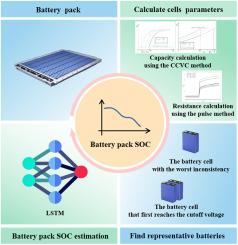
Electric vehicles (EVs) are central to achieving carbon neutrality, with the battery pack acting as the crucial energy storage system. However, applying models designed for single cells directly to battery packs can be problematic because of variations in electrochemical parameters such as capacity and internal resistance, even among cells from the same production batch. These discrepancies can lead to significant errors in the state of charge (SOC) estimation. To address this issue, we propose an algorithm combining the cell mean model (CMM) with a long short-term memory (LSTM) neural network for more accurate SOC estimation in battery packs. By analyzing the differences among individual cells, we identify those with the most pronounced variations and those that reach the cut-off voltage first as representative cells. The CMM is used to summarize the pack's overall characteristics, and an extended Kalman filter (EKF) is employed for preliminary SOC estimation. Finally, the LSTM model refines the SOC estimate by learning complex dynamics between initial SOC values, representative cell data, and the actual pack SOC. Experimental results show that this approach achieves a root mean square error and mean absolute error under 1 %, significantly improving SOC estimation accuracy in dynamic conditions compared to traditional methods.
期刊介绍:
The Journal of Power Sources is a publication catering to researchers and technologists interested in various aspects of the science, technology, and applications of electrochemical power sources. It covers original research and reviews on primary and secondary batteries, fuel cells, supercapacitors, and photo-electrochemical cells.
Topics considered include the research, development and applications of nanomaterials and novel componentry for these devices. Examples of applications of these electrochemical power sources include:
• Portable electronics
• Electric and Hybrid Electric Vehicles
• Uninterruptible Power Supply (UPS) systems
• Storage of renewable energy
• Satellites and deep space probes
• Boats and ships, drones and aircrafts
• Wearable energy storage systems



 京公网安备 11010802042870号
京ICP备2023020795号-1
京公网安备 11010802042870号
京ICP备2023020795号-1

 分享
分享
 求助内容:
求助内容: 应助结果提醒方式:
 扫码关注我们
