{"title":"N-doped BC/Ferrite collaborative degradation of antibiotics: Synthesis and mechanism research","authors":"Wenlu Wang, Xin Ke","doi":"10.1016/j.mssp.2025.109527","DOIUrl":null,"url":null,"abstract":"<div><div>The emergence of antibiotics, a new type of toxic organic pollutant, poses a pollution threat to water resources closely related to our health and living environment. An increasing number of scholars are investigating the removal of antibiotics from aquatic systems, which represent emerging contaminants of concern due to their widespread detection and persistence in water bodies. They have proposed an effective method for the synergistic treatment of antibiotics in water through adsorption and photocatalytic degradation. Among these materials, biochar demonstrates remarkable adsorption capacity during pollutant adsorption, attributable to its extensive specific surface area and profusion of surface functional groups. Ferrite semiconductors have been widely utilized for photocatalysts owing to their unique electronic properties and magnetic recoverability, enabling efficient degradation of organic pollutants under light irradiation. The synergistic interaction between biochar and ferrite substantially improves adsorption capacity and photocatalytic efficiency, offering a dual-functional mechanism for antibiotic pollutant remediation. Consequently, many scholars are dedicating themselves to the study of removing antibiotic pollutants in water via nitrogen-doped biochar and ferrite composites. This review examines N-doped biochar and ferrite composites from four perspectives: material preparation, material synthesis, principles of adsorption and photocatalysis, and future research directions. The latest research findings are summarized to advance the development of nitrogen-doped biochar and ferrite composites as effective adsorbents and photocatalysis for removing antibiotics from water.</div></div>","PeriodicalId":18240,"journal":{"name":"Materials Science in Semiconductor Processing","volume":"194 ","pages":"Article 109527"},"PeriodicalIF":4.6000,"publicationDate":"2025-04-02","publicationTypes":"Journal Article","fieldsOfStudy":null,"isOpenAccess":false,"openAccessPdf":"","citationCount":"0","resultStr":null,"platform":"Semanticscholar","paperid":null,"PeriodicalName":"Materials Science in Semiconductor Processing","FirstCategoryId":"5","ListUrlMain":"https://www.sciencedirect.com/science/article/pii/S1369800125002641","RegionNum":3,"RegionCategory":"工程技术","ArticlePicture":[],"TitleCN":null,"AbstractTextCN":null,"PMCID":null,"EPubDate":"","PubModel":"","JCR":"Q2","JCRName":"ENGINEERING, ELECTRICAL & ELECTRONIC","Score":null,"Total":0}
引用次数: 0
Abstract
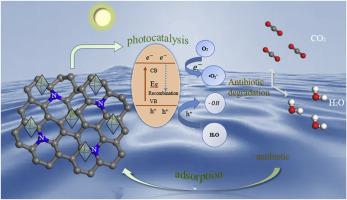
The emergence of antibiotics, a new type of toxic organic pollutant, poses a pollution threat to water resources closely related to our health and living environment. An increasing number of scholars are investigating the removal of antibiotics from aquatic systems, which represent emerging contaminants of concern due to their widespread detection and persistence in water bodies. They have proposed an effective method for the synergistic treatment of antibiotics in water through adsorption and photocatalytic degradation. Among these materials, biochar demonstrates remarkable adsorption capacity during pollutant adsorption, attributable to its extensive specific surface area and profusion of surface functional groups. Ferrite semiconductors have been widely utilized for photocatalysts owing to their unique electronic properties and magnetic recoverability, enabling efficient degradation of organic pollutants under light irradiation. The synergistic interaction between biochar and ferrite substantially improves adsorption capacity and photocatalytic efficiency, offering a dual-functional mechanism for antibiotic pollutant remediation. Consequently, many scholars are dedicating themselves to the study of removing antibiotic pollutants in water via nitrogen-doped biochar and ferrite composites. This review examines N-doped biochar and ferrite composites from four perspectives: material preparation, material synthesis, principles of adsorption and photocatalysis, and future research directions. The latest research findings are summarized to advance the development of nitrogen-doped biochar and ferrite composites as effective adsorbents and photocatalysis for removing antibiotics from water.
期刊介绍:
Materials Science in Semiconductor Processing provides a unique forum for the discussion of novel processing, applications and theoretical studies of functional materials and devices for (opto)electronics, sensors, detectors, biotechnology and green energy.
Each issue will aim to provide a snapshot of current insights, new achievements, breakthroughs and future trends in such diverse fields as microelectronics, energy conversion and storage, communications, biotechnology, (photo)catalysis, nano- and thin-film technology, hybrid and composite materials, chemical processing, vapor-phase deposition, device fabrication, and modelling, which are the backbone of advanced semiconductor processing and applications.
Coverage will include: advanced lithography for submicron devices; etching and related topics; ion implantation; damage evolution and related issues; plasma and thermal CVD; rapid thermal processing; advanced metallization and interconnect schemes; thin dielectric layers, oxidation; sol-gel processing; chemical bath and (electro)chemical deposition; compound semiconductor processing; new non-oxide materials and their applications; (macro)molecular and hybrid materials; molecular dynamics, ab-initio methods, Monte Carlo, etc.; new materials and processes for discrete and integrated circuits; magnetic materials and spintronics; heterostructures and quantum devices; engineering of the electrical and optical properties of semiconductors; crystal growth mechanisms; reliability, defect density, intrinsic impurities and defects.



 京公网安备 11010802042870号
京ICP备2023020795号-1
京公网安备 11010802042870号
京ICP备2023020795号-1

 分享
分享
 求助内容:
求助内容: 应助结果提醒方式:
 扫码关注我们
