{"title":"Sustainable ammonia recovery in electrochemical membranes: The critical role of electromigration","authors":"Siyao Qi , Wen Zhang , Guy Z. Ramon , Avner Ronen","doi":"10.1016/j.memsci.2025.124018","DOIUrl":null,"url":null,"abstract":"<div><div>Ammonia (NH<sub>3</sub>) is a vital chemical widely used in fertilizers, industry, and as a potential energy carrier. However, conventional ammonia production via the Haber-Bosch process is highly energy-intensive, consuming approximately 13.9 kWh per kg of nitrogen. Additionally, nitrogen-rich wastewater contributes to eutrophication and aquatic toxicity, necessitating sustainable recovery solutions. This study introduces an electrochemical membrane stripping (EMS) system incorporating hydrophobic, electrically conducting membranes (ECMs) to enhance ammonia recovery. By applying a controlled electric field and optimizing cathodic potential and crossflow velocity, the system efficiently transports ammonium (NH<sub>4</sub><sup>+</sup>) toward the cathodic membrane, where a localized pH shift converts it into free ammonia (NH<sub>3</sub>), eliminating the need for chemical pH adjustment.</div><div>Under optimal conditions, the EMS system achieved 88 % ammonia recovery with a high flux of 37 ± 1.45 g m<sup>−2</sup> d<sup>−1</sup>, representing a 33.5 % improvement over conventional methods. Mass balance analysis confirmed electromigration as a key transport mechanism, leading to a threefold increase in ammonia concentration at the membrane surface. Additionally, the system demonstrated high energy efficiency, with a specific energy consumption of 2 ± 0.15 kWh per kg of nitrogen, making it a cost-effective alternative for liquid fertilizer production.</div><div>As a proof-of-concept, the EMS system was successfully tested on real municipal wastewater, highlighting its practical viability. However, further research is needed to assess long-term stability, scalability, and integration with wastewater treatment infrastructure. This study demonstrates EMS as a promising technology for sustainable nitrogen recovery, supporting circular economy initiatives.</div></div>","PeriodicalId":368,"journal":{"name":"Journal of Membrane Science","volume":"726 ","pages":"Article 124018"},"PeriodicalIF":9.0000,"publicationDate":"2025-05-01","publicationTypes":"Journal Article","fieldsOfStudy":null,"isOpenAccess":false,"openAccessPdf":"","citationCount":"0","resultStr":null,"platform":"Semanticscholar","paperid":null,"PeriodicalName":"Journal of Membrane Science","FirstCategoryId":"5","ListUrlMain":"https://www.sciencedirect.com/science/article/pii/S037673882500331X","RegionNum":1,"RegionCategory":"工程技术","ArticlePicture":[],"TitleCN":null,"AbstractTextCN":null,"PMCID":null,"EPubDate":"2025/3/27 0:00:00","PubModel":"Epub","JCR":"Q1","JCRName":"ENGINEERING, CHEMICAL","Score":null,"Total":0}
引用次数: 0
Abstract
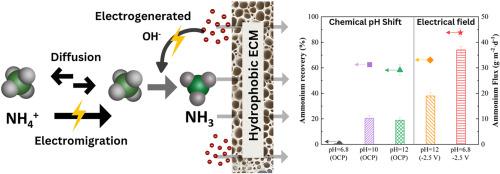
Ammonia (NH3) is a vital chemical widely used in fertilizers, industry, and as a potential energy carrier. However, conventional ammonia production via the Haber-Bosch process is highly energy-intensive, consuming approximately 13.9 kWh per kg of nitrogen. Additionally, nitrogen-rich wastewater contributes to eutrophication and aquatic toxicity, necessitating sustainable recovery solutions. This study introduces an electrochemical membrane stripping (EMS) system incorporating hydrophobic, electrically conducting membranes (ECMs) to enhance ammonia recovery. By applying a controlled electric field and optimizing cathodic potential and crossflow velocity, the system efficiently transports ammonium (NH4+) toward the cathodic membrane, where a localized pH shift converts it into free ammonia (NH3), eliminating the need for chemical pH adjustment.
Under optimal conditions, the EMS system achieved 88 % ammonia recovery with a high flux of 37 ± 1.45 g m−2 d−1, representing a 33.5 % improvement over conventional methods. Mass balance analysis confirmed electromigration as a key transport mechanism, leading to a threefold increase in ammonia concentration at the membrane surface. Additionally, the system demonstrated high energy efficiency, with a specific energy consumption of 2 ± 0.15 kWh per kg of nitrogen, making it a cost-effective alternative for liquid fertilizer production.
As a proof-of-concept, the EMS system was successfully tested on real municipal wastewater, highlighting its practical viability. However, further research is needed to assess long-term stability, scalability, and integration with wastewater treatment infrastructure. This study demonstrates EMS as a promising technology for sustainable nitrogen recovery, supporting circular economy initiatives.
氨(NH3)是一种重要的化学物质,广泛用于化肥、工业和潜在的能量载体。然而,通过Haber-Bosch工艺生产的传统氨是高度能源密集型的,每公斤氮消耗约13.9千瓦时。此外,富氮废水会导致富营养化和水生毒性,因此需要可持续的回收解决方案。本研究介绍了一种结合疏水导电膜(ECMs)的电化学膜剥离(EMS)系统,以提高氨的回收率。通过施加可控电场并优化阴极电位和横流速度,该系统有效地将铵(NH4+)输送到阴极膜上,在阴极膜上,局部pH位移将其转化为游离氨(NH3),从而无需化学pH调节。在最佳条件下,EMS系统的氨回收率为88%,通量为37±1.45 g m−2 d−1,比传统方法提高了33.5%。质量平衡分析证实了电迁移是一个关键的运输机制,导致膜表面氨浓度增加了三倍。此外,该系统还具有较高的能源效率,每千克氮的比能耗为2±0.15 kWh,使其成为具有成本效益的液体肥料生产替代品。作为概念验证,EMS系统在实际城市污水中成功进行了测试,突出了其实际可行性。然而,需要进一步的研究来评估长期稳定性、可扩展性以及与废水处理基础设施的集成。这项研究表明,EMS是一项有前途的可持续氮回收技术,支持循环经济倡议。
期刊介绍:
The Journal of Membrane Science is a publication that focuses on membrane systems and is aimed at academic and industrial chemists, chemical engineers, materials scientists, and membranologists. It publishes original research and reviews on various aspects of membrane transport, membrane formation/structure, fouling, module/process design, and processes/applications. The journal primarily focuses on the structure, function, and performance of non-biological membranes but also includes papers that relate to biological membranes. The Journal of Membrane Science publishes Full Text Papers, State-of-the-Art Reviews, Letters to the Editor, and Perspectives.



 京公网安备 11010802042870号
京ICP备2023020795号-1
京公网安备 11010802042870号
京ICP备2023020795号-1

 分享
分享
 求助内容:
求助内容: 应助结果提醒方式:
 扫码关注我们
