{"title":"Giant electrocaloric cooling in flexible BSZT/Terpolymer composites enabled by interfacial polarization and relaxor ferroelectric synergy","authors":"Mingtao Zhu , Hao Hu , Hongjian Zhang , Tian Zhang , Yong Zhang","doi":"10.1016/j.mssp.2025.109536","DOIUrl":null,"url":null,"abstract":"<div><div>With increasing global concerns about energy efficiency and environmental protection, conventional refrigeration technologies face significant challenges. The electrocaloric effect (ECE), as a solid-state and eco-friendly refrigeration technology, has emerged as a research hotspot for next-generation cooling solutions due to its performance controllability and broad applicability. A critical challenge lies in developing materials that exhibit large temperature change under low electric field. In this study, we designed a flexible composite film with remarkable electrocaloric capability by integrating BSZT-based relaxor ferroelectric fillers into a ternary copolymer matrix P(VDF-TrFE-CFE). Experimental results demonstrate that the incorporation of BSZT fillers significantly enhances the dielectric response and polarization intensity of the composites through interfacial polarization effect. Under a moderate electric field of 75 MV/m, the composite achieves a prominent adiabatic temperature change of 11.2 K, which is ∼2.7 times of the pure polymer matrix (ΔT = 4.09 K). This work provides a novel material solution for green refrigeration technology, particularly promising for applications in portable and wearable devices.</div></div>","PeriodicalId":18240,"journal":{"name":"Materials Science in Semiconductor Processing","volume":"194 ","pages":"Article 109536"},"PeriodicalIF":4.6000,"publicationDate":"2025-08-01","publicationTypes":"Journal Article","fieldsOfStudy":null,"isOpenAccess":false,"openAccessPdf":"","citationCount":"0","resultStr":null,"platform":"Semanticscholar","paperid":null,"PeriodicalName":"Materials Science in Semiconductor Processing","FirstCategoryId":"5","ListUrlMain":"https://www.sciencedirect.com/science/article/pii/S1369800125002732","RegionNum":3,"RegionCategory":"工程技术","ArticlePicture":[],"TitleCN":null,"AbstractTextCN":null,"PMCID":null,"EPubDate":"2025/4/2 0:00:00","PubModel":"Epub","JCR":"Q2","JCRName":"ENGINEERING, ELECTRICAL & ELECTRONIC","Score":null,"Total":0}
引用次数: 0
Abstract
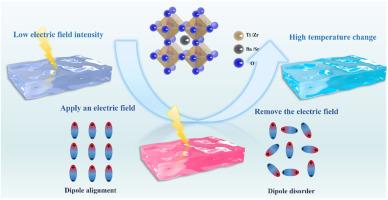
With increasing global concerns about energy efficiency and environmental protection, conventional refrigeration technologies face significant challenges. The electrocaloric effect (ECE), as a solid-state and eco-friendly refrigeration technology, has emerged as a research hotspot for next-generation cooling solutions due to its performance controllability and broad applicability. A critical challenge lies in developing materials that exhibit large temperature change under low electric field. In this study, we designed a flexible composite film with remarkable electrocaloric capability by integrating BSZT-based relaxor ferroelectric fillers into a ternary copolymer matrix P(VDF-TrFE-CFE). Experimental results demonstrate that the incorporation of BSZT fillers significantly enhances the dielectric response and polarization intensity of the composites through interfacial polarization effect. Under a moderate electric field of 75 MV/m, the composite achieves a prominent adiabatic temperature change of 11.2 K, which is ∼2.7 times of the pure polymer matrix (ΔT = 4.09 K). This work provides a novel material solution for green refrigeration technology, particularly promising for applications in portable and wearable devices.
期刊介绍:
Materials Science in Semiconductor Processing provides a unique forum for the discussion of novel processing, applications and theoretical studies of functional materials and devices for (opto)electronics, sensors, detectors, biotechnology and green energy.
Each issue will aim to provide a snapshot of current insights, new achievements, breakthroughs and future trends in such diverse fields as microelectronics, energy conversion and storage, communications, biotechnology, (photo)catalysis, nano- and thin-film technology, hybrid and composite materials, chemical processing, vapor-phase deposition, device fabrication, and modelling, which are the backbone of advanced semiconductor processing and applications.
Coverage will include: advanced lithography for submicron devices; etching and related topics; ion implantation; damage evolution and related issues; plasma and thermal CVD; rapid thermal processing; advanced metallization and interconnect schemes; thin dielectric layers, oxidation; sol-gel processing; chemical bath and (electro)chemical deposition; compound semiconductor processing; new non-oxide materials and their applications; (macro)molecular and hybrid materials; molecular dynamics, ab-initio methods, Monte Carlo, etc.; new materials and processes for discrete and integrated circuits; magnetic materials and spintronics; heterostructures and quantum devices; engineering of the electrical and optical properties of semiconductors; crystal growth mechanisms; reliability, defect density, intrinsic impurities and defects.




 京公网安备 11010802042870号
京ICP备2023020795号-1
京公网安备 11010802042870号
京ICP备2023020795号-1

 分享
分享
 求助内容:
求助内容: 应助结果提醒方式:
 扫码关注我们
