Punit Kumar , David H. Cook , Wenqing Wang , Madelyn Payne , Pedro P.P.O. Borges , Andrew M. Minor , Mark Asta , Robert O. Ritchie
{"title":"Fracture behavior of high-entropy alloys: Resistance to fracture from strain hardening and softening","authors":"Punit Kumar , David H. Cook , Wenqing Wang , Madelyn Payne , Pedro P.P.O. Borges , Andrew M. Minor , Mark Asta , Robert O. Ritchie","doi":"10.1016/j.matt.2025.102042","DOIUrl":null,"url":null,"abstract":"<div><div>Atomic structure and electronic state influence deformation mechanisms in traditional and high-entropy alloys (HEAs). In HEAs, nature and scale differ from those of traditional alloys due to lattice distortion and variations in local chemistry resulting from large concentrations of multiple principal elements. In CrCoNi, a face-centered cubic (<em>fcc</em>) HEA, dislocation dissociation, nanotwinning, and transformation-induced plasticity are promoted at cryogenic temperatures (<77 K). In Nb<sub>45</sub>Ta<sub>25</sub>Ti<sub>15</sub>Hf<sub>15</sub>, a body-centered cubic (<em>bcc</em>) HEA, screw dislocations, twinning, and kink band formation are activated at temperatures ranging from 77 to 1,473 K. These deformation mechanisms impart exceptionally high fracture resistance in CrCoNi and Nb<sub>45</sub>Ta<sub>25</sub>Ti<sub>15</sub>Hf<sub>15</sub>. However, their tensile stress-strain curves differ significantly at these temperatures; while CrCoNi exhibits extensive strain hardening, Nb<sub>45</sub>Ta<sub>25</sub>Ti<sub>15</sub>Hf<sub>15</sub> demonstrates nearly elastic, perfectly plastic stress-strain behavior. Understanding the origin of the high fracture resistance of these alloys, despite their contrasting stress-strain behavior, would enable the discovery of HEAs suitable for applications in extreme environments.</div></div>","PeriodicalId":388,"journal":{"name":"Matter","volume":"8 4","pages":"Article 102042"},"PeriodicalIF":17.5000,"publicationDate":"2025-04-02","publicationTypes":"Journal Article","fieldsOfStudy":null,"isOpenAccess":false,"openAccessPdf":"","citationCount":"0","resultStr":null,"platform":"Semanticscholar","paperid":null,"PeriodicalName":"Matter","FirstCategoryId":"88","ListUrlMain":"https://www.sciencedirect.com/science/article/pii/S2590238525000852","RegionNum":1,"RegionCategory":"材料科学","ArticlePicture":[],"TitleCN":null,"AbstractTextCN":null,"PMCID":null,"EPubDate":"","PubModel":"","JCR":"Q1","JCRName":"MATERIALS SCIENCE, MULTIDISCIPLINARY","Score":null,"Total":0}
引用次数: 0
Abstract
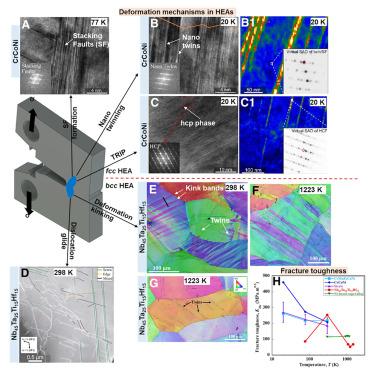
Atomic structure and electronic state influence deformation mechanisms in traditional and high-entropy alloys (HEAs). In HEAs, nature and scale differ from those of traditional alloys due to lattice distortion and variations in local chemistry resulting from large concentrations of multiple principal elements. In CrCoNi, a face-centered cubic (fcc) HEA, dislocation dissociation, nanotwinning, and transformation-induced plasticity are promoted at cryogenic temperatures (<77 K). In Nb45Ta25Ti15Hf15, a body-centered cubic (bcc) HEA, screw dislocations, twinning, and kink band formation are activated at temperatures ranging from 77 to 1,473 K. These deformation mechanisms impart exceptionally high fracture resistance in CrCoNi and Nb45Ta25Ti15Hf15. However, their tensile stress-strain curves differ significantly at these temperatures; while CrCoNi exhibits extensive strain hardening, Nb45Ta25Ti15Hf15 demonstrates nearly elastic, perfectly plastic stress-strain behavior. Understanding the origin of the high fracture resistance of these alloys, despite their contrasting stress-strain behavior, would enable the discovery of HEAs suitable for applications in extreme environments.
期刊介绍:
Matter, a monthly journal affiliated with Cell, spans the broad field of materials science from nano to macro levels,covering fundamentals to applications. Embracing groundbreaking technologies,it includes full-length research articles,reviews, perspectives,previews, opinions, personnel stories, and general editorial content.
Matter aims to be the primary resource for researchers in academia and industry, inspiring the next generation of materials scientists.



 京公网安备 11010802042870号
京ICP备2023020795号-1
京公网安备 11010802042870号
京ICP备2023020795号-1

 分享
分享
 求助内容:
求助内容: 应助结果提醒方式:
 扫码关注我们
