Khvaramze Shaverdashvili MD, PhD, Timothy F. Burns MD, PhD
{"title":"Advances in the treatment of KRASG12C mutant non–small cell lung cancer","authors":"Khvaramze Shaverdashvili MD, PhD, Timothy F. Burns MD, PhD","doi":"10.1002/cncr.35783","DOIUrl":null,"url":null,"abstract":"<p><i>Kirsten rat sarcoma</i> (<i>KRAS</i>) is one of the most frequently mutated oncogenic drivers in metastatic non–small cell lung cancer (NSCLC). The development of selective, covalent KRAS G12C (KRAS<sup>G12C</sup>) inhibitors represents a breakthrough in the treatment for <i>KRAS</i><sup><i>G12C</i></sup> mutant NSCLC, but the durability of response and efficacy of these inhibitors are limited by the rapid emergence of drug resistance and their ability to only bind KRAS<sup>G12C</sup> in the guanosine diphosphate-bound form. Importantly, co-occurring gene alterations, including <i>KEAP1</i>, <i>STK11</i>, and <i>CDKN2A</i>, may affect prognosis and response to therapies, including immunotherapy and KRAS<sup>G12C</sup> inhibitors. New therapeutic approaches are needed to both delay and overcome treatment resistance. Moreover, developing KRAS inhibitors with novel mechanisms of action and alternative allele specificities is necessary to overcome emerging on-target resistance mechanisms to KRAS<sup>G12C</sup> inhibitors. A literature search was performed using PubMed, the Food and Drug Administration website, and Google search. The inclusive dates in the literature search were between 1982 and July 2024. In this article, the authors reviewed the disease prevalence, biology and therapeutic options, including specific KRAS<sup>G12C</sup> inhibitors and new pan-KRAS therapeutic agents for <i>KRAS</i><sup><i>G12C</i></sup> mutant NSCLC. KRAS inhibitor resistance mechanisms, treatment strategies, and multi-targeted treatment approaches are also discussed.</p>","PeriodicalId":138,"journal":{"name":"Cancer","volume":"131 S1","pages":""},"PeriodicalIF":5.1000,"publicationDate":"2025-04-02","publicationTypes":"Journal Article","fieldsOfStudy":null,"isOpenAccess":false,"openAccessPdf":"https://onlinelibrary.wiley.com/doi/epdf/10.1002/cncr.35783","citationCount":"0","resultStr":null,"platform":"Semanticscholar","paperid":null,"PeriodicalName":"Cancer","FirstCategoryId":"3","ListUrlMain":"https://acsjournals.onlinelibrary.wiley.com/doi/10.1002/cncr.35783","RegionNum":2,"RegionCategory":"医学","ArticlePicture":[],"TitleCN":null,"AbstractTextCN":null,"PMCID":null,"EPubDate":"","PubModel":"","JCR":"Q1","JCRName":"ONCOLOGY","Score":null,"Total":0}
引用次数: 0
Abstract
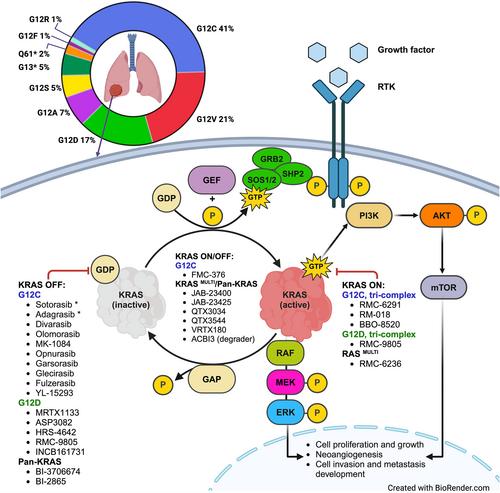
Kirsten rat sarcoma (KRAS) is one of the most frequently mutated oncogenic drivers in metastatic non–small cell lung cancer (NSCLC). The development of selective, covalent KRAS G12C (KRASG12C) inhibitors represents a breakthrough in the treatment for KRASG12C mutant NSCLC, but the durability of response and efficacy of these inhibitors are limited by the rapid emergence of drug resistance and their ability to only bind KRASG12C in the guanosine diphosphate-bound form. Importantly, co-occurring gene alterations, including KEAP1, STK11, and CDKN2A, may affect prognosis and response to therapies, including immunotherapy and KRASG12C inhibitors. New therapeutic approaches are needed to both delay and overcome treatment resistance. Moreover, developing KRAS inhibitors with novel mechanisms of action and alternative allele specificities is necessary to overcome emerging on-target resistance mechanisms to KRASG12C inhibitors. A literature search was performed using PubMed, the Food and Drug Administration website, and Google search. The inclusive dates in the literature search were between 1982 and July 2024. In this article, the authors reviewed the disease prevalence, biology and therapeutic options, including specific KRASG12C inhibitors and new pan-KRAS therapeutic agents for KRASG12C mutant NSCLC. KRAS inhibitor resistance mechanisms, treatment strategies, and multi-targeted treatment approaches are also discussed.
期刊介绍:
The CANCER site is a full-text, electronic implementation of CANCER, an Interdisciplinary International Journal of the American Cancer Society, and CANCER CYTOPATHOLOGY, a Journal of the American Cancer Society.
CANCER publishes interdisciplinary oncologic information according to, but not limited to, the following disease sites and disciplines: blood/bone marrow; breast disease; endocrine disorders; epidemiology; gastrointestinal tract; genitourinary disease; gynecologic oncology; head and neck disease; hepatobiliary tract; integrated medicine; lung disease; medical oncology; neuro-oncology; pathology radiation oncology; translational research





 京公网安备 11010802042870号
京ICP备2023020795号-1
京公网安备 11010802042870号
京ICP备2023020795号-1

 分享
分享
 求助内容:
求助内容: 应助结果提醒方式:
 扫码关注我们
