Yichao Wang , Hongchen Cao , Shiwen Yang , Leilei Zhang , Rui Wang , Aiqin Wang , Tao Zhang
{"title":"The decarboxylative and dehydrogenative coupling of formate: from anisyl formate to a high value-added diamine†","authors":"Yichao Wang , Hongchen Cao , Shiwen Yang , Leilei Zhang , Rui Wang , Aiqin Wang , Tao Zhang","doi":"10.1039/d5cc00518c","DOIUrl":null,"url":null,"abstract":"<div><div>The deoxygenative carbon–carbon bond formation from alcohols remains a formidable challenge toward cleaner coupling reactions. In this work, we first unlocked a novel homocoupling upgrading mode of benzyl alcohol by virtue of the two-side roles of the pre-introduced formyl group, which serves as both impetus for easier C–O bond dissociation and an endogenous hydrogen source. As a proof-of-concept, the decarboxylative and dehydrogenative homocoupling of anisyl formate toward 1,2-bis(4-methoxyphenyl)ethane was realized using a Ru/MoS<sub>2</sub> catalyst with an optimized yield of 66%. Structural characterizations and control experiments indicated the synergy effect between Ru and Mo. A tailored nitration–reduction route was further designed for upgrading the coupling product into a high value-added aromatic diamine, the overall yield of which reached 56% based on anisyl formate. This method opens a new avenue for catalytic transformations of alcohols through ester intermediates.</div></div>","PeriodicalId":67,"journal":{"name":"Chemical Communications","volume":"61 34","pages":"Pages 6308-6311"},"PeriodicalIF":4.2000,"publicationDate":"2025-03-24","publicationTypes":"Journal Article","fieldsOfStudy":null,"isOpenAccess":false,"openAccessPdf":"","citationCount":"0","resultStr":null,"platform":"Semanticscholar","paperid":null,"PeriodicalName":"Chemical Communications","FirstCategoryId":"92","ListUrlMain":"https://www.sciencedirect.com/org/science/article/pii/S135973452500641X","RegionNum":2,"RegionCategory":"化学","ArticlePicture":[],"TitleCN":null,"AbstractTextCN":null,"PMCID":null,"EPubDate":"2025/3/19 0:00:00","PubModel":"Epub","JCR":"Q2","JCRName":"CHEMISTRY, MULTIDISCIPLINARY","Score":null,"Total":0}
引用次数: 0
Abstract
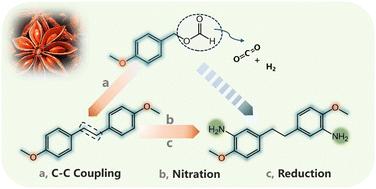
The deoxygenative carbon–carbon bond formation from alcohols remains a formidable challenge toward cleaner coupling reactions. In this work, we first unlocked a novel homocoupling upgrading mode of benzyl alcohol by virtue of the two-side roles of the pre-introduced formyl group, which serves as both impetus for easier C–O bond dissociation and an endogenous hydrogen source. As a proof-of-concept, the decarboxylative and dehydrogenative homocoupling of anisyl formate toward 1,2-bis(4-methoxyphenyl)ethane was realized using a Ru/MoS2 catalyst with an optimized yield of 66%. Structural characterizations and control experiments indicated the synergy effect between Ru and Mo. A tailored nitration–reduction route was further designed for upgrading the coupling product into a high value-added aromatic diamine, the overall yield of which reached 56% based on anisyl formate. This method opens a new avenue for catalytic transformations of alcohols through ester intermediates.
期刊介绍:
ChemComm (Chemical Communications) is renowned as the fastest publisher of articles providing information on new avenues of research, drawn from all the world''s major areas of chemical research.



 京公网安备 11010802042870号
京ICP备2023020795号-1
京公网安备 11010802042870号
京ICP备2023020795号-1

 分享
分享
 求助内容:
求助内容: 应助结果提醒方式:
 扫码关注我们
