Electrochemical sensor based on multi-walled carbon nanotubes and two-dimensional zeolitic imidazolate framework nanosheets: Application in determining dacarbazine.
Somayeh Tajik, Hadi Beitollahi, Fariba Garkani Nejad, Zahra Dourandish, Samuel Adeloju
{"title":"Electrochemical sensor based on multi-walled carbon nanotubes and two-dimensional zeolitic imidazolate framework nanosheets: Application in determining dacarbazine.","authors":"Somayeh Tajik, Hadi Beitollahi, Fariba Garkani Nejad, Zahra Dourandish, Samuel Adeloju","doi":"10.5599/admet.2617","DOIUrl":null,"url":null,"abstract":"<p><strong>Background and purpose: </strong>Cancer is a serious public health concern, hence the determination of dacarbazine as a significant chemotherapeutic agent is very important.</p><p><strong>Experimental approach: </strong>In the present work, we use a facile method to synthesize a nanocomposite of multi-walled carbon nanotubes (MWCNTs) and two-dimensional zeolitic imidazolate framework nanosheets (2D ZIF-L NSs). The resulting MWCNTs/2D ZIF-L NSs nanocomposite was characterized by field-emission scanning electron microscopy. The MWCNTs/2D ZIF-L NSs nanocomposite was subsequently used to modify a screen-printed carbon electrode (SPCE) to achieve an electrochemical sensing platform for the detection of dacarbazine.</p><p><strong>Key results: </strong>From cyclic voltammetric studies, it was found that the MWCNTs/2D ZIF-L NSs nanocomposite modified SPCE provided less anodic peak potential (700 mV) and higher anodic peak current (7.7 μA) for oxidation of dacarbazine when compared to other SPCEs. The MWCNTs/2D ZIF-L NSs/SPCE displayed good performance in the quantitative determination of dacarbazine. Under optimum conditions, the differential pulse voltammetry response exhibited a linear concentration range of 0.01 to 80.0 μM for dacarbazine with a relatively high sensitivity of 0.1384 μA μM<sup>-1</sup> and an estimated detection limit of 0.004 μM. The MWCNTs/2D ZIF-L NSs/SPCE sensor was also successfully applied to the determination of dacarbazine in injections samples of dacarbazine.</p><p><strong>Conclusion: </strong>This detection method can be used as a valuable tool in the analysis of pharmaceutical formulations to bring benefits in cancer treatment.</p>","PeriodicalId":7259,"journal":{"name":"ADMET and DMPK","volume":"13 1","pages":"2617"},"PeriodicalIF":4.3000,"publicationDate":"2025-01-25","publicationTypes":"Journal Article","fieldsOfStudy":null,"isOpenAccess":false,"openAccessPdf":"https://www.ncbi.nlm.nih.gov/pmc/articles/PMC11954146/pdf/","citationCount":"0","resultStr":null,"platform":"Semanticscholar","paperid":null,"PeriodicalName":"ADMET and DMPK","FirstCategoryId":"1085","ListUrlMain":"https://doi.org/10.5599/admet.2617","RegionNum":0,"RegionCategory":null,"ArticlePicture":[],"TitleCN":null,"AbstractTextCN":null,"PMCID":null,"EPubDate":"2025/1/1 0:00:00","PubModel":"eCollection","JCR":"Q2","JCRName":"CHEMISTRY, MEDICINAL","Score":null,"Total":0}
引用次数: 0
Abstract
Background and purpose: Cancer is a serious public health concern, hence the determination of dacarbazine as a significant chemotherapeutic agent is very important.
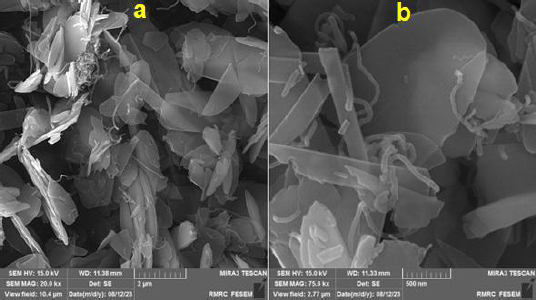
Experimental approach: In the present work, we use a facile method to synthesize a nanocomposite of multi-walled carbon nanotubes (MWCNTs) and two-dimensional zeolitic imidazolate framework nanosheets (2D ZIF-L NSs). The resulting MWCNTs/2D ZIF-L NSs nanocomposite was characterized by field-emission scanning electron microscopy. The MWCNTs/2D ZIF-L NSs nanocomposite was subsequently used to modify a screen-printed carbon electrode (SPCE) to achieve an electrochemical sensing platform for the detection of dacarbazine.
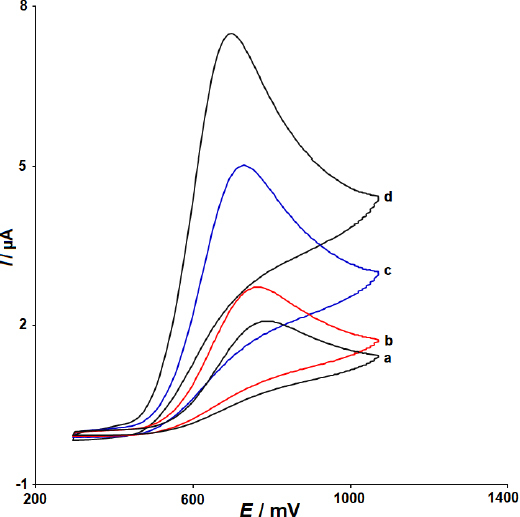
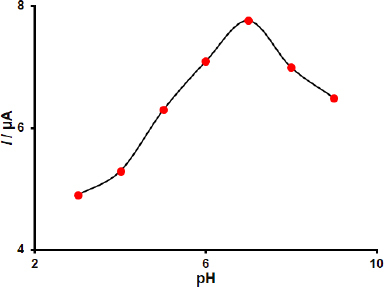
Key results: From cyclic voltammetric studies, it was found that the MWCNTs/2D ZIF-L NSs nanocomposite modified SPCE provided less anodic peak potential (700 mV) and higher anodic peak current (7.7 μA) for oxidation of dacarbazine when compared to other SPCEs. The MWCNTs/2D ZIF-L NSs/SPCE displayed good performance in the quantitative determination of dacarbazine. Under optimum conditions, the differential pulse voltammetry response exhibited a linear concentration range of 0.01 to 80.0 μM for dacarbazine with a relatively high sensitivity of 0.1384 μA μM-1 and an estimated detection limit of 0.004 μM. The MWCNTs/2D ZIF-L NSs/SPCE sensor was also successfully applied to the determination of dacarbazine in injections samples of dacarbazine.
Conclusion: This detection method can be used as a valuable tool in the analysis of pharmaceutical formulations to bring benefits in cancer treatment.
期刊介绍:
ADMET and DMPK is an open access journal devoted to the rapid dissemination of new and original scientific results in all areas of absorption, distribution, metabolism, excretion, toxicology and pharmacokinetics of drugs. ADMET and DMPK publishes the following types of contributions: - Original research papers - Feature articles - Review articles - Short communications and Notes - Letters to Editors - Book reviews The scope of the Journal involves, but is not limited to, the following areas: - physico-chemical properties of drugs and methods of their determination - drug permeabilities - drug absorption - drug-drug, drug-protein, drug-membrane and drug-DNA interactions - chemical stability and degradations of drugs - instrumental methods in ADMET - drug metablic processes - routes of administration and excretion of drug - pharmacokinetic/pharmacodynamic study - quantitative structure activity/property relationship - ADME/PK modelling - Toxicology screening - Transporter identification and study




 京公网安备 11010802042870号
京ICP备2023020795号-1
京公网安备 11010802042870号
京ICP备2023020795号-1

 分享
分享
 求助内容:
求助内容: 应助结果提醒方式:
 扫码关注我们
