Ileana Conde-Rodríguez, Silvia Pérez-Picazo, Víctor Javier Vázquez-Zamora, Julio Reyes-Leyva, Verónica Vallejo-Ruiz
{"title":"Serum soluble Tim‑3 is elevated in patients with cervical cancer and is higher in advanced clinical stages.","authors":"Ileana Conde-Rodríguez, Silvia Pérez-Picazo, Víctor Javier Vázquez-Zamora, Julio Reyes-Leyva, Verónica Vallejo-Ruiz","doi":"10.3892/br.2025.1968","DOIUrl":null,"url":null,"abstract":"<p><p>T-cell immunoglobulin and mucin domain-containing protein-3 (Tim-3) is an immune checkpoint molecule that is expressed generally on the cell membrane of immune and cancer cells and is implicated as a negative regulator of anti-tumour immune responses; this occurs through the interaction of Tim-3 with galectin-9. Although the function of membrane Tim-3 is well known, the role of soluble Tim-3 (sTim-3) has been poorly explored. The aim of the present study was to compare the serum levels of sTim-3 in the cervical cancer group of patients vs. the control group, to determine the association between the serum levels of sTim-3 with the clinicopathological characteristics of patients with cervical cancer and with serum galectin-9 levels. The concentrations of serum sTim-3 and galectin-9 were determined using ELISA. A receiver operating characteristic (ROC) curve was performed to determine the diagnostic value of sTim-3. The Mann-Whitney and Kruskall-Wallis tests were used to compare the serum sTim-3 concentrations between the control and cervical cancer groups and among the clinical subgroups. The association between the concentrations of sTim-3 and galectin-9 was determined using Spearman's rank correlation coefficient. sTim-3 expression was higher in patients with cervical cancer compared with control patients. The ROC curve revealed that sTim-3 has diagnostic potential, with a specificity of 95% and a sensitivity of 85.19%. sTim-3 was higher in patients with International Federation of Gynaecology and Obstetrics (FIGO) stage IV compared with those with FIGO stages I, II and III. A moderate positive correlation (ρ=0.41) was identified between sTim-3 and galectin-9. This was the first report of changes in the serum concentrations of sTim-3 in patients with cervical cancer and their diagnostic value. The association between sTim-3 with cervical cancer progression, and the positive correlation between the serum concentrations of sTim-3 and galectin-9 suggested that both proteins might be involved in the immune dysregulation in cervical cancer, but this requires further exploration.</p>","PeriodicalId":8863,"journal":{"name":"Biomedical reports","volume":"22 5","pages":"90"},"PeriodicalIF":1.9000,"publicationDate":"2025-03-20","publicationTypes":"Journal Article","fieldsOfStudy":null,"isOpenAccess":false,"openAccessPdf":"https://www.ncbi.nlm.nih.gov/pmc/articles/PMC11955819/pdf/","citationCount":"0","resultStr":null,"platform":"Semanticscholar","paperid":null,"PeriodicalName":"Biomedical reports","FirstCategoryId":"1085","ListUrlMain":"https://doi.org/10.3892/br.2025.1968","RegionNum":0,"RegionCategory":null,"ArticlePicture":[],"TitleCN":null,"AbstractTextCN":null,"PMCID":null,"EPubDate":"2025/5/1 0:00:00","PubModel":"eCollection","JCR":"Q3","JCRName":"MEDICINE, RESEARCH & EXPERIMENTAL","Score":null,"Total":0}
引用次数: 0
Abstract
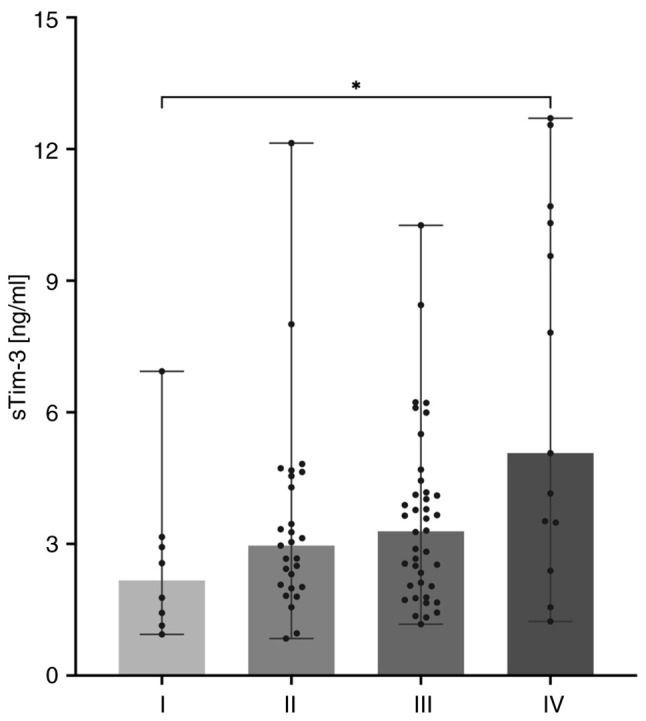
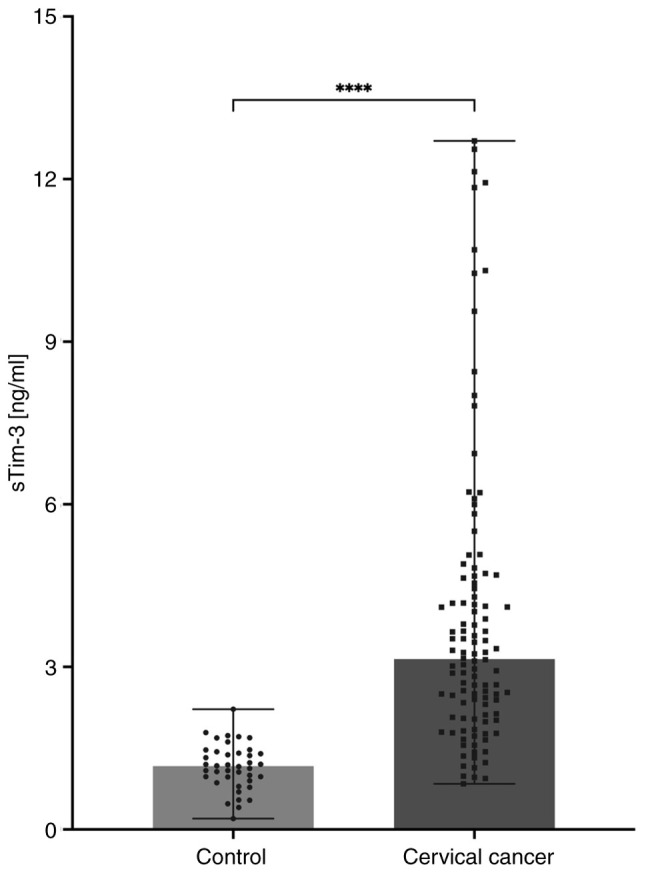
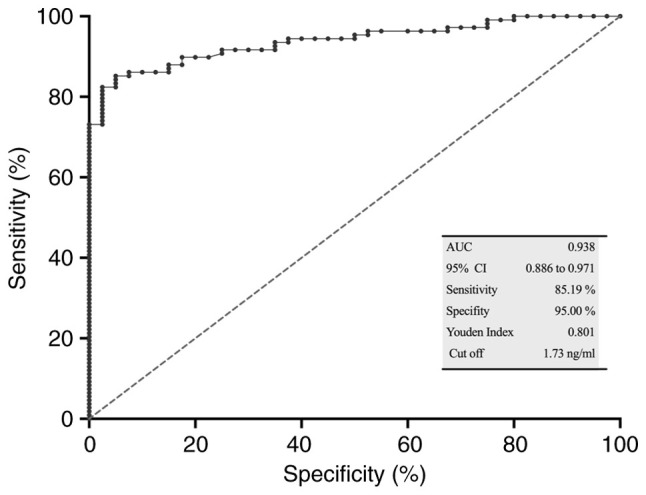
T-cell immunoglobulin and mucin domain-containing protein-3 (Tim-3) is an immune checkpoint molecule that is expressed generally on the cell membrane of immune and cancer cells and is implicated as a negative regulator of anti-tumour immune responses; this occurs through the interaction of Tim-3 with galectin-9. Although the function of membrane Tim-3 is well known, the role of soluble Tim-3 (sTim-3) has been poorly explored. The aim of the present study was to compare the serum levels of sTim-3 in the cervical cancer group of patients vs. the control group, to determine the association between the serum levels of sTim-3 with the clinicopathological characteristics of patients with cervical cancer and with serum galectin-9 levels. The concentrations of serum sTim-3 and galectin-9 were determined using ELISA. A receiver operating characteristic (ROC) curve was performed to determine the diagnostic value of sTim-3. The Mann-Whitney and Kruskall-Wallis tests were used to compare the serum sTim-3 concentrations between the control and cervical cancer groups and among the clinical subgroups. The association between the concentrations of sTim-3 and galectin-9 was determined using Spearman's rank correlation coefficient. sTim-3 expression was higher in patients with cervical cancer compared with control patients. The ROC curve revealed that sTim-3 has diagnostic potential, with a specificity of 95% and a sensitivity of 85.19%. sTim-3 was higher in patients with International Federation of Gynaecology and Obstetrics (FIGO) stage IV compared with those with FIGO stages I, II and III. A moderate positive correlation (ρ=0.41) was identified between sTim-3 and galectin-9. This was the first report of changes in the serum concentrations of sTim-3 in patients with cervical cancer and their diagnostic value. The association between sTim-3 with cervical cancer progression, and the positive correlation between the serum concentrations of sTim-3 and galectin-9 suggested that both proteins might be involved in the immune dysregulation in cervical cancer, but this requires further exploration.
期刊介绍:
Biomedical Reports is a monthly, peer-reviewed journal, dedicated to publishing research across all fields of biology and medicine, including pharmacology, pathology, gene therapy, genetics, microbiology, neurosciences, infectious diseases, molecular cardiology and molecular surgery. The journal provides a home for original research, case reports and review articles.




 京公网安备 11010802042870号
京ICP备2023020795号-1
京公网安备 11010802042870号
京ICP备2023020795号-1

 分享
分享
 求助内容:
求助内容: 应助结果提醒方式:
 扫码关注我们
