Sanna Iivanainen, Reetta Arokoski, Santeri Mentu, Laura Lang, Jussi Ekström, Henri Virtanen, Vesa Kataja, Jussi Pekka Koivunen
{"title":"Development of a Comprehensive Decision Support Tool for Chemotherapy-Cycle Prescribing: Initial Usability Study.","authors":"Sanna Iivanainen, Reetta Arokoski, Santeri Mentu, Laura Lang, Jussi Ekström, Henri Virtanen, Vesa Kataja, Jussi Pekka Koivunen","doi":"10.2196/62749","DOIUrl":null,"url":null,"abstract":"<p><strong>Background: </strong>Chemotherapy cycle prescription is generally carried out through a multistep manual process that is prone to human error. Clinical decision support tools can provide patient-specific assessments that support clinical decisions, improve prescribing practices, and reduce medication errors.</p><p><strong>Objective: </strong>We hypothesized that a knowledge-based, patient-derived, evidence-directed decision support tool consisting of multiple modules focusing on the core duties preceding chemotherapy-cycle prescription could result in a more cost-effective and error-free approach and streamline the workflow.</p><p><strong>Methods: </strong>A 1-arm, multicenter, prospective clinical trial (\"Follow-up of Cancer Patients Receiving Chemotherapy or Targeted Therapy by Electronic Patient Reported Outcomes-tool\" [ECHO] 7/2019-1/2021; NCT04081558) was initiated to investigate the tool. The most important inclusion criteria were the presence of colorectal cancer (CRC) treated with oxaliplatin-based chemotherapy, age ≥18 years, Eastern Cooperative Oncology Group [ECOG] performance score of 0 to 2, and internet access. A decision support tool that included digital symptom monitoring, a laboratory value interface, and treatment schedule integration for semiautomated chemotherapy cycle prescribing was integrated into the care pathway. Performance was assessed by the percentage of chemotherapy cycles with sent and completed symptom questionnaires, while perceptions of health care professionals (HCPs) on the feasibility of the approach were collected through a 1-time semistructured interview.</p><p><strong>Results: </strong>The ECHO trial included 43 patients with CRC treated with doublet or triplet chemotherapy in an adjuvant or metastatic setting. Altogether, 843 electronic patient-reported outcome (ePRO) symptom questionnaires were completed. Of the 15 recorded symptoms, fatigue (n=446, 52.9%) and peripheral neuropathy (n=429, 50.9%) were reported most often, while 137 grade 3 to 4 symptoms were recorded, of which diarrhea (n=5, 4%) and peripheral neuropathy (n=4, 3%) were the most common. During the study, 339 chemotherapy cycles were prescribed, and for the 77% (n=262) of new chemotherapy cycles, ePRO questionnaire data were available within preset limits (completed within 3 days prior to chemotherapy scheduling) while 65% of the cycles (n=221) had symptom questionnaire grading at ≤1%, and 67% of the cycles (n=228) had laboratory values in a preset range. The recommendations by the tool for a new chemotherapy cycle were tier 1 (green; meaning \"go\") in 145 (42.8%) of the cycles, tier 2 (yellow; \"evaluate\") in 83 (25%), and tier 3 (red; \"hold\") in 111 (32.7%). HCPs (n=3) were interviewed with a questionnaire (comprising 8 questions), revealing that they most valued the improved workflow, faster patient evaluation, and direct messaging option.</p><p><strong>Conclusions: </strong>In this study, we investigated the feasibility of a decision support system for chemotherapy-cycle pre-evaluation and prescription that was developed for the prospective ECHO trial. The study showed that the functionalities of the investigated tool were feasible and that an automated approach to chemotherapy-cycle prescription was possible for nearly half of the cycles.</p>","PeriodicalId":14841,"journal":{"name":"JMIR Formative Research","volume":"9 ","pages":"e62749"},"PeriodicalIF":2.0000,"publicationDate":"2025-03-31","publicationTypes":"Journal Article","fieldsOfStudy":null,"isOpenAccess":false,"openAccessPdf":"https://www.ncbi.nlm.nih.gov/pmc/articles/PMC11975257/pdf/","citationCount":"0","resultStr":null,"platform":"Semanticscholar","paperid":null,"PeriodicalName":"JMIR Formative Research","FirstCategoryId":"1085","ListUrlMain":"https://doi.org/10.2196/62749","RegionNum":0,"RegionCategory":null,"ArticlePicture":[],"TitleCN":null,"AbstractTextCN":null,"PMCID":null,"EPubDate":"","PubModel":"","JCR":"Q3","JCRName":"HEALTH CARE SCIENCES & SERVICES","Score":null,"Total":0}
引用次数: 0
Abstract
Background: Chemotherapy cycle prescription is generally carried out through a multistep manual process that is prone to human error. Clinical decision support tools can provide patient-specific assessments that support clinical decisions, improve prescribing practices, and reduce medication errors.
Objective: We hypothesized that a knowledge-based, patient-derived, evidence-directed decision support tool consisting of multiple modules focusing on the core duties preceding chemotherapy-cycle prescription could result in a more cost-effective and error-free approach and streamline the workflow.
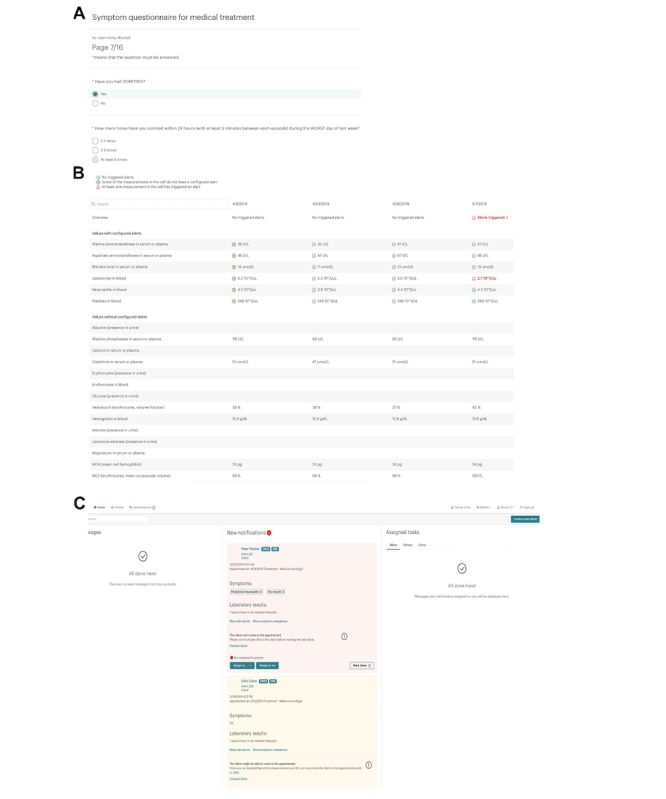
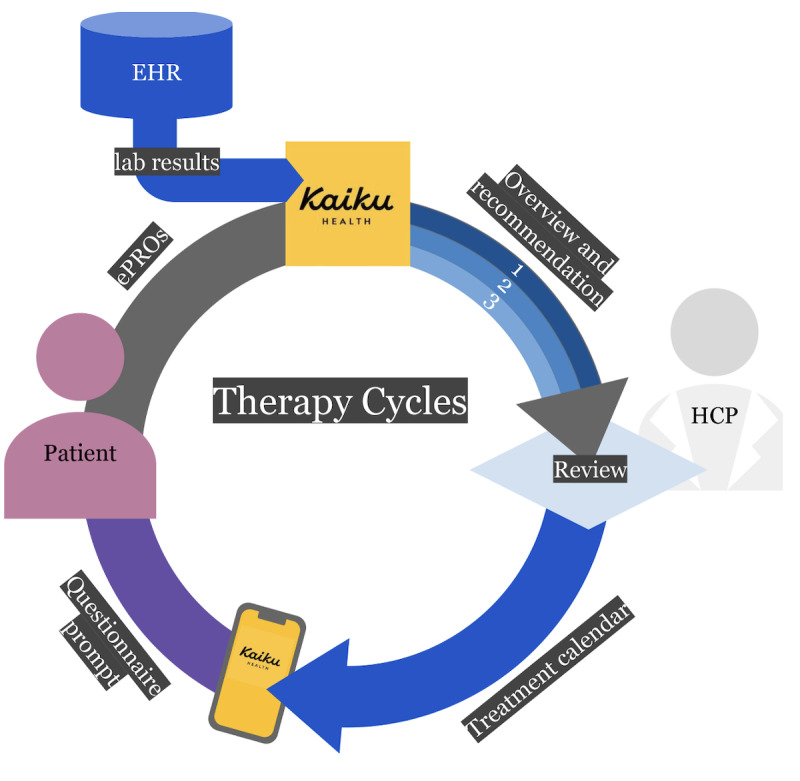
Methods: A 1-arm, multicenter, prospective clinical trial ("Follow-up of Cancer Patients Receiving Chemotherapy or Targeted Therapy by Electronic Patient Reported Outcomes-tool" [ECHO] 7/2019-1/2021; NCT04081558) was initiated to investigate the tool. The most important inclusion criteria were the presence of colorectal cancer (CRC) treated with oxaliplatin-based chemotherapy, age ≥18 years, Eastern Cooperative Oncology Group [ECOG] performance score of 0 to 2, and internet access. A decision support tool that included digital symptom monitoring, a laboratory value interface, and treatment schedule integration for semiautomated chemotherapy cycle prescribing was integrated into the care pathway. Performance was assessed by the percentage of chemotherapy cycles with sent and completed symptom questionnaires, while perceptions of health care professionals (HCPs) on the feasibility of the approach were collected through a 1-time semistructured interview.
Results: The ECHO trial included 43 patients with CRC treated with doublet or triplet chemotherapy in an adjuvant or metastatic setting. Altogether, 843 electronic patient-reported outcome (ePRO) symptom questionnaires were completed. Of the 15 recorded symptoms, fatigue (n=446, 52.9%) and peripheral neuropathy (n=429, 50.9%) were reported most often, while 137 grade 3 to 4 symptoms were recorded, of which diarrhea (n=5, 4%) and peripheral neuropathy (n=4, 3%) were the most common. During the study, 339 chemotherapy cycles were prescribed, and for the 77% (n=262) of new chemotherapy cycles, ePRO questionnaire data were available within preset limits (completed within 3 days prior to chemotherapy scheduling) while 65% of the cycles (n=221) had symptom questionnaire grading at ≤1%, and 67% of the cycles (n=228) had laboratory values in a preset range. The recommendations by the tool for a new chemotherapy cycle were tier 1 (green; meaning "go") in 145 (42.8%) of the cycles, tier 2 (yellow; "evaluate") in 83 (25%), and tier 3 (red; "hold") in 111 (32.7%). HCPs (n=3) were interviewed with a questionnaire (comprising 8 questions), revealing that they most valued the improved workflow, faster patient evaluation, and direct messaging option.
Conclusions: In this study, we investigated the feasibility of a decision support system for chemotherapy-cycle pre-evaluation and prescription that was developed for the prospective ECHO trial. The study showed that the functionalities of the investigated tool were feasible and that an automated approach to chemotherapy-cycle prescription was possible for nearly half of the cycles.





 京公网安备 11010802042870号
京ICP备2023020795号-1
京公网安备 11010802042870号
京ICP备2023020795号-1

 分享
分享
 求助内容:
求助内容: 应助结果提醒方式:
 扫码关注我们
