Genetic Insights into Brain Morphology: a Genome-Wide Association Study of Cortical Thickness and T1-Weighted MRI Gray Matter-White Matter Intensity Contrast.
Nicholas J Kim, Nahian F Chowdhury, Kenneth H Buetow, Paul M Thompson, Andrei Irimia
{"title":"Genetic Insights into Brain Morphology: a Genome-Wide Association Study of Cortical Thickness and T<sub>1</sub>-Weighted MRI Gray Matter-White Matter Intensity Contrast.","authors":"Nicholas J Kim, Nahian F Chowdhury, Kenneth H Buetow, Paul M Thompson, Andrei Irimia","doi":"10.1007/s12021-025-09722-9","DOIUrl":null,"url":null,"abstract":"<p><p>In T<sub>1</sub>-weighted magnetic resonance imaging (MRI), cortical thickness (CT) and gray-white matter contrast (GWC) capture brain morphological traits and vary with age-related disease. To gain insight into genetic factors underlying brain structure and dynamics observed during neurodegeneration, this genome-wide association study (GWAS) quantifies the relationship between single nucleotide polymorphisms (SNPs) and both CT and GWC in UK Biobank participants (N = 43,002). To our knowledge, this is the first GWAS to investigate the genetic determinants of cortical T<sub>1</sub>-MRI GWC in humans. We found 251 SNPs associated with CT or GWC for at least 1% of cortical locations, including 42 for both CT and GWC; 127 for only CT; and 82 for only GWC. Identified SNPs include rs1080066 (THSB1, featuring the strongest association with both CT and GWC), rs13107325 (SLC39A8, linked to CT at the largest number of cortical locations), and rs864736 (KCNK2, associated with GWC at the largest number of cortical locations). Dimensionality reduction reveals three major gene ontologies constraining CT (neural signaling, ion transport, cell migration) and four constraining GWC (neural cell development, cellular homeostasis, tissue repair, ion transport). Our findings provide insight into genetic determinants of GWC and CT, highlighting pathways associated with brain anatomy and dynamics of neurodegeneration. These insights can assist the development of gene therapies and treatments targeting brain diseases.</p>","PeriodicalId":49761,"journal":{"name":"Neuroinformatics","volume":"23 2","pages":"26"},"PeriodicalIF":3.1000,"publicationDate":"2025-04-01","publicationTypes":"Journal Article","fieldsOfStudy":null,"isOpenAccess":false,"openAccessPdf":"https://www.ncbi.nlm.nih.gov/pmc/articles/PMC11961481/pdf/","citationCount":"0","resultStr":null,"platform":"Semanticscholar","paperid":null,"PeriodicalName":"Neuroinformatics","FirstCategoryId":"3","ListUrlMain":"https://doi.org/10.1007/s12021-025-09722-9","RegionNum":4,"RegionCategory":"医学","ArticlePicture":[],"TitleCN":null,"AbstractTextCN":null,"PMCID":null,"EPubDate":"","PubModel":"","JCR":"Q2","JCRName":"COMPUTER SCIENCE, INTERDISCIPLINARY APPLICATIONS","Score":null,"Total":0}
引用次数: 0
Abstract
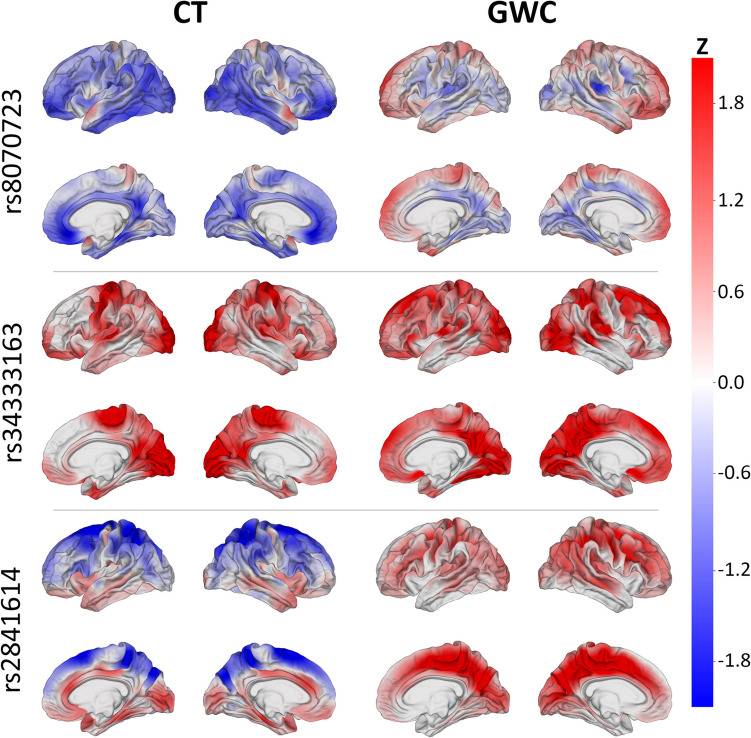
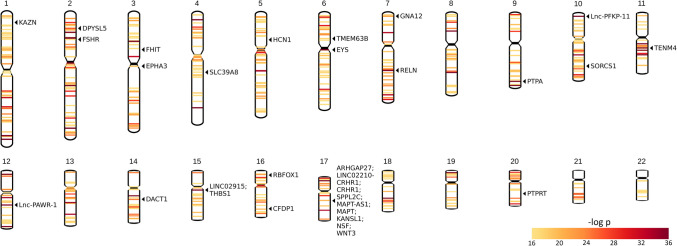
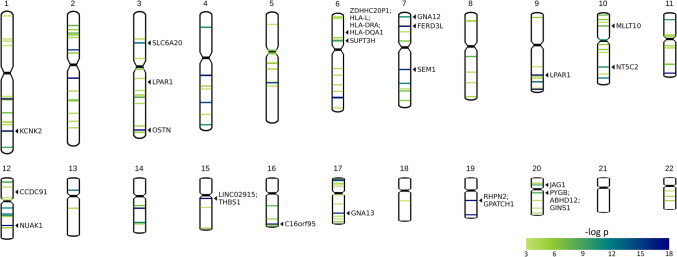
In T1-weighted magnetic resonance imaging (MRI), cortical thickness (CT) and gray-white matter contrast (GWC) capture brain morphological traits and vary with age-related disease. To gain insight into genetic factors underlying brain structure and dynamics observed during neurodegeneration, this genome-wide association study (GWAS) quantifies the relationship between single nucleotide polymorphisms (SNPs) and both CT and GWC in UK Biobank participants (N = 43,002). To our knowledge, this is the first GWAS to investigate the genetic determinants of cortical T1-MRI GWC in humans. We found 251 SNPs associated with CT or GWC for at least 1% of cortical locations, including 42 for both CT and GWC; 127 for only CT; and 82 for only GWC. Identified SNPs include rs1080066 (THSB1, featuring the strongest association with both CT and GWC), rs13107325 (SLC39A8, linked to CT at the largest number of cortical locations), and rs864736 (KCNK2, associated with GWC at the largest number of cortical locations). Dimensionality reduction reveals three major gene ontologies constraining CT (neural signaling, ion transport, cell migration) and four constraining GWC (neural cell development, cellular homeostasis, tissue repair, ion transport). Our findings provide insight into genetic determinants of GWC and CT, highlighting pathways associated with brain anatomy and dynamics of neurodegeneration. These insights can assist the development of gene therapies and treatments targeting brain diseases.
期刊介绍:
Neuroinformatics publishes original articles and reviews with an emphasis on data structure and software tools related to analysis, modeling, integration, and sharing in all areas of neuroscience research. The editors particularly invite contributions on: (1) Theory and methodology, including discussions on ontologies, modeling approaches, database design, and meta-analyses; (2) Descriptions of developed databases and software tools, and of the methods for their distribution; (3) Relevant experimental results, such as reports accompanie by the release of massive data sets; (4) Computational simulations of models integrating and organizing complex data; and (5) Neuroengineering approaches, including hardware, robotics, and information theory studies.



 京公网安备 11010802042870号
京ICP备2023020795号-1
京公网安备 11010802042870号
京ICP备2023020795号-1

 分享
分享
 求助内容:
求助内容: 应助结果提醒方式:
 扫码关注我们
