{"title":"Aspects of gravitational portals and freeze-in during reheating","authors":"Stephen E. Henrich, Yann Mambrini, Keith A. Olive","doi":"10.1103/physrevd.111.083501","DOIUrl":null,"url":null,"abstract":"We conduct a systematic investigation of freeze-in during reheating while taking care to include both direct and indirect production of dark matter (DM) via gravitational portals and inflaton decay. Direct production of DM can occur via gravitational scattering of the inflaton, while indirect production occurs through scattering in the Standard Model radiation bath. We consider two main contributions to the radiation bath during reheating. The first, which may dominate at the onset of the reheating process, is produced via gravitational scattering of the inflaton. The second (and more standard contribution) comes from inflaton decay. We consider a broad class of DM production rates parametrized as R</a:mi>χ</a:mi></a:msub>∝</a:mo>T</a:mi>n</a:mi>+</a:mo>6</a:mn></a:mrow></a:msup>/</a:mo>Λ</a:mi>n</a:mi>+</a:mo>2</a:mn></a:mrow></a:msup></a:math>, and inflaton potentials with a power-law form <d:math xmlns:d=\"http://www.w3.org/1998/Math/MathML\" display=\"inline\"><d:mi>V</d:mi><d:mo stretchy=\"false\">(</d:mo><d:mi>ϕ</d:mi><d:mo stretchy=\"false\">)</d:mo><d:mo>∝</d:mo><d:msup><d:mi>ϕ</d:mi><d:mi>k</d:mi></d:msup></d:math> about the minimum. We find the relic density produced by freeze-in for each contribution to the Standard Model bath for arbitrary <h:math xmlns:h=\"http://www.w3.org/1998/Math/MathML\" display=\"inline\"><h:mi>k</h:mi></h:math> and <j:math xmlns:j=\"http://www.w3.org/1998/Math/MathML\" display=\"inline\"><j:mi>n</j:mi></j:math>, and compare these with the DM density produced gravitationally by inflaton scattering. We find that freeze-in production from the gravitationally produced radiation bath can exceed that of the conventional decay bath and account for the observed relic density provided that <l:math xmlns:l=\"http://www.w3.org/1998/Math/MathML\" display=\"inline\"><l:msub><l:mi>m</l:mi><l:mi>χ</l:mi></l:msub><l:mo>></l:mo><l:msub><l:mi>T</l:mi><l:mrow><l:mi>RH</l:mi></l:mrow></l:msub></l:math>, with additional <n:math xmlns:n=\"http://www.w3.org/1998/Math/MathML\" display=\"inline\"><n:mi>k</n:mi></n:math>- and <p:math xmlns:p=\"http://www.w3.org/1998/Math/MathML\" display=\"inline\"><p:mi>n</p:mi></p:math>-dependent constraints. For each freeze-in interaction considered, we also find <r:math xmlns:r=\"http://www.w3.org/1998/Math/MathML\" display=\"inline\"><r:msub><r:mi>m</r:mi><r:mi>χ</r:mi></r:msub></r:math>- and <t:math xmlns:t=\"http://www.w3.org/1998/Math/MathML\" display=\"inline\"><t:msub><t:mi>T</t:mi><t:mrow><t:mi>RH</t:mi></t:mrow></t:msub></t:math>-dependent limits on the beyond the Standard Model scale, <v:math xmlns:v=\"http://www.w3.org/1998/Math/MathML\" display=\"inline\"><v:mi mathvariant=\"normal\">Λ</v:mi></v:math>, for which gravitational production will exceed ordinary freeze-in production. <jats:supplementary-material> <jats:copyright-statement>Published by the American Physical Society</jats:copyright-statement> <jats:copyright-year>2025</jats:copyright-year> </jats:permissions> </jats:supplementary-material>","PeriodicalId":20167,"journal":{"name":"Physical Review D","volume":"235 1","pages":""},"PeriodicalIF":5.3000,"publicationDate":"2025-04-02","publicationTypes":"Journal Article","fieldsOfStudy":null,"isOpenAccess":false,"openAccessPdf":"","citationCount":"0","resultStr":null,"platform":"Semanticscholar","paperid":null,"PeriodicalName":"Physical Review D","FirstCategoryId":"101","ListUrlMain":"https://doi.org/10.1103/physrevd.111.083501","RegionNum":2,"RegionCategory":"物理与天体物理","ArticlePicture":[],"TitleCN":null,"AbstractTextCN":null,"PMCID":null,"EPubDate":"","PubModel":"","JCR":"Q1","JCRName":"Physics and Astronomy","Score":null,"Total":0}
引用次数: 0
Abstract
We conduct a systematic investigation of freeze-in during reheating while taking care to include both direct and indirect production of dark matter (DM) via gravitational portals and inflaton decay. Direct production of DM can occur via gravitational scattering of the inflaton, while indirect production occurs through scattering in the Standard Model radiation bath. We consider two main contributions to the radiation bath during reheating. The first, which may dominate at the onset of the reheating process, is produced via gravitational scattering of the inflaton. The second (and more standard contribution) comes from inflaton decay. We consider a broad class of DM production rates parametrized as Rχ∝Tn+6/Λn+2, and inflaton potentials with a power-law form V(ϕ)∝ϕk about the minimum. We find the relic density produced by freeze-in for each contribution to the Standard Model bath for arbitrary k and n, and compare these with the DM density produced gravitationally by inflaton scattering. We find that freeze-in production from the gravitationally produced radiation bath can exceed that of the conventional decay bath and account for the observed relic density provided that mχ>TRH, with additional k- and n-dependent constraints. For each freeze-in interaction considered, we also find mχ- and TRH-dependent limits on the beyond the Standard Model scale, Λ, for which gravitational production will exceed ordinary freeze-in production. Published by the American Physical Society2025
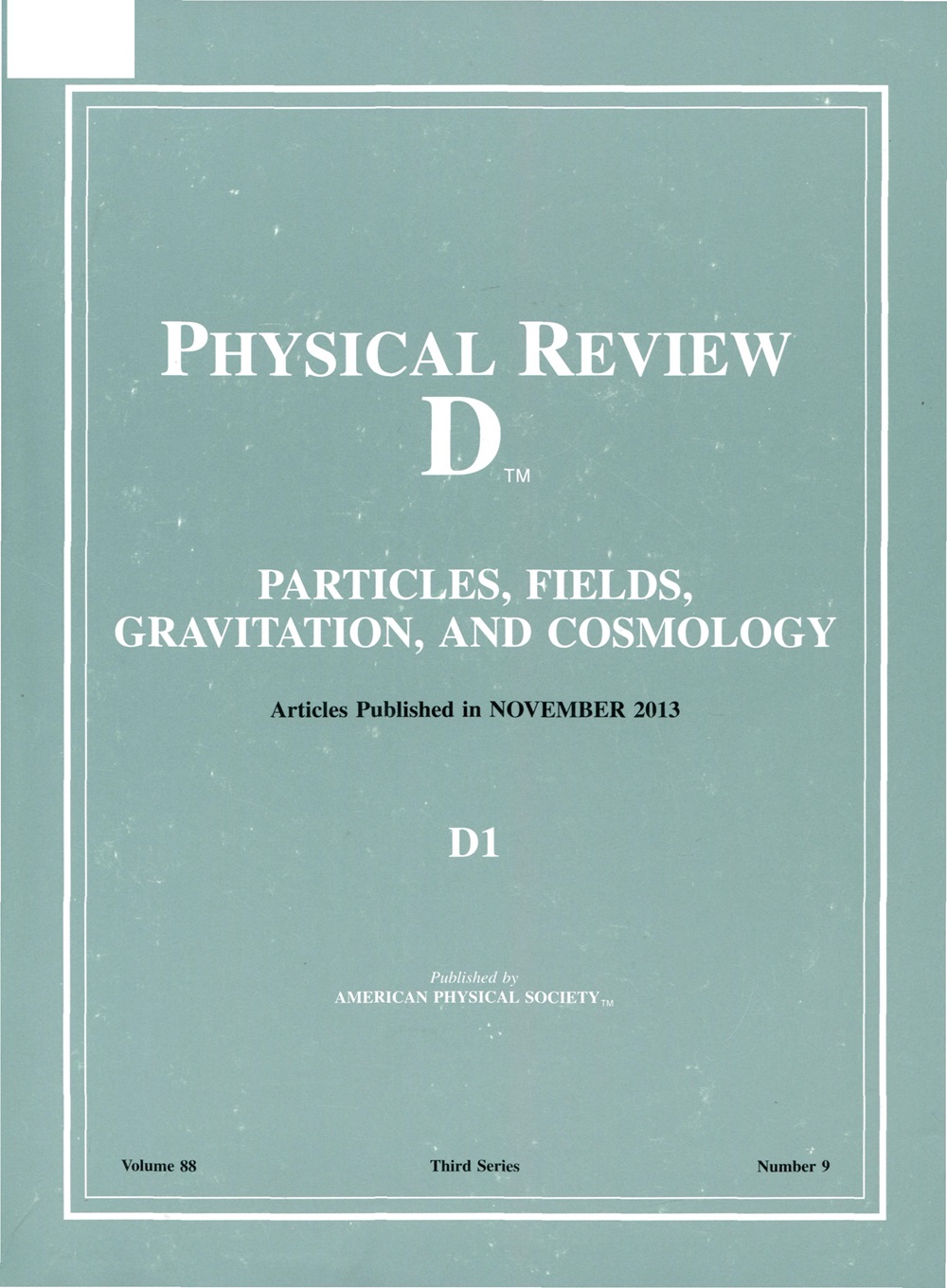
期刊介绍:
Physical Review D (PRD) is a leading journal in elementary particle physics, field theory, gravitation, and cosmology and is one of the top-cited journals in high-energy physics.
PRD covers experimental and theoretical results in all aspects of particle physics, field theory, gravitation and cosmology, including:
Particle physics experiments,
Electroweak interactions,
Strong interactions,
Lattice field theories, lattice QCD,
Beyond the standard model physics,
Phenomenological aspects of field theory, general methods,
Gravity, cosmology, cosmic rays,
Astrophysics and astroparticle physics,
General relativity,
Formal aspects of field theory, field theory in curved space,
String theory, quantum gravity, gauge/gravity duality.



 京公网安备 11010802042870号
京ICP备2023020795号-1
京公网安备 11010802042870号
京ICP备2023020795号-1

 分享
分享
 求助内容:
求助内容: 应助结果提醒方式:
 扫码关注我们
