Katarina A. Ćeranić, Snežana D. Zarić and Dušan P. Malenov
{"title":"Cation recognition by benzene sandwich compounds – a DFT perspective†","authors":"Katarina A. Ćeranić, Snežana D. Zarić and Dušan P. Malenov","doi":"10.1039/D5DT00395D","DOIUrl":null,"url":null,"abstract":"<p >Cation–π interactions between alkali, alkaline earth and ammonium cations and sandwich compounds of benzene and the cyclopentadienyl (Cp) anion were studied using quantum chemical CCSD(T)/CBS and DFT (B3LYP/def2-TZVP) calculations. The results show significantly stronger interactions of sandwich compounds with respect to (uncoordinated) benzene. Moreover, very strong cation–π interactions of Cp sandwich compounds are furthermore surpassed by cation–π interactions of benzene sandwich compounds, which are capable of reaching a remarkable interaction energy value of −196.8 kcal mol<small><sup>−1</sup></small> (Mg<small><sup>2+</sup></small>/W(benzene)<small><sub>2</sub></small>). While there are only small variations of interaction energy values for sandwich compounds of different transition metals (3d metals < 4d < 5d), cation–π interactions progressively become stronger in the following order: (uncoordinated) benzene < Cp sandwich < benzene sandwich. Aside from interaction energies, the cation–π interactions can be assessed by means of their influence on the geometries of sandwich compounds, which are found to strongly correlate with the strength of cation–π interactions. These results emphasize sandwich compounds, particularly those containing C<small><sub>6</sub></small> aromatic rings, as promising candidates for new receptors for common metal cations.</p>","PeriodicalId":71,"journal":{"name":"Dalton Transactions","volume":" 19","pages":" 7700-7706"},"PeriodicalIF":3.3000,"publicationDate":"2025-04-02","publicationTypes":"Journal Article","fieldsOfStudy":null,"isOpenAccess":false,"openAccessPdf":"","citationCount":"0","resultStr":null,"platform":"Semanticscholar","paperid":null,"PeriodicalName":"Dalton Transactions","FirstCategoryId":"92","ListUrlMain":"https://pubs.rsc.org/en/content/articlelanding/2025/dt/d5dt00395d","RegionNum":3,"RegionCategory":"化学","ArticlePicture":[],"TitleCN":null,"AbstractTextCN":null,"PMCID":null,"EPubDate":"","PubModel":"","JCR":"Q2","JCRName":"CHEMISTRY, INORGANIC & NUCLEAR","Score":null,"Total":0}
引用次数: 0
Abstract
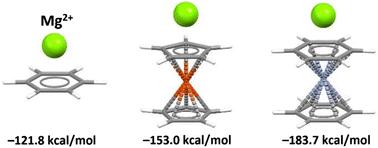
Cation–π interactions between alkali, alkaline earth and ammonium cations and sandwich compounds of benzene and the cyclopentadienyl (Cp) anion were studied using quantum chemical CCSD(T)/CBS and DFT (B3LYP/def2-TZVP) calculations. The results show significantly stronger interactions of sandwich compounds with respect to (uncoordinated) benzene. Moreover, very strong cation–π interactions of Cp sandwich compounds are furthermore surpassed by cation–π interactions of benzene sandwich compounds, which are capable of reaching a remarkable interaction energy value of −196.8 kcal mol−1 (Mg2+/W(benzene)2). While there are only small variations of interaction energy values for sandwich compounds of different transition metals (3d metals < 4d < 5d), cation–π interactions progressively become stronger in the following order: (uncoordinated) benzene < Cp sandwich < benzene sandwich. Aside from interaction energies, the cation–π interactions can be assessed by means of their influence on the geometries of sandwich compounds, which are found to strongly correlate with the strength of cation–π interactions. These results emphasize sandwich compounds, particularly those containing C6 aromatic rings, as promising candidates for new receptors for common metal cations.
期刊介绍:
Dalton Transactions is a journal for all areas of inorganic chemistry, which encompasses the organometallic, bioinorganic and materials chemistry of the elements, with applications including synthesis, catalysis, energy conversion/storage, electrical devices and medicine. Dalton Transactions welcomes high-quality, original submissions in all of these areas and more, where the advancement of knowledge in inorganic chemistry is significant.



 京公网安备 11010802042870号
京ICP备2023020795号-1
京公网安备 11010802042870号
京ICP备2023020795号-1

 分享
分享
 求助内容:
求助内容: 应助结果提醒方式:
 扫码关注我们
