Synthesis, electronic and photophysical investigations of ruthenium(ii)-centred heterometallic Kuratowski complexes which feature redox-active metal centres†
Wiebke G. Rehfuß, Andreas Kalytta-Mewes, Maryana Kraft, Binh Minh Nguyen, Wolfgang Brütting and Dirk Volkmer
{"title":"Synthesis, electronic and photophysical investigations of ruthenium(ii)-centred heterometallic Kuratowski complexes which feature redox-active metal centres†","authors":"Wiebke G. Rehfuß, Andreas Kalytta-Mewes, Maryana Kraft, Binh Minh Nguyen, Wolfgang Brütting and Dirk Volkmer","doi":"10.1039/D5DT00088B","DOIUrl":null,"url":null,"abstract":"<p >We present the synthesis and comprehensive characterization of a series of complexes belonging to the Kuratowski (K<small><sub>3,3</sub></small>) family. These are pentanuclear {Ru<small><sup>II</sup></small>M<small><sub>4</sub></small>} complexes (M = Co<small><sup>2+</sup></small>, Ni<small><sup>2+</sup></small>, Zn<small><sup>2+</sup></small>) which were prepared by employing a directed two-step synthesis facilitated by the recently published [Ru<small><sup>II</sup></small>(Me<small><sub>2</sub></small>bta)<small><sub>2</sub></small>(Me<small><sub>2</sub></small>btaH)<small><sub>4</sub></small>] precursor complex (Me<small><sub>2</sub></small>btaH = 5,6-dimethyl-1,2,3-benzotriazole). The pentanuclear Kuratowski complexes showcase a unique combination of photo-active ruthenium with redox-active metal centres. The μ<small><sub>3</sub></small>-bridging 1,2,3-triazolate ligands in these complexes facilitate electronic coupling between the metal centers, as revealed through electrochemical and photophysical studies. Comparisons with {Ru<small><sup>II</sup></small>Zn<small><sub>4</sub></small>} and {Ru<small><sup>II</sup></small>Cu<small><sub>4</sub></small>} Kuratowski compounds reveal that Co(<small>II</small>) significantly influences both the Ru(<small>II</small>/<small>III</small>) redox step and the position of the MLCT (metal-to-ligand charge transfer) band, whereas Cu(<small>II</small>) and Ni(<small>II</small>) exhibit minimal influence. Photophysical investigations reveal the {Ru<small><sup>II</sup></small>Zn<small><sub>4</sub></small>} compound as the only phosphorescent species, displaying an emission band extending into the near-infrared region. This emission originates from a triplet <small><sup>3</sup></small>MLCT state and features an exceptionally large Stokes shift, with a long lifetime of the excited-state of about 3.3 μs in powdered form at room temperature.</p>","PeriodicalId":71,"journal":{"name":"Dalton Transactions","volume":" 17","pages":" 6910-6921"},"PeriodicalIF":3.3000,"publicationDate":"2025-04-02","publicationTypes":"Journal Article","fieldsOfStudy":null,"isOpenAccess":false,"openAccessPdf":"","citationCount":"0","resultStr":null,"platform":"Semanticscholar","paperid":null,"PeriodicalName":"Dalton Transactions","FirstCategoryId":"92","ListUrlMain":"https://pubs.rsc.org/en/content/articlelanding/2025/dt/d5dt00088b","RegionNum":3,"RegionCategory":"化学","ArticlePicture":[],"TitleCN":null,"AbstractTextCN":null,"PMCID":null,"EPubDate":"","PubModel":"","JCR":"Q2","JCRName":"CHEMISTRY, INORGANIC & NUCLEAR","Score":null,"Total":0}
引用次数: 0
Abstract
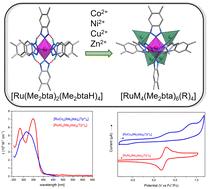
We present the synthesis and comprehensive characterization of a series of complexes belonging to the Kuratowski (K3,3) family. These are pentanuclear {RuIIM4} complexes (M = Co2+, Ni2+, Zn2+) which were prepared by employing a directed two-step synthesis facilitated by the recently published [RuII(Me2bta)2(Me2btaH)4] precursor complex (Me2btaH = 5,6-dimethyl-1,2,3-benzotriazole). The pentanuclear Kuratowski complexes showcase a unique combination of photo-active ruthenium with redox-active metal centres. The μ3-bridging 1,2,3-triazolate ligands in these complexes facilitate electronic coupling between the metal centers, as revealed through electrochemical and photophysical studies. Comparisons with {RuIIZn4} and {RuIICu4} Kuratowski compounds reveal that Co(II) significantly influences both the Ru(II/III) redox step and the position of the MLCT (metal-to-ligand charge transfer) band, whereas Cu(II) and Ni(II) exhibit minimal influence. Photophysical investigations reveal the {RuIIZn4} compound as the only phosphorescent species, displaying an emission band extending into the near-infrared region. This emission originates from a triplet 3MLCT state and features an exceptionally large Stokes shift, with a long lifetime of the excited-state of about 3.3 μs in powdered form at room temperature.
期刊介绍:
Dalton Transactions is a journal for all areas of inorganic chemistry, which encompasses the organometallic, bioinorganic and materials chemistry of the elements, with applications including synthesis, catalysis, energy conversion/storage, electrical devices and medicine. Dalton Transactions welcomes high-quality, original submissions in all of these areas and more, where the advancement of knowledge in inorganic chemistry is significant.




 京公网安备 11010802042870号
京ICP备2023020795号-1
京公网安备 11010802042870号
京ICP备2023020795号-1

 分享
分享
 求助内容:
求助内容: 应助结果提醒方式:
 扫码关注我们
