{"title":"Large-Area Stable Flexible X-Ray Scintillation Screens with Group IIB Ions Doped CsMnCl3 Microcrystals","authors":"Wenqing Liang, Huimin Tong, Jingwei Zhu, Xia Hao, Cong Chen, Shengqiang Ren, Min Wu, Shuyu Zhang, Dewei Zhao","doi":"10.1002/lpor.202402306","DOIUrl":null,"url":null,"abstract":"<p>Lead-free metal halide perovskites and derivatives microcrystals (MCs) have become emerging candidates for X-ray scintillation imaging applications. However, the luminescent properties of micrometric crystals need to be further improved, and the development of flexible scintillation screens utilizing large-scale MCs remains a significant challenge. Here, all-inorganic manganese (Mn)-based perovskite CsMnCl<sub>3</sub> MCs are reported by room-temperature solution-synthesized co-precipitation method. Introducing an amount of Group IIB divalent metal cations (i.e., Zn and Cd in this work) into CsMnCl<sub>3</sub> MCs greatly increases the photoluminescence quantum yield (PLQY) from 48.2% to 92.3% for CsMnCl<sub>3</sub>:1.5% Zn MCs (82.5% for CsMnCl<sub>3</sub>:1%Cd MCs). The CsMnCl<sub>3</sub>:1.5% Zn MCs feature excellent scintillation performance and achieve a low detection limit of 22.53 nGy<sub>air</sub> s<sup>−1</sup>. Furthermore, solvent engineering by adding n-hexane to the mixture of doped CsMnCl<sub>3</sub> MCs and polydimethylsiloxane (PDMS) assists in fabricating 100 cm<sup>2</sup> large-area uniform scintillation screens. As a result, the spatial resolution of CsMnCl<sub>3</sub>:1.5%Zn@PDMS achieves 7.6 line pairs (lp) mm<sup>−1</sup>, which is among the best values of CsMnCl<sub>3</sub>@PDMS scintillation screens. In addition, high-resolution flexible imaging applications of non-planar objects are achieved. The work offers a promising approach to develop high-performance large-area flexible scintillation screens based on large-size MCs for high-resolution X-ray imaging.</p>","PeriodicalId":204,"journal":{"name":"Laser & Photonics Reviews","volume":"19 14","pages":""},"PeriodicalIF":10.0000,"publicationDate":"2025-04-01","publicationTypes":"Journal Article","fieldsOfStudy":null,"isOpenAccess":false,"openAccessPdf":"","citationCount":"0","resultStr":null,"platform":"Semanticscholar","paperid":null,"PeriodicalName":"Laser & Photonics Reviews","FirstCategoryId":"101","ListUrlMain":"https://onlinelibrary.wiley.com/doi/10.1002/lpor.202402306","RegionNum":1,"RegionCategory":"物理与天体物理","ArticlePicture":[],"TitleCN":null,"AbstractTextCN":null,"PMCID":null,"EPubDate":"","PubModel":"","JCR":"Q1","JCRName":"OPTICS","Score":null,"Total":0}
引用次数: 0
Abstract
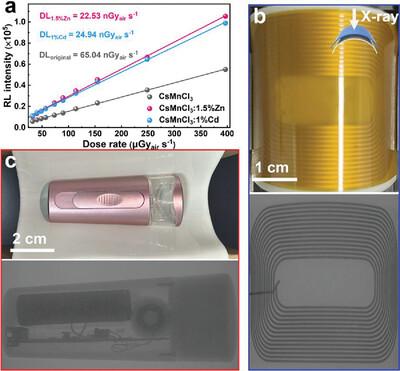
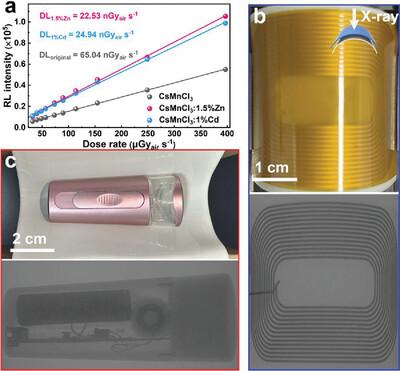
Lead-free metal halide perovskites and derivatives microcrystals (MCs) have become emerging candidates for X-ray scintillation imaging applications. However, the luminescent properties of micrometric crystals need to be further improved, and the development of flexible scintillation screens utilizing large-scale MCs remains a significant challenge. Here, all-inorganic manganese (Mn)-based perovskite CsMnCl3 MCs are reported by room-temperature solution-synthesized co-precipitation method. Introducing an amount of Group IIB divalent metal cations (i.e., Zn and Cd in this work) into CsMnCl3 MCs greatly increases the photoluminescence quantum yield (PLQY) from 48.2% to 92.3% for CsMnCl3:1.5% Zn MCs (82.5% for CsMnCl3:1%Cd MCs). The CsMnCl3:1.5% Zn MCs feature excellent scintillation performance and achieve a low detection limit of 22.53 nGyair s−1. Furthermore, solvent engineering by adding n-hexane to the mixture of doped CsMnCl3 MCs and polydimethylsiloxane (PDMS) assists in fabricating 100 cm2 large-area uniform scintillation screens. As a result, the spatial resolution of CsMnCl3:1.5%Zn@PDMS achieves 7.6 line pairs (lp) mm−1, which is among the best values of CsMnCl3@PDMS scintillation screens. In addition, high-resolution flexible imaging applications of non-planar objects are achieved. The work offers a promising approach to develop high-performance large-area flexible scintillation screens based on large-size MCs for high-resolution X-ray imaging.
期刊介绍:
Laser & Photonics Reviews is a reputable journal that publishes high-quality Reviews, original Research Articles, and Perspectives in the field of photonics and optics. It covers both theoretical and experimental aspects, including recent groundbreaking research, specific advancements, and innovative applications.
As evidence of its impact and recognition, Laser & Photonics Reviews boasts a remarkable 2022 Impact Factor of 11.0, according to the Journal Citation Reports from Clarivate Analytics (2023). Moreover, it holds impressive rankings in the InCites Journal Citation Reports: in 2021, it was ranked 6th out of 101 in the field of Optics, 15th out of 161 in Applied Physics, and 12th out of 69 in Condensed Matter Physics.
The journal uses the ISSN numbers 1863-8880 for print and 1863-8899 for online publications.




 京公网安备 11010802042870号
京ICP备2023020795号-1
京公网安备 11010802042870号
京ICP备2023020795号-1

 分享
分享
 求助内容:
求助内容: 应助结果提醒方式:
 扫码关注我们
