Wenting Yuan, Lifang Zhang, Wangchao Zhao, Bo Yang, Xiaoqiao Jiao, Li Zhou, Huizhong Shen, Jianhuai Ye, Lei Zhu, Tzung-May Fu, Xin Yang, Chen Wang
{"title":"Multiphase Reaction of Ozone with HONO/NO2– on Surfaces: Effects on Indoor HONO and Ozone","authors":"Wenting Yuan, Lifang Zhang, Wangchao Zhao, Bo Yang, Xiaoqiao Jiao, Li Zhou, Huizhong Shen, Jianhuai Ye, Lei Zhu, Tzung-May Fu, Xin Yang, Chen Wang","doi":"10.1021/acs.est.5c01450","DOIUrl":null,"url":null,"abstract":"Nitrous acid (HONO) and ozone (O<sub>3</sub>) are two important indoor pollutants that affect the indoor oxidation capacity. Previous field studies have observed an inverse correlation between these two pollutants indoors, but the specific mechanism remains unclear. Given the semivolatile behavior of HONO, a possible mechanism is its multiphase reaction with ozone. In this study, we measured ozone uptake on surface HONO/NO<sub>2</sub><sup>–</sup> under environmentally relevant conditions in a flow tube. The ozone deposition velocities (<i>v</i><sub>d</sub> = 0.002 ± 0.001–0.3 ± 0.005 cm s<sup>–1</sup>) and uptake coefficients (γ = (0.2 ± 0.1) × 10<sup>–6</sup>–(2.0 ± 0.2) × 10<sup>–4</sup>) depend on reactant concentrations, relative humidity, and reaction time but are less affected by illumination. The lifetimes of gaseous HONO and ozone are approximately 10 min due to this multiphase reaction under indoor conditions, which is a significant sink for HONO and O<sub>3</sub> as compared to those of other indoor reactions and air exchange. This study for the first time revealed the previously overlooked vital role of the reaction of surface HONO/NO<sub>2</sub><sup>–</sup> with O<sub>3</sub> in affecting both indoor HONO and O<sub>3</sub> and has significance for understanding the multiphase chemistry of HONO and O<sub>3</sub>, with implications for outdoor surfaces and model studies to better constrain HONO sinks.","PeriodicalId":36,"journal":{"name":"环境科学与技术","volume":"183 1","pages":""},"PeriodicalIF":11.3000,"publicationDate":"2025-04-02","publicationTypes":"Journal Article","fieldsOfStudy":null,"isOpenAccess":false,"openAccessPdf":"","citationCount":"0","resultStr":null,"platform":"Semanticscholar","paperid":null,"PeriodicalName":"环境科学与技术","FirstCategoryId":"1","ListUrlMain":"https://doi.org/10.1021/acs.est.5c01450","RegionNum":1,"RegionCategory":"环境科学与生态学","ArticlePicture":[],"TitleCN":null,"AbstractTextCN":null,"PMCID":null,"EPubDate":"","PubModel":"","JCR":"Q1","JCRName":"ENGINEERING, ENVIRONMENTAL","Score":null,"Total":0}
引用次数: 0
Abstract
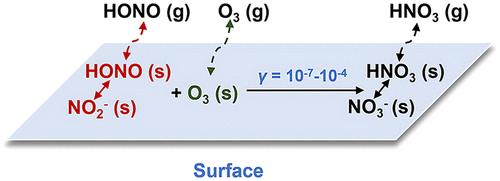
Nitrous acid (HONO) and ozone (O3) are two important indoor pollutants that affect the indoor oxidation capacity. Previous field studies have observed an inverse correlation between these two pollutants indoors, but the specific mechanism remains unclear. Given the semivolatile behavior of HONO, a possible mechanism is its multiphase reaction with ozone. In this study, we measured ozone uptake on surface HONO/NO2– under environmentally relevant conditions in a flow tube. The ozone deposition velocities (vd = 0.002 ± 0.001–0.3 ± 0.005 cm s–1) and uptake coefficients (γ = (0.2 ± 0.1) × 10–6–(2.0 ± 0.2) × 10–4) depend on reactant concentrations, relative humidity, and reaction time but are less affected by illumination. The lifetimes of gaseous HONO and ozone are approximately 10 min due to this multiphase reaction under indoor conditions, which is a significant sink for HONO and O3 as compared to those of other indoor reactions and air exchange. This study for the first time revealed the previously overlooked vital role of the reaction of surface HONO/NO2– with O3 in affecting both indoor HONO and O3 and has significance for understanding the multiphase chemistry of HONO and O3, with implications for outdoor surfaces and model studies to better constrain HONO sinks.
期刊介绍:
Environmental Science & Technology (ES&T) is a co-sponsored academic and technical magazine by the Hubei Provincial Environmental Protection Bureau and the Hubei Provincial Academy of Environmental Sciences.
Environmental Science & Technology (ES&T) holds the status of Chinese core journals, scientific papers source journals of China, Chinese Science Citation Database source journals, and Chinese Academic Journal Comprehensive Evaluation Database source journals. This publication focuses on the academic field of environmental protection, featuring articles related to environmental protection and technical advancements.



 京公网安备 11010802042870号
京ICP备2023020795号-1
京公网安备 11010802042870号
京ICP备2023020795号-1

 分享
分享
 求助内容:
求助内容: 应助结果提醒方式:
 扫码关注我们
