Chengye Song, Yan Zhao, Zonghao Liu, Yueqing Zhang, Jiahao Lai, Chaoqun Tan, Min Song
{"title":"Plasma-Generated Free Electrons Induced Perfluorooctanoic Acid Efficient Degradation at the Gas–Liquid Interface","authors":"Chengye Song, Yan Zhao, Zonghao Liu, Yueqing Zhang, Jiahao Lai, Chaoqun Tan, Min Song","doi":"10.1021/acs.est.5c02062","DOIUrl":null,"url":null,"abstract":"Low-temperature plasma, generating both reductive electrons and diverse oxidative species, has demonstrated considerable potential for the degradation of perfluorooctanoic acid (PFOA). However, limited understanding of electron propagation mechanisms during discharge has led previous research to focus on hydrated electrons (e<sub>aq</sub><sup>–</sup>) while neglecting free electrons (e<sup>–</sup>). In this study, a consistent and modeled dielectric barrier discharge (DBD) plasma was employed to degrade PFOA. Contribution analysis indicated that reactions driven by e<sup>–</sup> were dominant, with substantial contributions from hydroxyl radical (•OH)-mediated oxidation. By integrating a kinetic model with a streamer solver, a basic discharge unit model was developed. Simulation of e<sup>–</sup> streamer propagation identified a high-intensity response electric field formed by the e<sup>–</sup> memory effect, with a peak strength of 1.816 × 10<sup>6</sup> V/m. This electric field facilitated a secondary acceleration of e<sup>–</sup>, allowing e<sup>–</sup> to penetrate the surface water layer and directly attack PFOA via chain-shortening mechanisms. The delocalized state of e<sup>–</sup> restricted degradation primarily to the gas–liquid interface, minimizing interference from the surrounding medium. This study highlights the previously overlooked role of e<sup>–</sup> and provides essential theoretical insights for the plasma-based treatment of PFOA-contaminated water.","PeriodicalId":36,"journal":{"name":"环境科学与技术","volume":"67 1","pages":""},"PeriodicalIF":11.3000,"publicationDate":"2025-04-02","publicationTypes":"Journal Article","fieldsOfStudy":null,"isOpenAccess":false,"openAccessPdf":"","citationCount":"0","resultStr":null,"platform":"Semanticscholar","paperid":null,"PeriodicalName":"环境科学与技术","FirstCategoryId":"1","ListUrlMain":"https://doi.org/10.1021/acs.est.5c02062","RegionNum":1,"RegionCategory":"环境科学与生态学","ArticlePicture":[],"TitleCN":null,"AbstractTextCN":null,"PMCID":null,"EPubDate":"","PubModel":"","JCR":"Q1","JCRName":"ENGINEERING, ENVIRONMENTAL","Score":null,"Total":0}
引用次数: 0
Abstract
Low-temperature plasma, generating both reductive electrons and diverse oxidative species, has demonstrated considerable potential for the degradation of perfluorooctanoic acid (PFOA). However, limited understanding of electron propagation mechanisms during discharge has led previous research to focus on hydrated electrons (eaq–) while neglecting free electrons (e–). In this study, a consistent and modeled dielectric barrier discharge (DBD) plasma was employed to degrade PFOA. Contribution analysis indicated that reactions driven by e– were dominant, with substantial contributions from hydroxyl radical (•OH)-mediated oxidation. By integrating a kinetic model with a streamer solver, a basic discharge unit model was developed. Simulation of e– streamer propagation identified a high-intensity response electric field formed by the e– memory effect, with a peak strength of 1.816 × 10⁶ V/m. This electric field facilitated a secondary acceleration of e–, allowing e– to penetrate the surface water layer and directly attack PFOA via chain-shortening mechanisms. The delocalized state of e– restricted degradation primarily to the gas–liquid interface, minimizing interference from the surrounding medium. This study highlights the previously overlooked role of e– and provides essential theoretical insights for the plasma-based treatment of PFOA-contaminated water.
期刊介绍:
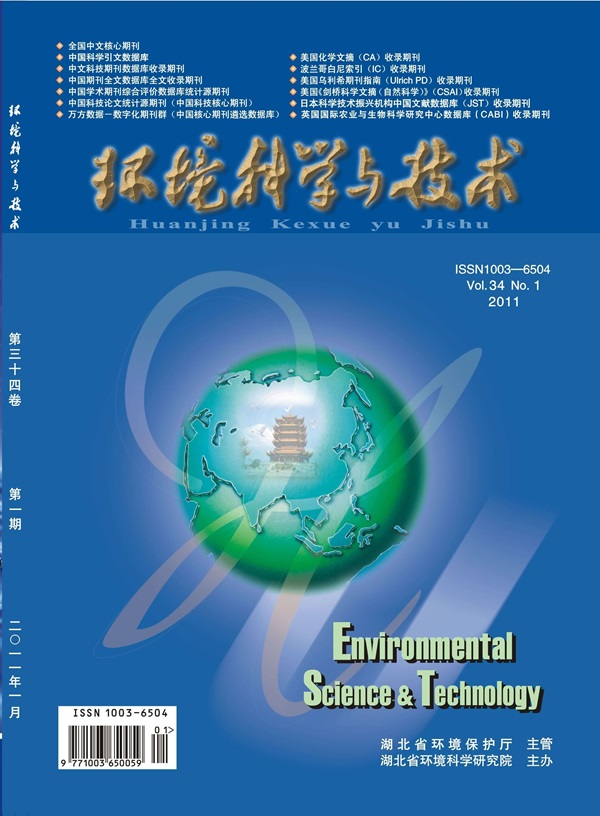
Environmental Science & Technology (ES&T) is a co-sponsored academic and technical magazine by the Hubei Provincial Environmental Protection Bureau and the Hubei Provincial Academy of Environmental Sciences.
Environmental Science & Technology (ES&T) holds the status of Chinese core journals, scientific papers source journals of China, Chinese Science Citation Database source journals, and Chinese Academic Journal Comprehensive Evaluation Database source journals. This publication focuses on the academic field of environmental protection, featuring articles related to environmental protection and technical advancements.




 京公网安备 11010802042870号
京ICP备2023020795号-1
京公网安备 11010802042870号
京ICP备2023020795号-1

 分享
分享
 求助内容:
求助内容: 应助结果提醒方式:
 扫码关注我们
