Qi Wang, Yuefei Ruan, Yetong Shao, Linjie Jin, Naiyu Xie, Xiaoqiang Yang, Yuanyuan Hong, He Wang, Akira Tsujimoto, Moriaki Yasuhara, Kenneth Mei Yee Leung, Paul K. S. Lam
{"title":"Spatiotemporal Trend of PFAS in Estuarine Sediments: Insights into Chlorinated Polyfluoroalkyl Ether Sulfonate Transformation","authors":"Qi Wang, Yuefei Ruan, Yetong Shao, Linjie Jin, Naiyu Xie, Xiaoqiang Yang, Yuanyuan Hong, He Wang, Akira Tsujimoto, Moriaki Yasuhara, Kenneth Mei Yee Leung, Paul K. S. Lam","doi":"10.1021/acs.est.5c02731","DOIUrl":null,"url":null,"abstract":"Per- and polyfluoroalkyl substances (PFAS) are synthetic long-lasting chemicals. Marine sediment is a major repository for PFAS in the environment; accordingly, this work investigated 45 legacy and emerging PFAS in samples of surface sediments and sediment cores (1940s–2020s) collected in the Pearl River outlets, its estuary, and the adjacent northern South China Sea (NSCS), one of the global pollution hotspots. The range of total PFAS concentrations in surface sediments from the river outlets and the NSCS was 244–14400 pg/g dry weight (dw) and 31.6–363 pg/g dw, respectively. In sediment cores, perfluorooctanesulfonate (PFOS) concentrations initially increased and then declined around ten years ago. Levels of long-chain perfluorinated carboxylates have been increasing since the 1980s and experienced an accelerated rise in the 2000s. Hydrogen-substituted polyfluoroalkyl ether sulfonate (H-PFESA) was widely found in sediment samples for the first time. The ratios of 6:2 H-PFESA to 6:2 chlorinated (Cl-) PFESA in sediment cores exceeded those in surface sediment and exhibited an increasing trend with the sediment age, implying the gradual transformation of 6:2 Cl-PFESA to its hydrogen-substituted analog in sediments. A preliminary risk assessment indicated that ∑6:2 PFESAs and PFOS posed medium to high risks over recent decades.","PeriodicalId":36,"journal":{"name":"环境科学与技术","volume":"235 1","pages":""},"PeriodicalIF":11.3000,"publicationDate":"2025-04-02","publicationTypes":"Journal Article","fieldsOfStudy":null,"isOpenAccess":false,"openAccessPdf":"","citationCount":"0","resultStr":null,"platform":"Semanticscholar","paperid":null,"PeriodicalName":"环境科学与技术","FirstCategoryId":"1","ListUrlMain":"https://doi.org/10.1021/acs.est.5c02731","RegionNum":1,"RegionCategory":"环境科学与生态学","ArticlePicture":[],"TitleCN":null,"AbstractTextCN":null,"PMCID":null,"EPubDate":"","PubModel":"","JCR":"Q1","JCRName":"ENGINEERING, ENVIRONMENTAL","Score":null,"Total":0}
引用次数: 0
Abstract
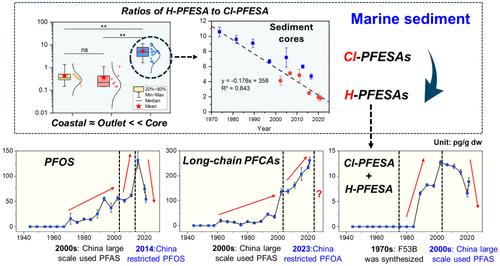
Per- and polyfluoroalkyl substances (PFAS) are synthetic long-lasting chemicals. Marine sediment is a major repository for PFAS in the environment; accordingly, this work investigated 45 legacy and emerging PFAS in samples of surface sediments and sediment cores (1940s–2020s) collected in the Pearl River outlets, its estuary, and the adjacent northern South China Sea (NSCS), one of the global pollution hotspots. The range of total PFAS concentrations in surface sediments from the river outlets and the NSCS was 244–14400 pg/g dry weight (dw) and 31.6–363 pg/g dw, respectively. In sediment cores, perfluorooctanesulfonate (PFOS) concentrations initially increased and then declined around ten years ago. Levels of long-chain perfluorinated carboxylates have been increasing since the 1980s and experienced an accelerated rise in the 2000s. Hydrogen-substituted polyfluoroalkyl ether sulfonate (H-PFESA) was widely found in sediment samples for the first time. The ratios of 6:2 H-PFESA to 6:2 chlorinated (Cl-) PFESA in sediment cores exceeded those in surface sediment and exhibited an increasing trend with the sediment age, implying the gradual transformation of 6:2 Cl-PFESA to its hydrogen-substituted analog in sediments. A preliminary risk assessment indicated that ∑6:2 PFESAs and PFOS posed medium to high risks over recent decades.
期刊介绍:
Environmental Science & Technology (ES&T) is a co-sponsored academic and technical magazine by the Hubei Provincial Environmental Protection Bureau and the Hubei Provincial Academy of Environmental Sciences.
Environmental Science & Technology (ES&T) holds the status of Chinese core journals, scientific papers source journals of China, Chinese Science Citation Database source journals, and Chinese Academic Journal Comprehensive Evaluation Database source journals. This publication focuses on the academic field of environmental protection, featuring articles related to environmental protection and technical advancements.



 京公网安备 11010802042870号
京ICP备2023020795号-1
京公网安备 11010802042870号
京ICP备2023020795号-1

 分享
分享
 求助内容:
求助内容: 应助结果提醒方式:
 扫码关注我们
