Jie Zeng, Yifei Wang, Dawei Feng, Qian Liu, Yan Gong, Guangsuo Yu, Fuchen Wang
{"title":"Effect of Centrifugal Force on the Disturbance Wave Characteristics of Decay Swirl Liquid Film","authors":"Jie Zeng, Yifei Wang, Dawei Feng, Qian Liu, Yan Gong, Guangsuo Yu, Fuchen Wang","doi":"10.1021/acs.iecr.4c04684","DOIUrl":null,"url":null,"abstract":"The liquid film interfacial wave characteristics of vertical and swirling flow are experimentally investigated with the ultrasonic Doppler velocimetry and a high-speed camera under a liquid-phase Reynolds number (<i>Re</i><sub>l</sub>) of 5.88 × 10<sup>3</sup>–1.23 × 10<sup>4</sup>, and a correlation for the disturbance wave frequency of swirling flow was developed based on the centrifugal-gravity ratio. The interfacial waves of swirling flow have no apparent periodicity and correlation, similar to the vertical flow. In swirling flow, centrifugal force promotes the accumulation of liquid film mass, reflected in the increase of the substrate liquid film. The circumferential velocity of the swirling flow increases the wall friction stress, reducing the disturbance wave velocity. The superposition of swirling streaks promotes the formation of disturbance waves. Still, the increasing centrifugal force forces the disturbance waves to transfer mass and energy to the ripples, suppressing the formation of disturbance waves. The established correlation for the disturbance wave frequency has a good prediction effect with a mean absolute percentage error of 19.89%.","PeriodicalId":39,"journal":{"name":"Industrial & Engineering Chemistry Research","volume":"8 1","pages":""},"PeriodicalIF":3.9000,"publicationDate":"2025-04-02","publicationTypes":"Journal Article","fieldsOfStudy":null,"isOpenAccess":false,"openAccessPdf":"","citationCount":"0","resultStr":null,"platform":"Semanticscholar","paperid":null,"PeriodicalName":"Industrial & Engineering Chemistry Research","FirstCategoryId":"5","ListUrlMain":"https://doi.org/10.1021/acs.iecr.4c04684","RegionNum":3,"RegionCategory":"工程技术","ArticlePicture":[],"TitleCN":null,"AbstractTextCN":null,"PMCID":null,"EPubDate":"","PubModel":"","JCR":"Q2","JCRName":"ENGINEERING, CHEMICAL","Score":null,"Total":0}
引用次数: 0
Abstract
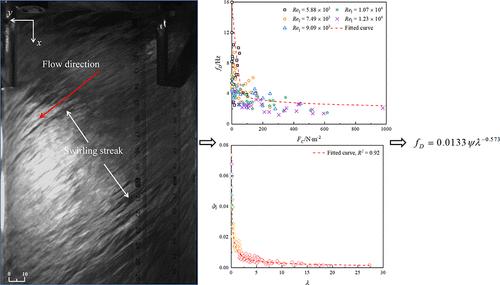
The liquid film interfacial wave characteristics of vertical and swirling flow are experimentally investigated with the ultrasonic Doppler velocimetry and a high-speed camera under a liquid-phase Reynolds number (Rel) of 5.88 × 10³–1.23 × 10⁴, and a correlation for the disturbance wave frequency of swirling flow was developed based on the centrifugal-gravity ratio. The interfacial waves of swirling flow have no apparent periodicity and correlation, similar to the vertical flow. In swirling flow, centrifugal force promotes the accumulation of liquid film mass, reflected in the increase of the substrate liquid film. The circumferential velocity of the swirling flow increases the wall friction stress, reducing the disturbance wave velocity. The superposition of swirling streaks promotes the formation of disturbance waves. Still, the increasing centrifugal force forces the disturbance waves to transfer mass and energy to the ripples, suppressing the formation of disturbance waves. The established correlation for the disturbance wave frequency has a good prediction effect with a mean absolute percentage error of 19.89%.
期刊介绍:
ndustrial & Engineering Chemistry, with variations in title and format, has been published since 1909 by the American Chemical Society. Industrial & Engineering Chemistry Research is a weekly publication that reports industrial and academic research in the broad fields of applied chemistry and chemical engineering with special focus on fundamentals, processes, and products.



 京公网安备 11010802042870号
京ICP备2023020795号-1
京公网安备 11010802042870号
京ICP备2023020795号-1

 分享
分享
 求助内容:
求助内容: 应助结果提醒方式:
 扫码关注我们
