Shu Ji , Haomiao Cheng , Tengyi Zhu , Hanyang Xu , Guanlong Tang , Jian Zhang , Fukan Yang , Haohan Yang
{"title":"Transport mechanisms and fate of neonicotinoids in the soil-water systems under the effects of wetting-drying cycles and rice cultivation","authors":"Shu Ji , Haomiao Cheng , Tengyi Zhu , Hanyang Xu , Guanlong Tang , Jian Zhang , Fukan Yang , Haohan Yang","doi":"10.1016/j.envpol.2025.126181","DOIUrl":null,"url":null,"abstract":"<div><div>Neonicotinoids (NEOs), the most widely used class of insecticides in global agriculture, pose environmental risks due to their persistence and mobility. Despite their extensive application, the transport mechanisms and fate of NEOs in agroecosystem remain unclear. This study investigated the spatial-temporal dynamics mechanisms of six typical NEOs (<em>i.e</em>., clothianidin (CLO), imidacloprid (IMI), acetamiprid (ACE), thiamethoxam (THM), dinotefuran (DIN), and nitenpyram (NIT)) under the effects of different water managements and rice cultivation in soil-water systems. After 61 days incubation, the dissipation in the soil-water systems were the dominated fate of NEOs (accounting for 96.3 ± 3.1 %), followed by storage in soils (2.6 ± 1.2 %), dissolution in interstitial water (0.7 ± 0.5 %) and overlying water (0.1 ± 0.1 %), and leakage in leakage water (0.3 ± 0.3 %). Both wetting-drying cycles and rice cultivation accelerated the NEOs dissipation. The possible reasons for this phenomenon were the wetting-drying cycles and rice cultivation stimulated NEO-degrader (<em>i.e</em>., <em>Pseudomonas</em>) growth in topsoil. Compared to flooding no rice treatment (half-life = 15.5 ± 4.4 days), the severe wetting-drying cycle with rice cultivation reduced NEO half-lives to 10.5 ± 3.1 days. The residual amounts of NEOs in each treatment were negatively (<em>p</em> < 0.05) correlated with the water solubility (CLO > IMI > ACE > THM > DIN > NIT), with the topsoil acting as the primary NEOs sink (41.6 % of total residues). The concentration of NEOs in the water phase decreased by 74.5 % from overlying water to leakage water, which due to the filtering effect of soils. The findings provide a scientific theoretical basis for the further prevention, control, and remediation of NEO pollution in agroecosystem.</div></div>","PeriodicalId":311,"journal":{"name":"Environmental Pollution","volume":"373 ","pages":"Article 126181"},"PeriodicalIF":7.3000,"publicationDate":"2025-04-01","publicationTypes":"Journal Article","fieldsOfStudy":null,"isOpenAccess":false,"openAccessPdf":"","citationCount":"0","resultStr":null,"platform":"Semanticscholar","paperid":null,"PeriodicalName":"Environmental Pollution","FirstCategoryId":"93","ListUrlMain":"https://www.sciencedirect.com/science/article/pii/S0269749125005548","RegionNum":2,"RegionCategory":"环境科学与生态学","ArticlePicture":[],"TitleCN":null,"AbstractTextCN":null,"PMCID":null,"EPubDate":"","PubModel":"","JCR":"Q1","JCRName":"ENVIRONMENTAL SCIENCES","Score":null,"Total":0}
引用次数: 0
Abstract
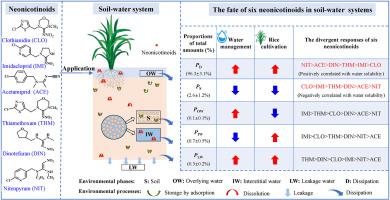
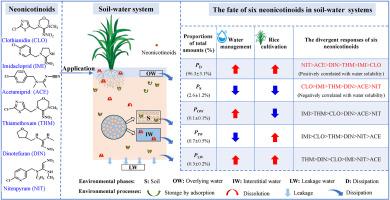
Neonicotinoids (NEOs), the most widely used class of insecticides in global agriculture, pose environmental risks due to their persistence and mobility. Despite their extensive application, the transport mechanisms and fate of NEOs in agroecosystem remain unclear. This study investigated the spatial-temporal dynamics mechanisms of six typical NEOs (i.e., clothianidin (CLO), imidacloprid (IMI), acetamiprid (ACE), thiamethoxam (THM), dinotefuran (DIN), and nitenpyram (NIT)) under the effects of different water managements and rice cultivation in soil-water systems. After 61 days incubation, the dissipation in the soil-water systems were the dominated fate of NEOs (accounting for 96.3 ± 3.1 %), followed by storage in soils (2.6 ± 1.2 %), dissolution in interstitial water (0.7 ± 0.5 %) and overlying water (0.1 ± 0.1 %), and leakage in leakage water (0.3 ± 0.3 %). Both wetting-drying cycles and rice cultivation accelerated the NEOs dissipation. The possible reasons for this phenomenon were the wetting-drying cycles and rice cultivation stimulated NEO-degrader (i.e., Pseudomonas) growth in topsoil. Compared to flooding no rice treatment (half-life = 15.5 ± 4.4 days), the severe wetting-drying cycle with rice cultivation reduced NEO half-lives to 10.5 ± 3.1 days. The residual amounts of NEOs in each treatment were negatively (p < 0.05) correlated with the water solubility (CLO > IMI > ACE > THM > DIN > NIT), with the topsoil acting as the primary NEOs sink (41.6 % of total residues). The concentration of NEOs in the water phase decreased by 74.5 % from overlying water to leakage water, which due to the filtering effect of soils. The findings provide a scientific theoretical basis for the further prevention, control, and remediation of NEO pollution in agroecosystem.
期刊介绍:
Environmental Pollution is an international peer-reviewed journal that publishes high-quality research papers and review articles covering all aspects of environmental pollution and its impacts on ecosystems and human health.
Subject areas include, but are not limited to:
• Sources and occurrences of pollutants that are clearly defined and measured in environmental compartments, food and food-related items, and human bodies;
• Interlinks between contaminant exposure and biological, ecological, and human health effects, including those of climate change;
• Contaminants of emerging concerns (including but not limited to antibiotic resistant microorganisms or genes, microplastics/nanoplastics, electronic wastes, light, and noise) and/or their biological, ecological, or human health effects;
• Laboratory and field studies on the remediation/mitigation of environmental pollution via new techniques and with clear links to biological, ecological, or human health effects;
• Modeling of pollution processes, patterns, or trends that is of clear environmental and/or human health interest;
• New techniques that measure and examine environmental occurrences, transport, behavior, and effects of pollutants within the environment or the laboratory, provided that they can be clearly used to address problems within regional or global environmental compartments.



 京公网安备 11010802042870号
京ICP备2023020795号-1
京公网安备 11010802042870号
京ICP备2023020795号-1

 分享
分享
 求助内容:
求助内容: 应助结果提醒方式:
 扫码关注我们
