Hanjun Kim, Sarah M. Kang, Angeline G. Pendergrass, Flavio Lehner, Yechul Shin, Paulo Ceppi, Sang-Wook Yeh, Se-Yong Song
{"title":"Higher precipitation in East Asia and western United States expected with future Southern Ocean warming","authors":"Hanjun Kim, Sarah M. Kang, Angeline G. Pendergrass, Flavio Lehner, Yechul Shin, Paulo Ceppi, Sang-Wook Yeh, Se-Yong Song","doi":"10.1038/s41561-025-01669-5","DOIUrl":null,"url":null,"abstract":"Precipitation over East Asia and the western United States is projected to increase as a result of global warming, although substantial uncertainties persist regarding the magnitude. A key factor driving these uncertainties is the tropical surface warming pattern, yet the mechanisms behind both this warming pattern and the resulting regional precipitation changes remain elusive. Here we use a set of climate model experiments to argue that these changes are partly driven by global teleconnection from the Southern Ocean, which rapidly absorbs anthropogenic heat but releases it with a delay of decades to a century. We show that the delayed Southern Ocean warming contributes to broad tropical ocean warming with an El Niño-like pattern, enhancing precipitation during summer in East Asia and winter in the western United States. The atmospheric teleconnections from the tropical ocean link the Southern Ocean warming to the Northern Hemisphere regional wetting. Southern Hemisphere low clouds are a key regulator of this teleconnection, partly explaining the projected uncertainty of regional precipitation. The documented teleconnection has practical implications: even if climate mitigation reduces carbon dioxide levels, the delayed Southern Ocean warming will sustain a wetter East Asia and western United States for decades to centuries. Anthropogenic climate change leads to higher precipitation in East Asia and western United States due to a teleconnection associated to delayed warming in the Southern Ocean.","PeriodicalId":19053,"journal":{"name":"Nature Geoscience","volume":"18 4","pages":"313-321"},"PeriodicalIF":16.1000,"publicationDate":"2025-04-02","publicationTypes":"Journal Article","fieldsOfStudy":null,"isOpenAccess":false,"openAccessPdf":"https://www.nature.comhttps://www.nature.com/articles/s41561-025-01669-5.pdf","citationCount":"0","resultStr":null,"platform":"Semanticscholar","paperid":null,"PeriodicalName":"Nature Geoscience","FirstCategoryId":"89","ListUrlMain":"https://www.nature.com/articles/s41561-025-01669-5","RegionNum":1,"RegionCategory":"地球科学","ArticlePicture":[],"TitleCN":null,"AbstractTextCN":null,"PMCID":null,"EPubDate":"","PubModel":"","JCR":"Q1","JCRName":"GEOSCIENCES, MULTIDISCIPLINARY","Score":null,"Total":0}
引用次数: 0
Abstract
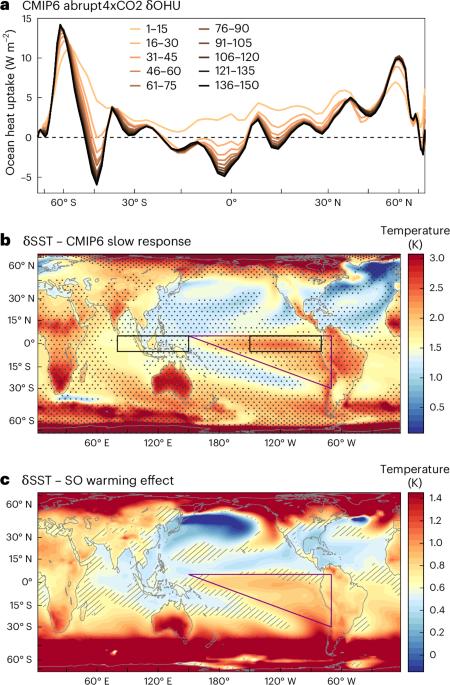
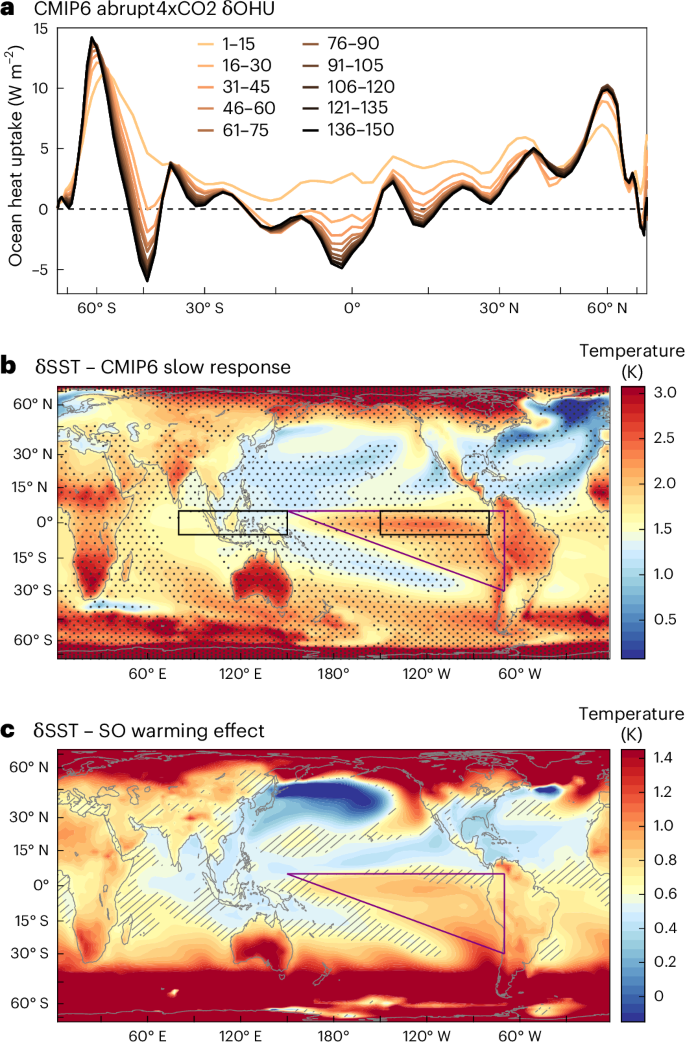
Precipitation over East Asia and the western United States is projected to increase as a result of global warming, although substantial uncertainties persist regarding the magnitude. A key factor driving these uncertainties is the tropical surface warming pattern, yet the mechanisms behind both this warming pattern and the resulting regional precipitation changes remain elusive. Here we use a set of climate model experiments to argue that these changes are partly driven by global teleconnection from the Southern Ocean, which rapidly absorbs anthropogenic heat but releases it with a delay of decades to a century. We show that the delayed Southern Ocean warming contributes to broad tropical ocean warming with an El Niño-like pattern, enhancing precipitation during summer in East Asia and winter in the western United States. The atmospheric teleconnections from the tropical ocean link the Southern Ocean warming to the Northern Hemisphere regional wetting. Southern Hemisphere low clouds are a key regulator of this teleconnection, partly explaining the projected uncertainty of regional precipitation. The documented teleconnection has practical implications: even if climate mitigation reduces carbon dioxide levels, the delayed Southern Ocean warming will sustain a wetter East Asia and western United States for decades to centuries. Anthropogenic climate change leads to higher precipitation in East Asia and western United States due to a teleconnection associated to delayed warming in the Southern Ocean.
期刊介绍:
Nature Geoscience is a monthly interdisciplinary journal that gathers top-tier research spanning Earth Sciences and related fields.
The journal covers all geoscience disciplines, including fieldwork, modeling, and theoretical studies.
Topics include atmospheric science, biogeochemistry, climate science, geobiology, geochemistry, geoinformatics, remote sensing, geology, geomagnetism, paleomagnetism, geomorphology, geophysics, glaciology, hydrology, limnology, mineralogy, oceanography, paleontology, paleoclimatology, paleoceanography, petrology, planetary science, seismology, space physics, tectonics, and volcanology.
Nature Geoscience upholds its commitment to publishing significant, high-quality Earth Sciences research through fair, rapid, and rigorous peer review, overseen by a team of full-time professional editors.



 京公网安备 11010802042870号
京ICP备2023020795号-1
京公网安备 11010802042870号
京ICP备2023020795号-1

 分享
分享
 求助内容:
求助内容: 应助结果提醒方式:
 扫码关注我们
