Qianqian Yang, Xiangyi Hou, Feng Lu, Dahai Zhang, Wentao Lin, Nick Schlensky, Zhixiang Chen, Yan Zhang and Xuzhi Zhang
{"title":"Evidently diverse effects of silver nanoparticles on Vibrio parahaemolyticus across different estuarine water samples†","authors":"Qianqian Yang, Xiangyi Hou, Feng Lu, Dahai Zhang, Wentao Lin, Nick Schlensky, Zhixiang Chen, Yan Zhang and Xuzhi Zhang","doi":"10.1039/D5EN00018A","DOIUrl":null,"url":null,"abstract":"<p >Potential threats that silver nanoparticles (Ag NPs) pose to bacterial communities in estuarine environments have become a subject of intensifying global interest. Herein, eight water samples were collected from various estuarine sites. They were characterized by a wide array of distinct physicochemical properties, including pH, salinity, conductivity, turbidity, chemical oxygen demand (COD) and total suspended solids (TSS). <em>Vibrio parahaemolyticus</em> (<em>V. parahaemolyticus</em>) were exposed to Ag NPs at a series of concentrations in these water samples. Subsequently, the growth curves of the surviving bacterial cells were measured using an electronic microbial growth analyzer to determine the minimum inhibitory concentrations (MICs) of Ag NPs against <em>V. parahaemolyticus</em>. The results revealed a remarkable variation in the MICs, with values ranging from 12.0 mg L<small><sup>−1</sup></small> to >48.0 mg L<small><sup>−1</sup></small>. A comprehensive analysis indicated that there were no clear and definitive relationships between the MIC and individual physicochemical parameters such as pH, salinity, conductivity, turbidity, COD and TSS. Instead, the adverse effect of Ag NPs on <em>V. parahaemolyticus</em> depended on the combination of these factors. In contrast, the MIC of Ag NPs against <em>V. parahaemolyticus</em> in physiological saline, a commonly used simple laboratory medium, was determined to be 6.0 mg L<small><sup>−1</sup></small>, which was significantly lower compared to those observed in the estuarine water samples. Therefore, when assessing the ecotoxicity of Ag NPs in actual estuarine scenarios, it is essential to rely on the antimicrobial data collected directly from realistic environmental matrices, rather than relying on data obtained from simple laboratory media or so-called representative water samples.</p>","PeriodicalId":73,"journal":{"name":"Environmental Science: Nano","volume":" 5","pages":" 2657-2666"},"PeriodicalIF":5.1000,"publicationDate":"2025-04-02","publicationTypes":"Journal Article","fieldsOfStudy":null,"isOpenAccess":false,"openAccessPdf":"","citationCount":"0","resultStr":null,"platform":"Semanticscholar","paperid":null,"PeriodicalName":"Environmental Science: Nano","FirstCategoryId":"6","ListUrlMain":"https://pubs.rsc.org/en/content/articlelanding/2025/en/d5en00018a","RegionNum":2,"RegionCategory":"环境科学与生态学","ArticlePicture":[],"TitleCN":null,"AbstractTextCN":null,"PMCID":null,"EPubDate":"","PubModel":"","JCR":"Q1","JCRName":"CHEMISTRY, MULTIDISCIPLINARY","Score":null,"Total":0}
引用次数: 0
Abstract
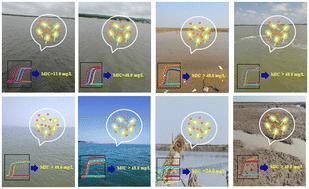
Potential threats that silver nanoparticles (Ag NPs) pose to bacterial communities in estuarine environments have become a subject of intensifying global interest. Herein, eight water samples were collected from various estuarine sites. They were characterized by a wide array of distinct physicochemical properties, including pH, salinity, conductivity, turbidity, chemical oxygen demand (COD) and total suspended solids (TSS). Vibrio parahaemolyticus (V. parahaemolyticus) were exposed to Ag NPs at a series of concentrations in these water samples. Subsequently, the growth curves of the surviving bacterial cells were measured using an electronic microbial growth analyzer to determine the minimum inhibitory concentrations (MICs) of Ag NPs against V. parahaemolyticus. The results revealed a remarkable variation in the MICs, with values ranging from 12.0 mg L−1 to >48.0 mg L−1. A comprehensive analysis indicated that there were no clear and definitive relationships between the MIC and individual physicochemical parameters such as pH, salinity, conductivity, turbidity, COD and TSS. Instead, the adverse effect of Ag NPs on V. parahaemolyticus depended on the combination of these factors. In contrast, the MIC of Ag NPs against V. parahaemolyticus in physiological saline, a commonly used simple laboratory medium, was determined to be 6.0 mg L−1, which was significantly lower compared to those observed in the estuarine water samples. Therefore, when assessing the ecotoxicity of Ag NPs in actual estuarine scenarios, it is essential to rely on the antimicrobial data collected directly from realistic environmental matrices, rather than relying on data obtained from simple laboratory media or so-called representative water samples.
期刊介绍:
Environmental Science: Nano serves as a comprehensive and high-impact peer-reviewed source of information on the design and demonstration of engineered nanomaterials for environment-based applications. It also covers the interactions between engineered, natural, and incidental nanomaterials with biological and environmental systems. This scope includes, but is not limited to, the following topic areas:
Novel nanomaterial-based applications for water, air, soil, food, and energy sustainability
Nanomaterial interactions with biological systems and nanotoxicology
Environmental fate, reactivity, and transformations of nanoscale materials
Nanoscale processes in the environment
Sustainable nanotechnology including rational nanomaterial design, life cycle assessment, risk/benefit analysis



 京公网安备 11010802042870号
京ICP备2023020795号-1
京公网安备 11010802042870号
京ICP备2023020795号-1

 分享
分享
 求助内容:
求助内容: 应助结果提醒方式:
 扫码关注我们
