{"title":"Thermal history influences the recovery of phototrophic biofilms exposed to agricultural run-off in intermittent rivers","authors":"Camille Courcoul, Joséphine Leflaive, Anne-Sophie Benoiston, Jessica Ferriol, Stéphanie Boulêtreau","doi":"10.1016/j.watres.2025.123580","DOIUrl":null,"url":null,"abstract":"<div><div>The response of microbial communities to disturbances may be controlled by the past environmental conditions, through their legacy effect. In intermittent rivers, the fixed microorganisms, such as phototrophic biofilms, are exposed to variable environmental conditions, including changes in water chemistry, hydrodynamics and, in some cases water temperature. The latter may be particularly affected by the increasing frequency of summer heat waves. Our objective was therefore to assess the legacy effect of warming on phototrophic biofilms during a flow intermittency sequence. Our main hypotheses were that the thermal history of biofilms determines (i) the community trajectory after rewetting and (ii) its resistance and resilience to a new disturbance.</div><div>To test these hypotheses, we exposed phototrophic biofilms grown in the lab to a flow intermittency sequence (1 week no flow / 12 weeks no water) at two contrasted temperatures (22 °C and 32 °C). After rewetting (22 °C), some of the biofilms were exposed for 1 week to a new disturbance, i.e. a contaminant mimicking agricultural run-off (nitrate, copper, insecticide, herbicide, fungicide). The structure (pigments, elementary composition, extracellular polymeric substances, prokaryotic composition) and functioning (respiration, photosynthesis, functional diversity) of the biofilms were measured at the end of the contamination, and after 1 and 3 weeks of recovery without contaminant.</div><div>Our results unexpectedly show that one week after rewetting the “warmed” biofilms were less heterotrophic than the “non-warmed” biofilms. This effect was transitory, although the prokaryotic composition of the biofilms still diverged 4 weeks after rewetting. The legacy effect of warming was an increased sensitivity of the biofilms to the complex contaminant, especially at the highest concentrations. This legacy effect decreased with time for the general structure and functioning of the biofilms, but persisted for the prokaryotic composition. These findings highlight the importance of historical conditions, and particularly thermal history, in the ability of microbial communities to respond to disturbances.</div></div>","PeriodicalId":443,"journal":{"name":"Water Research","volume":"281 ","pages":"Article 123580"},"PeriodicalIF":12.4000,"publicationDate":"2025-08-01","publicationTypes":"Journal Article","fieldsOfStudy":null,"isOpenAccess":false,"openAccessPdf":"","citationCount":"0","resultStr":null,"platform":"Semanticscholar","paperid":null,"PeriodicalName":"Water Research","FirstCategoryId":"93","ListUrlMain":"https://www.sciencedirect.com/science/article/pii/S0043135425004932","RegionNum":1,"RegionCategory":"环境科学与生态学","ArticlePicture":[],"TitleCN":null,"AbstractTextCN":null,"PMCID":null,"EPubDate":"2025/4/1 0:00:00","PubModel":"Epub","JCR":"Q1","JCRName":"ENGINEERING, ENVIRONMENTAL","Score":null,"Total":0}
引用次数: 0
Abstract
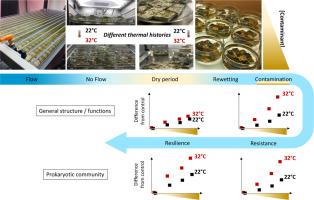
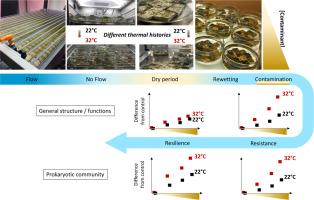
The response of microbial communities to disturbances may be controlled by the past environmental conditions, through their legacy effect. In intermittent rivers, the fixed microorganisms, such as phototrophic biofilms, are exposed to variable environmental conditions, including changes in water chemistry, hydrodynamics and, in some cases water temperature. The latter may be particularly affected by the increasing frequency of summer heat waves. Our objective was therefore to assess the legacy effect of warming on phototrophic biofilms during a flow intermittency sequence. Our main hypotheses were that the thermal history of biofilms determines (i) the community trajectory after rewetting and (ii) its resistance and resilience to a new disturbance.
To test these hypotheses, we exposed phototrophic biofilms grown in the lab to a flow intermittency sequence (1 week no flow / 12 weeks no water) at two contrasted temperatures (22 °C and 32 °C). After rewetting (22 °C), some of the biofilms were exposed for 1 week to a new disturbance, i.e. a contaminant mimicking agricultural run-off (nitrate, copper, insecticide, herbicide, fungicide). The structure (pigments, elementary composition, extracellular polymeric substances, prokaryotic composition) and functioning (respiration, photosynthesis, functional diversity) of the biofilms were measured at the end of the contamination, and after 1 and 3 weeks of recovery without contaminant.
Our results unexpectedly show that one week after rewetting the “warmed” biofilms were less heterotrophic than the “non-warmed” biofilms. This effect was transitory, although the prokaryotic composition of the biofilms still diverged 4 weeks after rewetting. The legacy effect of warming was an increased sensitivity of the biofilms to the complex contaminant, especially at the highest concentrations. This legacy effect decreased with time for the general structure and functioning of the biofilms, but persisted for the prokaryotic composition. These findings highlight the importance of historical conditions, and particularly thermal history, in the ability of microbial communities to respond to disturbances.
期刊介绍:
Water Research, along with its open access companion journal Water Research X, serves as a platform for publishing original research papers covering various aspects of the science and technology related to the anthropogenic water cycle, water quality, and its management worldwide. The audience targeted by the journal comprises biologists, chemical engineers, chemists, civil engineers, environmental engineers, limnologists, and microbiologists. The scope of the journal include:
•Treatment processes for water and wastewaters (municipal, agricultural, industrial, and on-site treatment), including resource recovery and residuals management;
•Urban hydrology including sewer systems, stormwater management, and green infrastructure;
•Drinking water treatment and distribution;
•Potable and non-potable water reuse;
•Sanitation, public health, and risk assessment;
•Anaerobic digestion, solid and hazardous waste management, including source characterization and the effects and control of leachates and gaseous emissions;
•Contaminants (chemical, microbial, anthropogenic particles such as nanoparticles or microplastics) and related water quality sensing, monitoring, fate, and assessment;
•Anthropogenic impacts on inland, tidal, coastal and urban waters, focusing on surface and ground waters, and point and non-point sources of pollution;
•Environmental restoration, linked to surface water, groundwater and groundwater remediation;
•Analysis of the interfaces between sediments and water, and between water and atmosphere, focusing specifically on anthropogenic impacts;
•Mathematical modelling, systems analysis, machine learning, and beneficial use of big data related to the anthropogenic water cycle;
•Socio-economic, policy, and regulations studies.



 京公网安备 11010802042870号
京ICP备2023020795号-1
京公网安备 11010802042870号
京ICP备2023020795号-1

 分享
分享
 求助内容:
求助内容: 应助结果提醒方式:
 扫码关注我们
