Phenotypic discrimination and characterization of microbial populations in enhanced biological phosphorus removal using single-cell raman spectroscopy-based methods
Jiayu Bi , Ricardo Marques , Dongqi Wang , Lu Qin , Kylie Close , Guangyu Li , Zijian Leo Wang , Nicholas B. Tooker , Varun Srinivasan , Annalisa Onnis-Hayden , Adrian Oehmen , April Z. Gu
{"title":"Phenotypic discrimination and characterization of microbial populations in enhanced biological phosphorus removal using single-cell raman spectroscopy-based methods","authors":"Jiayu Bi , Ricardo Marques , Dongqi Wang , Lu Qin , Kylie Close , Guangyu Li , Zijian Leo Wang , Nicholas B. Tooker , Varun Srinivasan , Annalisa Onnis-Hayden , Adrian Oehmen , April Z. Gu","doi":"10.1016/j.watres.2025.123577","DOIUrl":null,"url":null,"abstract":"<div><div>Single-cell Raman spectroscopy (SCRS) represents a non-invasive, expedient, and label-free strategy for investigating the molecular composition of individual cells. In this study, we applied SCRS to perform qualitative and quantitative analyses of polyphosphate (polyP) accumulating organisms (PAOs) and glycogen accumulating organisms (GAOs) within enhanced biological phosphorus removal (EBPR) systems, enabling their metabolic trait-based profiling and phenotypic classification. SCRS analysis revealed diverse metabolic profiles of metabolically active EBPR populations including unknown GAOs and PAOs performing GAO metabolism. The dynamics of intracellular polymers quantified by SCRS were highly correlated with bulk measurements, while also providing additional metabolic information. SCRS analysis, combined with carbon feeding batch tests and hierarchical clustering analysis (HCA), could phenotypically classify clade-level PAO/GAO subpopulations with distinct carbon metabolisms and Raman spectral features (e.g., shift in signature peak, whole fingerprint region). The combination of fluorescence <em>in situ</em> hybridization (FISH) with Raman (FISH–Raman) and HCA, for the first time, revealed higher phenotypic microdiversity for <em>Tetrasphaera</em> and substantial differences in polyP peak position between <em>Tetrasphaera</em> and <em>Accumulibacter</em> cells. <em>Tetrasphaera</em> PG1, characterized by high polyP content and potentially belonging to members of clade 2 or 3, was identified as a primary contributor in a side-stream EBPR system. These findings offer novel insights into the metabolic processes and growth dynamics of microorganisms within EBPR systems, providing a critical tool for deciphering the microdiversity and metabolic behaviors of PAO/GAO populations in complex EBPR communities.</div></div>","PeriodicalId":443,"journal":{"name":"Water Research","volume":"281 ","pages":"Article 123577"},"PeriodicalIF":12.4000,"publicationDate":"2025-08-01","publicationTypes":"Journal Article","fieldsOfStudy":null,"isOpenAccess":false,"openAccessPdf":"","citationCount":"0","resultStr":null,"platform":"Semanticscholar","paperid":null,"PeriodicalName":"Water Research","FirstCategoryId":"93","ListUrlMain":"https://www.sciencedirect.com/science/article/pii/S0043135425004907","RegionNum":1,"RegionCategory":"环境科学与生态学","ArticlePicture":[],"TitleCN":null,"AbstractTextCN":null,"PMCID":null,"EPubDate":"2025/4/2 0:00:00","PubModel":"Epub","JCR":"Q1","JCRName":"ENGINEERING, ENVIRONMENTAL","Score":null,"Total":0}
引用次数: 0
Abstract
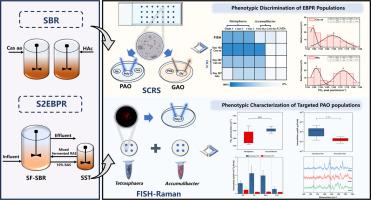
Single-cell Raman spectroscopy (SCRS) represents a non-invasive, expedient, and label-free strategy for investigating the molecular composition of individual cells. In this study, we applied SCRS to perform qualitative and quantitative analyses of polyphosphate (polyP) accumulating organisms (PAOs) and glycogen accumulating organisms (GAOs) within enhanced biological phosphorus removal (EBPR) systems, enabling their metabolic trait-based profiling and phenotypic classification. SCRS analysis revealed diverse metabolic profiles of metabolically active EBPR populations including unknown GAOs and PAOs performing GAO metabolism. The dynamics of intracellular polymers quantified by SCRS were highly correlated with bulk measurements, while also providing additional metabolic information. SCRS analysis, combined with carbon feeding batch tests and hierarchical clustering analysis (HCA), could phenotypically classify clade-level PAO/GAO subpopulations with distinct carbon metabolisms and Raman spectral features (e.g., shift in signature peak, whole fingerprint region). The combination of fluorescence in situ hybridization (FISH) with Raman (FISH–Raman) and HCA, for the first time, revealed higher phenotypic microdiversity for Tetrasphaera and substantial differences in polyP peak position between Tetrasphaera and Accumulibacter cells. Tetrasphaera PG1, characterized by high polyP content and potentially belonging to members of clade 2 or 3, was identified as a primary contributor in a side-stream EBPR system. These findings offer novel insights into the metabolic processes and growth dynamics of microorganisms within EBPR systems, providing a critical tool for deciphering the microdiversity and metabolic behaviors of PAO/GAO populations in complex EBPR communities.
期刊介绍:
Water Research, along with its open access companion journal Water Research X, serves as a platform for publishing original research papers covering various aspects of the science and technology related to the anthropogenic water cycle, water quality, and its management worldwide. The audience targeted by the journal comprises biologists, chemical engineers, chemists, civil engineers, environmental engineers, limnologists, and microbiologists. The scope of the journal include:
•Treatment processes for water and wastewaters (municipal, agricultural, industrial, and on-site treatment), including resource recovery and residuals management;
•Urban hydrology including sewer systems, stormwater management, and green infrastructure;
•Drinking water treatment and distribution;
•Potable and non-potable water reuse;
•Sanitation, public health, and risk assessment;
•Anaerobic digestion, solid and hazardous waste management, including source characterization and the effects and control of leachates and gaseous emissions;
•Contaminants (chemical, microbial, anthropogenic particles such as nanoparticles or microplastics) and related water quality sensing, monitoring, fate, and assessment;
•Anthropogenic impacts on inland, tidal, coastal and urban waters, focusing on surface and ground waters, and point and non-point sources of pollution;
•Environmental restoration, linked to surface water, groundwater and groundwater remediation;
•Analysis of the interfaces between sediments and water, and between water and atmosphere, focusing specifically on anthropogenic impacts;
•Mathematical modelling, systems analysis, machine learning, and beneficial use of big data related to the anthropogenic water cycle;
•Socio-economic, policy, and regulations studies.




 京公网安备 11010802042870号
京ICP备2023020795号-1
京公网安备 11010802042870号
京ICP备2023020795号-1

 分享
分享
 求助内容:
求助内容: 应助结果提醒方式:
 扫码关注我们
