{"title":"Polyurethane synthesis revisited: Effect of solvent, stoichiometry, and temperature on the reaction of MDI with polyether glycols","authors":"Armen Yildirim, Emel Yilgor, Iskender Yilgor","doi":"10.1016/j.polymer.2025.128340","DOIUrl":null,"url":null,"abstract":"<div><div>Thermoplastic polyurethanes (TPU) are one of the most widely investigated polymeric systems due to their interesting structure-morphology-property behavior. They also find broad range of applications in various fields. Global TPU market is projected to grow about 7.3 % annually from $2.30 billion in 2021 to $3.80 billion in 2028. 4,4′-Diphenylmethane diisocyanate (MDI) is the most widely used diisocyanate for the preparation of TPUs both in academia and industry. When TPU synthesis is carried out in solution, a polar aprotic solvent is necessary to obtain high molecular weight polymers. Most preferred solvents for TPU synthesis are high boiling, polar, aprotic solvents, such as dimethylacetamide (DMAC), dimethylformamide (DMF), dimethyl sulfoxide (DMSO) and N-methyl pyrrolidone (NMP). When MDI is used as the diisocyanate, depending on the solvent used and reaction temperature, extensive side reactions may be observed, which consume excess diisocyanate and affect reaction stoichiometry. Side reactions also strongly influence TPU structure, topology, microphase morphology, and properties. In this study influence of the solvent, initial [NCO]/[OH] stoichiometry and reaction temperature on the rate of isocyanate consumption and kinetics of the reactions between MDI and poly(tetramethylene oxide) glycol (PTMO) were investigated. Catalytic effect of DMF even at reactions conducted at room temperature were observed, resulting in significant excess MDI consumption due to extensive side reactions. During prepolymer formation in [MDI]/[PTMO] = 2.0 system at 50 °C, side reactions were minimized or eliminated by using THF/DMF or toluene/DMF (90/10 by volume) solvent mixtures.</div></div>","PeriodicalId":405,"journal":{"name":"Polymer","volume":"326 ","pages":"Article 128340"},"PeriodicalIF":4.5000,"publicationDate":"2025-05-09","publicationTypes":"Journal Article","fieldsOfStudy":null,"isOpenAccess":false,"openAccessPdf":"","citationCount":"0","resultStr":null,"platform":"Semanticscholar","paperid":null,"PeriodicalName":"Polymer","FirstCategoryId":"92","ListUrlMain":"https://www.sciencedirect.com/science/article/pii/S003238612500326X","RegionNum":2,"RegionCategory":"化学","ArticlePicture":[],"TitleCN":null,"AbstractTextCN":null,"PMCID":null,"EPubDate":"2025/4/1 0:00:00","PubModel":"Epub","JCR":"Q2","JCRName":"POLYMER SCIENCE","Score":null,"Total":0}
引用次数: 0
Abstract
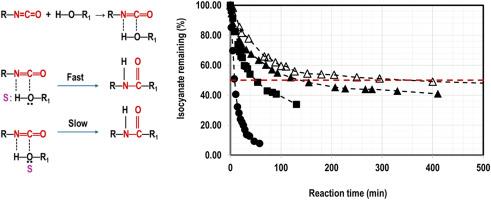
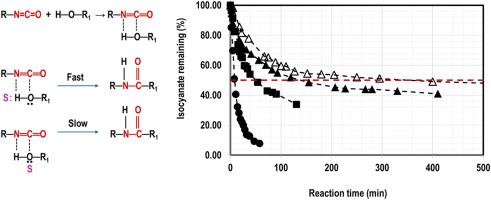
Thermoplastic polyurethanes (TPU) are one of the most widely investigated polymeric systems due to their interesting structure-morphology-property behavior. They also find broad range of applications in various fields. Global TPU market is projected to grow about 7.3 % annually from $2.30 billion in 2021 to $3.80 billion in 2028. 4,4′-Diphenylmethane diisocyanate (MDI) is the most widely used diisocyanate for the preparation of TPUs both in academia and industry. When TPU synthesis is carried out in solution, a polar aprotic solvent is necessary to obtain high molecular weight polymers. Most preferred solvents for TPU synthesis are high boiling, polar, aprotic solvents, such as dimethylacetamide (DMAC), dimethylformamide (DMF), dimethyl sulfoxide (DMSO) and N-methyl pyrrolidone (NMP). When MDI is used as the diisocyanate, depending on the solvent used and reaction temperature, extensive side reactions may be observed, which consume excess diisocyanate and affect reaction stoichiometry. Side reactions also strongly influence TPU structure, topology, microphase morphology, and properties. In this study influence of the solvent, initial [NCO]/[OH] stoichiometry and reaction temperature on the rate of isocyanate consumption and kinetics of the reactions between MDI and poly(tetramethylene oxide) glycol (PTMO) were investigated. Catalytic effect of DMF even at reactions conducted at room temperature were observed, resulting in significant excess MDI consumption due to extensive side reactions. During prepolymer formation in [MDI]/[PTMO] = 2.0 system at 50 °C, side reactions were minimized or eliminated by using THF/DMF or toluene/DMF (90/10 by volume) solvent mixtures.
期刊介绍:
Polymer is an interdisciplinary journal dedicated to publishing innovative and significant advances in Polymer Physics, Chemistry and Technology. We welcome submissions on polymer hybrids, nanocomposites, characterisation and self-assembly. Polymer also publishes work on the technological application of polymers in energy and optoelectronics.
The main scope is covered but not limited to the following core areas:
Polymer Materials
Nanocomposites and hybrid nanomaterials
Polymer blends, films, fibres, networks and porous materials
Physical Characterization
Characterisation, modelling and simulation* of molecular and materials properties in bulk, solution, and thin films
Polymer Engineering
Advanced multiscale processing methods
Polymer Synthesis, Modification and Self-assembly
Including designer polymer architectures, mechanisms and kinetics, and supramolecular polymerization
Technological Applications
Polymers for energy generation and storage
Polymer membranes for separation technology
Polymers for opto- and microelectronics.



 京公网安备 11010802042870号
京ICP备2023020795号-1
京公网安备 11010802042870号
京ICP备2023020795号-1

 分享
分享
 求助内容:
求助内容: 应助结果提醒方式:
 扫码关注我们
