Huijuan Chen, Li Lv, Kaifeng Xue, Pinhua Zhang, Lulu Du, Guangliang Cui
{"title":"Oral Exhalation H2S Sensor Based on Cu2O/ZnO Heterostructures","authors":"Huijuan Chen, Li Lv, Kaifeng Xue, Pinhua Zhang, Lulu Du, Guangliang Cui","doi":"10.1021/acssensors.4c02989","DOIUrl":null,"url":null,"abstract":"Developing a portable and compact sensor for room temperature detection of H<sub>2</sub>S in exhaled breath for health assessment presents considerable technical challenges. This work successfully synthesized Cu<sub>2</sub>O/ZnO heterostructures with excellent gas sensitivity to H<sub>2</sub>S at room and lower temperatures using a two-dimensional (2D) electrodeposition in situ assembly method with the application of a semisine wave voltage as well as CuZnO nanoarrays deposited under direct current voltage. The Cu<sub>2</sub>O/ZnO heterostructure sensors, with high response of 8.53 × 10<sup>4</sup> to 1 ppm of H<sub>2</sub>S and a minimum detection limit of 10 ppb at room temperature, exhibit a response of 42 for 10 ppm of H<sub>2</sub>S even at −20 °C, and its response to 50 ppm of H<sub>2</sub>S is approximately 3774 times greater than that of the CuZnO sensor, which is a significant challenge to achieve with sensors based on oxygen adsorption/desorption mechanisms. These outstanding gas-sensing properties are attributed to the formation of p–n heterojunctions in the Cu<sub>2</sub>O/ZnO heterostructures and the occurrence of the sulfuration reaction. In addition, we successfully employed the Cu<sub>2</sub>O/ZnO sensor to detect H<sub>2</sub>S in human exhaled breath, offering valuable insights for the monitoring of various chronic diseases and new directions for the development of portable room-temperature breath sensors.","PeriodicalId":24,"journal":{"name":"ACS Sensors","volume":"58 1","pages":""},"PeriodicalIF":9.1000,"publicationDate":"2025-04-02","publicationTypes":"Journal Article","fieldsOfStudy":null,"isOpenAccess":false,"openAccessPdf":"","citationCount":"0","resultStr":null,"platform":"Semanticscholar","paperid":null,"PeriodicalName":"ACS Sensors","FirstCategoryId":"92","ListUrlMain":"https://doi.org/10.1021/acssensors.4c02989","RegionNum":1,"RegionCategory":"化学","ArticlePicture":[],"TitleCN":null,"AbstractTextCN":null,"PMCID":null,"EPubDate":"","PubModel":"","JCR":"Q1","JCRName":"CHEMISTRY, ANALYTICAL","Score":null,"Total":0}
引用次数: 0
Abstract
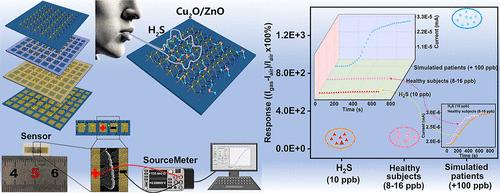
Developing a portable and compact sensor for room temperature detection of H2S in exhaled breath for health assessment presents considerable technical challenges. This work successfully synthesized Cu2O/ZnO heterostructures with excellent gas sensitivity to H2S at room and lower temperatures using a two-dimensional (2D) electrodeposition in situ assembly method with the application of a semisine wave voltage as well as CuZnO nanoarrays deposited under direct current voltage. The Cu2O/ZnO heterostructure sensors, with high response of 8.53 × 10⁴ to 1 ppm of H2S and a minimum detection limit of 10 ppb at room temperature, exhibit a response of 42 for 10 ppm of H2S even at −20 °C, and its response to 50 ppm of H2S is approximately 3774 times greater than that of the CuZnO sensor, which is a significant challenge to achieve with sensors based on oxygen adsorption/desorption mechanisms. These outstanding gas-sensing properties are attributed to the formation of p–n heterojunctions in the Cu2O/ZnO heterostructures and the occurrence of the sulfuration reaction. In addition, we successfully employed the Cu2O/ZnO sensor to detect H2S in human exhaled breath, offering valuable insights for the monitoring of various chronic diseases and new directions for the development of portable room-temperature breath sensors.
期刊介绍:
ACS Sensors is a peer-reviewed research journal that focuses on the dissemination of new and original knowledge in the field of sensor science, particularly those that selectively sense chemical or biological species or processes. The journal covers a broad range of topics, including but not limited to biosensors, chemical sensors, gas sensors, intracellular sensors, single molecule sensors, cell chips, and microfluidic devices. It aims to publish articles that address conceptual advances in sensing technology applicable to various types of analytes or application papers that report on the use of existing sensing concepts in new ways or for new analytes.




 京公网安备 11010802042870号
京ICP备2023020795号-1
京公网安备 11010802042870号
京ICP备2023020795号-1

 分享
分享
 求助内容:
求助内容: 应助结果提醒方式:
 扫码关注我们
