Genetic Encoding of Fluorinated Analogues of Phenylalanine for 19F NMR Spectroscopy: Detection of Conformational Heterogeneity in Flaviviral NS2B-NS3 Proteases
Haocheng Qianzhu, Yi Jiun Tan, Elwy H. Abdelkader, Thomas Huber, Gottfried Otting
{"title":"Genetic Encoding of Fluorinated Analogues of Phenylalanine for 19F NMR Spectroscopy: Detection of Conformational Heterogeneity in Flaviviral NS2B-NS3 Proteases","authors":"Haocheng Qianzhu, Yi Jiun Tan, Elwy H. Abdelkader, Thomas Huber, Gottfried Otting","doi":"10.1021/acssensors.5c00432","DOIUrl":null,"url":null,"abstract":"Substituting a single hydrogen atom in a protein by fluorine provides a probe for site-specific sensing by <sup>19</sup>F nuclear magnetic resonance (NMR) spectroscopy with minimal impact on the properties of the protein. Genetic encoding systems are presented for five different fluorinated analogues of phenylalanine: 2-, 3-, 4-fluorophenylalanine, 2,6-difluorophenylalanine, and 3,5-difluorophenylalanine. The systems allow the installation of each of these amino acids with high fidelity during in vivo bacterial protein synthesis in response to an amber stop codon. The respective target proteins are obtained in high yield. At the site of Phe116 in different constructs of the dengue virus and Zika virus NS2B-NS3 proteases, the fluorinated phenylalanine analogues reveal evidence of significant conformational heterogeneity in <sup>19</sup>F NMR spectra and demonstrate conformational dynamics. The availability of different <sup>19</sup>F NMR probes allows discriminating between impacts arising from the fluorine atoms and the properties intrinsic to the protein.","PeriodicalId":24,"journal":{"name":"ACS Sensors","volume":"56 1","pages":""},"PeriodicalIF":9.1000,"publicationDate":"2025-04-01","publicationTypes":"Journal Article","fieldsOfStudy":null,"isOpenAccess":false,"openAccessPdf":"","citationCount":"0","resultStr":null,"platform":"Semanticscholar","paperid":null,"PeriodicalName":"ACS Sensors","FirstCategoryId":"92","ListUrlMain":"https://doi.org/10.1021/acssensors.5c00432","RegionNum":1,"RegionCategory":"化学","ArticlePicture":[],"TitleCN":null,"AbstractTextCN":null,"PMCID":null,"EPubDate":"","PubModel":"","JCR":"Q1","JCRName":"CHEMISTRY, ANALYTICAL","Score":null,"Total":0}
引用次数: 0
Abstract
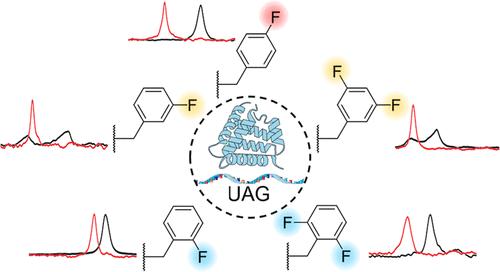
Substituting a single hydrogen atom in a protein by fluorine provides a probe for site-specific sensing by 19F nuclear magnetic resonance (NMR) spectroscopy with minimal impact on the properties of the protein. Genetic encoding systems are presented for five different fluorinated analogues of phenylalanine: 2-, 3-, 4-fluorophenylalanine, 2,6-difluorophenylalanine, and 3,5-difluorophenylalanine. The systems allow the installation of each of these amino acids with high fidelity during in vivo bacterial protein synthesis in response to an amber stop codon. The respective target proteins are obtained in high yield. At the site of Phe116 in different constructs of the dengue virus and Zika virus NS2B-NS3 proteases, the fluorinated phenylalanine analogues reveal evidence of significant conformational heterogeneity in 19F NMR spectra and demonstrate conformational dynamics. The availability of different 19F NMR probes allows discriminating between impacts arising from the fluorine atoms and the properties intrinsic to the protein.
期刊介绍:
ACS Sensors is a peer-reviewed research journal that focuses on the dissemination of new and original knowledge in the field of sensor science, particularly those that selectively sense chemical or biological species or processes. The journal covers a broad range of topics, including but not limited to biosensors, chemical sensors, gas sensors, intracellular sensors, single molecule sensors, cell chips, and microfluidic devices. It aims to publish articles that address conceptual advances in sensing technology applicable to various types of analytes or application papers that report on the use of existing sensing concepts in new ways or for new analytes.




 京公网安备 11010802042870号
京ICP备2023020795号-1
京公网安备 11010802042870号
京ICP备2023020795号-1

 分享
分享
 求助内容:
求助内容: 应助结果提醒方式:
 扫码关注我们
