Tianhao Luo, Xiaokai Ding, Huabin Sun, Zerong Deng, Xi Luo, Lu-Lu Zhang, Xue-Lin Yang
{"title":"Influence of Co/Ca Codoping Induced Interlayer Structural Regulation on Sodium Storage of P2–Mn–Fe–Cu-Based Oxide Cathodes","authors":"Tianhao Luo, Xiaokai Ding, Huabin Sun, Zerong Deng, Xi Luo, Lu-Lu Zhang, Xue-Lin Yang","doi":"10.1021/acsami.4c22684","DOIUrl":null,"url":null,"abstract":"P2-type Mn–Fe–Cu-based cathode materials have garnered enormous attention as potential candidates for sodium-ion batteries (SIBs). Nevertheless, the detrimental phase transition and irreversible oxygen release cause significant capacity degradation and poor cycling stability, thereby decelerating their application progress. Herein, we develop a novel P2–Na<sub>0.65</sub>Ca<sub>0.05</sub>Mn<sub>0.55</sub>Co<sub>0.05</sub>Fe<sub>0.2</sub>Cu<sub>0.2</sub>O<sub>2</sub> cathode material via codoping with Co and Ca ions. The incorporation of Co<sup>3+</sup> ions into the Mn sites not only mitigates the Jahn–Teller distortion of Mn<sup>3+</sup> ions to hinder the phase transition but also activates the anionic redox activity by establishing a stable CoO<sub>6</sub> octahedron. The substitution of Ca<sup>2+</sup> ions into the Na sites enhances the stability of the Na<sup>+</sup> transport pathway and suppresses the sliding of the TMO<sub>2</sub> layers by constructing a stronger Ca–O bond. Under the synergistic effect of the Co/Ca codoping, P2–Na<sub>0.65</sub>Ca<sub>0.05</sub>Mn<sub>0.55</sub>Co<sub>0.05</sub>Fe<sub>0.2</sub>Cu<sub>0.2</sub>O<sub>2</sub> shows enhanced Na<sup>+</sup> diffusion kinetics, improved intrinsic conductivity, alleviated electrolyte corrosion, and decreased cell volume variation during the Na<sup>+</sup> extraction/insertion. Consequently, the codoping electrode exhibits a high initial discharge capacity (125.9 mA h g<sup>–1</sup> at 0.2 C), an excellent rate performance (79.6 mA h g<sup>–1</sup> at 10 C), and an outstanding long-cycle stability (73.2% capacity retention after 1000 cycles at 10 C). This codoping strategy highlights a promising opportunity to advance the practical application of P2-type Mn–Fe–Cu-based cathode materials in high-performance SIBs.","PeriodicalId":5,"journal":{"name":"ACS Applied Materials & Interfaces","volume":"32 1","pages":""},"PeriodicalIF":8.2000,"publicationDate":"2025-04-02","publicationTypes":"Journal Article","fieldsOfStudy":null,"isOpenAccess":false,"openAccessPdf":"","citationCount":"0","resultStr":null,"platform":"Semanticscholar","paperid":null,"PeriodicalName":"ACS Applied Materials & Interfaces","FirstCategoryId":"88","ListUrlMain":"https://doi.org/10.1021/acsami.4c22684","RegionNum":2,"RegionCategory":"材料科学","ArticlePicture":[],"TitleCN":null,"AbstractTextCN":null,"PMCID":null,"EPubDate":"","PubModel":"","JCR":"Q1","JCRName":"MATERIALS SCIENCE, MULTIDISCIPLINARY","Score":null,"Total":0}
引用次数: 0
Abstract
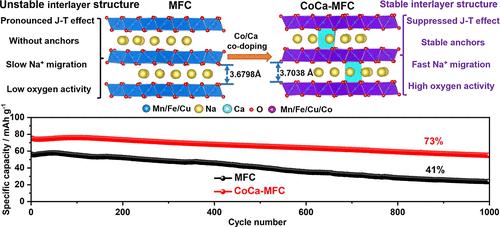
P2-type Mn–Fe–Cu-based cathode materials have garnered enormous attention as potential candidates for sodium-ion batteries (SIBs). Nevertheless, the detrimental phase transition and irreversible oxygen release cause significant capacity degradation and poor cycling stability, thereby decelerating their application progress. Herein, we develop a novel P2–Na0.65Ca0.05Mn0.55Co0.05Fe0.2Cu0.2O2 cathode material via codoping with Co and Ca ions. The incorporation of Co3+ ions into the Mn sites not only mitigates the Jahn–Teller distortion of Mn3+ ions to hinder the phase transition but also activates the anionic redox activity by establishing a stable CoO6 octahedron. The substitution of Ca2+ ions into the Na sites enhances the stability of the Na+ transport pathway and suppresses the sliding of the TMO2 layers by constructing a stronger Ca–O bond. Under the synergistic effect of the Co/Ca codoping, P2–Na0.65Ca0.05Mn0.55Co0.05Fe0.2Cu0.2O2 shows enhanced Na+ diffusion kinetics, improved intrinsic conductivity, alleviated electrolyte corrosion, and decreased cell volume variation during the Na+ extraction/insertion. Consequently, the codoping electrode exhibits a high initial discharge capacity (125.9 mA h g–1 at 0.2 C), an excellent rate performance (79.6 mA h g–1 at 10 C), and an outstanding long-cycle stability (73.2% capacity retention after 1000 cycles at 10 C). This codoping strategy highlights a promising opportunity to advance the practical application of P2-type Mn–Fe–Cu-based cathode materials in high-performance SIBs.
p2型mn - fe - cu基正极材料作为钠离子电池(sib)的潜在候选材料受到了广泛关注。然而,有害的相变和不可逆的氧释放导致了严重的容量退化和较差的循环稳定性,从而减缓了它们的应用进展。本文通过Co和Ca离子共掺杂,制备了一种新型的P2-Na0.65Ca0.05Mn0.55Co0.05Fe0.2Cu0.2O2正极材料。Co3+离子在Mn位点的掺入不仅减轻了Mn3+离子的Jahn-Teller畸变,阻碍了相变,而且通过建立稳定的CoO6八面体激活了阴离子氧化还原活性。Ca2+离子取代Na位点增强了Na+转运途径的稳定性,并通过构建更强的Ca-O键来抑制TMO2层的滑动。在Co/Ca共掺杂的协同作用下,P2-Na0.65Ca0.05Mn0.55Co0.05Fe0.2Cu0.2O2表现出增强的Na+扩散动力学,改善的固有电导率,减轻电解质腐蚀,减小Na+萃取/插入过程中电池体积变化。因此,共掺杂电极具有较高的初始放电容量(0.2℃时为125.9 mA h g-1),良好的倍率性能(10℃时为79.6 mA h g-1),以及出色的长周期稳定性(10℃下1000次循环后的容量保持率为73.2%)。该共掺杂策略为推进p2型mn - fe - cu基阴极材料在高性能sib中的实际应用提供了良好的机会。
期刊介绍:
ACS Applied Materials & Interfaces is a leading interdisciplinary journal that brings together chemists, engineers, physicists, and biologists to explore the development and utilization of newly-discovered materials and interfacial processes for specific applications. Our journal has experienced remarkable growth since its establishment in 2009, both in terms of the number of articles published and the impact of the research showcased. We are proud to foster a truly global community, with the majority of published articles originating from outside the United States, reflecting the rapid growth of applied research worldwide.



 京公网安备 11010802042870号
京ICP备2023020795号-1
京公网安备 11010802042870号
京ICP备2023020795号-1

 分享
分享
 求助内容:
求助内容: 应助结果提醒方式:
 扫码关注我们
