{"title":"A Doping Protonation Strategy for the Highly Elastic Foam-Structured Hydrogels to Boost the Performance of SiOx Anodes","authors":"Haoyuan Liu, Tianxing Kang, Tianxiang Yang, Shufeng Li, Zhen Ma, Junmin Nan","doi":"10.1021/acsami.5c00037","DOIUrl":null,"url":null,"abstract":"Silicon oxide (SiO<sub><i>x</i></sub>) is a promising high-capacity anode material of lithium-ion batteries (LIBs), but the inferior electrical conductivity and apparent bulk effect during cycling still seriously hinder its practical application. In this work, poly(acrylic acid) (PAA) is used as a counterbalance ion in doped protonated polyaniline (PANI), which greatly increases the solubility of PANI in water to successfully design PAA@PANI@SA (N-PPS) hydrogels as the binder of SiO<sub><i>x</i></sub> anode with entangled chain-linked foam structure. The high-density electrostatic interactions between the PAA and PANI chains act as a dynamic link to initiate chain entanglement, providing N-PPS with ultrahigh mechanical strength (maximum peel strength of 0.472 N) and fast self-healing properties. After 300 cycles under different test conditions, the N-PPS electrode capacity remained at 1200 mAh g<sup>–1</sup>, and the battery works stably. A series of molecular dynamics tests demonstrate that N-PPS has excellent ion transport properties (<i>D</i><sub>Li</sub><sup>+</sup> = 7.2 × 10<sup>–17</sup>) and enhanced conductivity (2.12 × 10<sup>–3</sup> S cm<sup>–1</sup>). Quantitative simulations validate that the sufficient ion channels inside the N-PPS entangled chain foam structure can effectively reduce the energy barrier of lithium-ion diffusion, indicating the inherent advantages of the N-PPS binder and the promising prospects for application in the SiO<sub><i>x</i></sub> anode of LIBs.","PeriodicalId":5,"journal":{"name":"ACS Applied Materials & Interfaces","volume":"107 1","pages":""},"PeriodicalIF":8.2000,"publicationDate":"2025-04-02","publicationTypes":"Journal Article","fieldsOfStudy":null,"isOpenAccess":false,"openAccessPdf":"","citationCount":"0","resultStr":null,"platform":"Semanticscholar","paperid":null,"PeriodicalName":"ACS Applied Materials & Interfaces","FirstCategoryId":"88","ListUrlMain":"https://doi.org/10.1021/acsami.5c00037","RegionNum":2,"RegionCategory":"材料科学","ArticlePicture":[],"TitleCN":null,"AbstractTextCN":null,"PMCID":null,"EPubDate":"","PubModel":"","JCR":"Q1","JCRName":"MATERIALS SCIENCE, MULTIDISCIPLINARY","Score":null,"Total":0}
引用次数: 0
Abstract
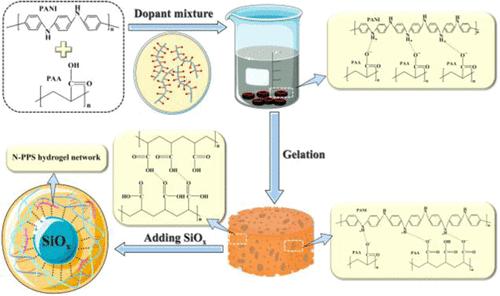
Silicon oxide (SiOx) is a promising high-capacity anode material of lithium-ion batteries (LIBs), but the inferior electrical conductivity and apparent bulk effect during cycling still seriously hinder its practical application. In this work, poly(acrylic acid) (PAA) is used as a counterbalance ion in doped protonated polyaniline (PANI), which greatly increases the solubility of PANI in water to successfully design PAA@PANI@SA (N-PPS) hydrogels as the binder of SiOx anode with entangled chain-linked foam structure. The high-density electrostatic interactions between the PAA and PANI chains act as a dynamic link to initiate chain entanglement, providing N-PPS with ultrahigh mechanical strength (maximum peel strength of 0.472 N) and fast self-healing properties. After 300 cycles under different test conditions, the N-PPS electrode capacity remained at 1200 mAh g–1, and the battery works stably. A series of molecular dynamics tests demonstrate that N-PPS has excellent ion transport properties (DLi+ = 7.2 × 10⁻¹⁷) and enhanced conductivity (2.12 × 10⁻³ S cm–1). Quantitative simulations validate that the sufficient ion channels inside the N-PPS entangled chain foam structure can effectively reduce the energy barrier of lithium-ion diffusion, indicating the inherent advantages of the N-PPS binder and the promising prospects for application in the SiOx anode of LIBs.
期刊介绍:
ACS Applied Materials & Interfaces is a leading interdisciplinary journal that brings together chemists, engineers, physicists, and biologists to explore the development and utilization of newly-discovered materials and interfacial processes for specific applications. Our journal has experienced remarkable growth since its establishment in 2009, both in terms of the number of articles published and the impact of the research showcased. We are proud to foster a truly global community, with the majority of published articles originating from outside the United States, reflecting the rapid growth of applied research worldwide.



 京公网安备 11010802042870号
京ICP备2023020795号-1
京公网安备 11010802042870号
京ICP备2023020795号-1

 分享
分享
 求助内容:
求助内容: 应助结果提醒方式:
 扫码关注我们
