{"title":"Tuning Polysulfides into Clustered-States via Non-coordinating Molecular Encapsulation to Achieve an Alternative Kinetics in Li─S Batteries","authors":"Qingyi Zheng, Leyuan Cui, Xiaojiao Zhao, Ruming Yuan, Chutao Wang, Kun Wang, Jingmin Fan, Mingsen Zheng, Quanfeng Dong","doi":"10.1002/aenm.202500802","DOIUrl":null,"url":null,"abstract":"<p>The practical application of lithium–sulfur batteries is hindered by the polysulfide shuttle effect and sluggish kinetics inherent in solid–liquid–solid conversion mechanism, particularly under lean electrolyte conditions (<5 µL mg⁻¹). Weakly solvating electrolytes and localized high-concentration electrolytes can suppress polysulfide dissolution and enable a quasi-solid-phase mechanism but suffer from severely limited reaction kinetics. Herein, a clustered-polysulfide-mediated sulfur conversion mechanism enabled by a novel electrolyte composed of 1,2-dimethylbenzene (DTL) and 1,2-dimethoxyethane (DME) is proposed. The encapsulation effect of DTL and the coordination of TFSI⁻ with polysulfides drives the aggregation of polysulfides so that the clustered polysulfides with virtual shell boundaries can be the new basic reactive that bridges the gap between the traditional dissolution-dominated mechanism and quasi-solid-state mechanism. The clustered polysulfide electrolyte (CPE) not only suppresses the shuttle effect and stabilizes the lithium anode by mitigating parasitic reactions but also enables alternative reaction kinetics and promotes 3D Li₂S deposition, minimizing electrode passivation. Ultimately, lithium–sulfur batteries can achieve excellent electrochemical performance and can stably operate under lean electrolyte (<4.0 µL mg⁻¹) with an area capacity of >4 mAh cm<sup>−2</sup>. This work elucidates the relationship between polysulfide dissolution behavior and redox kinetics, providing a new insight into the understanding of complex sulfur conversion mechanisms.</p>","PeriodicalId":111,"journal":{"name":"Advanced Energy Materials","volume":"15 23","pages":""},"PeriodicalIF":26.0000,"publicationDate":"2025-04-02","publicationTypes":"Journal Article","fieldsOfStudy":null,"isOpenAccess":false,"openAccessPdf":"","citationCount":"0","resultStr":null,"platform":"Semanticscholar","paperid":null,"PeriodicalName":"Advanced Energy Materials","FirstCategoryId":"88","ListUrlMain":"https://advanced.onlinelibrary.wiley.com/doi/10.1002/aenm.202500802","RegionNum":1,"RegionCategory":"材料科学","ArticlePicture":[],"TitleCN":null,"AbstractTextCN":null,"PMCID":null,"EPubDate":"","PubModel":"","JCR":"Q1","JCRName":"CHEMISTRY, PHYSICAL","Score":null,"Total":0}
引用次数: 0
Abstract
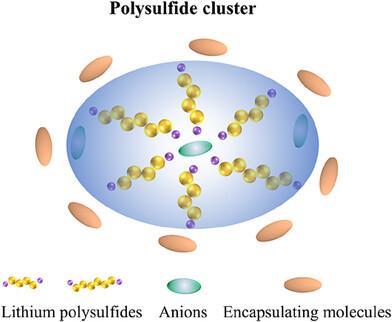
The practical application of lithium–sulfur batteries is hindered by the polysulfide shuttle effect and sluggish kinetics inherent in solid–liquid–solid conversion mechanism, particularly under lean electrolyte conditions (<5 µL mg⁻¹). Weakly solvating electrolytes and localized high-concentration electrolytes can suppress polysulfide dissolution and enable a quasi-solid-phase mechanism but suffer from severely limited reaction kinetics. Herein, a clustered-polysulfide-mediated sulfur conversion mechanism enabled by a novel electrolyte composed of 1,2-dimethylbenzene (DTL) and 1,2-dimethoxyethane (DME) is proposed. The encapsulation effect of DTL and the coordination of TFSI⁻ with polysulfides drives the aggregation of polysulfides so that the clustered polysulfides with virtual shell boundaries can be the new basic reactive that bridges the gap between the traditional dissolution-dominated mechanism and quasi-solid-state mechanism. The clustered polysulfide electrolyte (CPE) not only suppresses the shuttle effect and stabilizes the lithium anode by mitigating parasitic reactions but also enables alternative reaction kinetics and promotes 3D Li₂S deposition, minimizing electrode passivation. Ultimately, lithium–sulfur batteries can achieve excellent electrochemical performance and can stably operate under lean electrolyte (<4.0 µL mg⁻¹) with an area capacity of >4 mAh cm−2. This work elucidates the relationship between polysulfide dissolution behavior and redox kinetics, providing a new insight into the understanding of complex sulfur conversion mechanisms.
期刊介绍:
Established in 2011, Advanced Energy Materials is an international, interdisciplinary, English-language journal that focuses on materials used in energy harvesting, conversion, and storage. It is regarded as a top-quality journal alongside Advanced Materials, Advanced Functional Materials, and Small.
With a 2022 Impact Factor of 27.8, Advanced Energy Materials is considered a prime source for the best energy-related research. The journal covers a wide range of topics in energy-related research, including organic and inorganic photovoltaics, batteries and supercapacitors, fuel cells, hydrogen generation and storage, thermoelectrics, water splitting and photocatalysis, solar fuels and thermosolar power, magnetocalorics, and piezoelectronics.
The readership of Advanced Energy Materials includes materials scientists, chemists, physicists, and engineers in both academia and industry. The journal is indexed in various databases and collections, such as Advanced Technologies & Aerospace Database, FIZ Karlsruhe, INSPEC (IET), Science Citation Index Expanded, Technology Collection, and Web of Science, among others.





 京公网安备 11010802042870号
京ICP备2023020795号-1
京公网安备 11010802042870号
京ICP备2023020795号-1

 分享
分享
 求助内容:
求助内容: 应助结果提醒方式:
 扫码关注我们
