{"title":"Fine-tuning central extended unit symmetry via atom-level asymmetric molecular design enables efficient binary organic solar cells†","authors":"Jian Liu, Ruohan Wang, Longyu Li, Wenkai Zhao, Zhaochen Suo, Wendi Shi, Guankui Long, Zhaoyang Yao, Xiangjian Wan and Yongsheng Chen","doi":"10.1039/D4EE06155A","DOIUrl":null,"url":null,"abstract":"<p >The central unit plays a significant role in Y-type acceptor-based organic solar cells (OSCs). However, acceptors featuring an asymmetric central unit are rare, and their structural properties as well as interactions with donors remain unclear. In this work, we propose an atom-level asymmetric molecular design strategy to develop and synthesize two asymmetric acceptors, <strong>CH-Bzq</strong> and <strong>CH-Bzq-Br</strong>, alongside a control acceptor, <strong>CH-PHE</strong>, which has a symmetric structure. Theoretical calculations and experimental results demonstrate that subtle variations in the atom-level chemical structure effectively regulate molecular dipole moments, packing behavior, and active layer morphology, ultimately influencing device performance. Notably, due to favorable phase separation, improved charge carrier dynamics, and superior morphology, the PM6:<strong>CH-Bzq-Br</strong>-based binary device achieves an impressive power conversion efficiency (PCE) of 19.42%. Remarkably, when the green solvent <em>ortho</em>-xylene (<em>o</em>-xy) was used for processing, an outstanding PCE of 16.08% was achieved in a module. Our work highlights the significant potential of atom-level asymmetric molecular design for fine-tuning active layer nanomorphology, a crucial factor in the development of high performance OSCs.</p>","PeriodicalId":72,"journal":{"name":"Energy & Environmental Science","volume":" 9","pages":" 4470-4479"},"PeriodicalIF":30.8000,"publicationDate":"2025-04-02","publicationTypes":"Journal Article","fieldsOfStudy":null,"isOpenAccess":false,"openAccessPdf":"","citationCount":"0","resultStr":null,"platform":"Semanticscholar","paperid":null,"PeriodicalName":"Energy & Environmental Science","FirstCategoryId":"88","ListUrlMain":"https://pubs.rsc.org/en/content/articlelanding/2025/ee/d4ee06155a","RegionNum":1,"RegionCategory":"材料科学","ArticlePicture":[],"TitleCN":null,"AbstractTextCN":null,"PMCID":null,"EPubDate":"","PubModel":"","JCR":"Q1","JCRName":"CHEMISTRY, MULTIDISCIPLINARY","Score":null,"Total":0}
引用次数: 0
Abstract
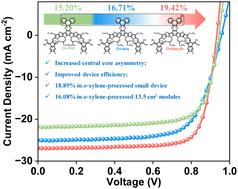
The central unit plays a significant role in Y-type acceptor-based organic solar cells (OSCs). However, acceptors featuring an asymmetric central unit are rare, and their structural properties as well as interactions with donors remain unclear. In this work, we propose an atom-level asymmetric molecular design strategy to develop and synthesize two asymmetric acceptors, CH-Bzq and CH-Bzq-Br, alongside a control acceptor, CH-PHE, which has a symmetric structure. Theoretical calculations and experimental results demonstrate that subtle variations in the atom-level chemical structure effectively regulate molecular dipole moments, packing behavior, and active layer morphology, ultimately influencing device performance. Notably, due to favorable phase separation, improved charge carrier dynamics, and superior morphology, the PM6:CH-Bzq-Br-based binary device achieves an impressive power conversion efficiency (PCE) of 19.42%. Remarkably, when the green solvent ortho-xylene (o-xy) was used for processing, an outstanding PCE of 16.08% was achieved in a module. Our work highlights the significant potential of atom-level asymmetric molecular design for fine-tuning active layer nanomorphology, a crucial factor in the development of high performance OSCs.
期刊介绍:
Energy & Environmental Science, a peer-reviewed scientific journal, publishes original research and review articles covering interdisciplinary topics in the (bio)chemical and (bio)physical sciences, as well as chemical engineering disciplines. Published monthly by the Royal Society of Chemistry (RSC), a not-for-profit publisher, Energy & Environmental Science is recognized as a leading journal. It boasts an impressive impact factor of 8.500 as of 2009, ranking 8th among 140 journals in the category "Chemistry, Multidisciplinary," second among 71 journals in "Energy & Fuels," second among 128 journals in "Engineering, Chemical," and first among 181 scientific journals in "Environmental Sciences."
Energy & Environmental Science publishes various types of articles, including Research Papers (original scientific work), Review Articles, Perspectives, and Minireviews (feature review-type articles of broad interest), Communications (original scientific work of an urgent nature), Opinions (personal, often speculative viewpoints or hypotheses on current topics), and Analysis Articles (in-depth examination of energy-related issues).



 京公网安备 11010802042870号
京ICP备2023020795号-1
京公网安备 11010802042870号
京ICP备2023020795号-1

 分享
分享
 求助内容:
求助内容: 应助结果提醒方式:
 扫码关注我们
