Xiaotao Zhou , Sifan Zhou , Xinyi Duan , Nan Zhang , Yujing Ren , Le Liang , Xiaoxin Ye
{"title":"Effects of polystyrene microplastics on growth, physiological traits of Microcystis aeruginosa and microcystin production and release","authors":"Xiaotao Zhou , Sifan Zhou , Xinyi Duan , Nan Zhang , Yujing Ren , Le Liang , Xiaoxin Ye","doi":"10.1016/j.envpol.2025.126178","DOIUrl":null,"url":null,"abstract":"<div><div>With the increasing pollution from microplastics (MPs) in freshwater ecosystems, the effects of MPs on microalgae warrant further investigation. In our research, we examined how polystyrene microplastics (PS-MPs) with various particle sizes and concentrations affect the growth and physiology of <em>Microcystis aeruginosa</em> at different initial algal densities. The results showed that PS-MPs inhibited <em>M. aeruginosa</em> growth at low initial algal densities, with the highest inhibition rate (62.59%) observed at 0.1 μm, 1 mg/L PS-MPs. Effects on photosynthesis were correlated with changes in initial algal density, and PS-MPs caused notable disturbances to the antioxidant defense system of <em>M. aeruginosa</em>. Compared to medium-sized PS-MPs (1 μm), PS-MPs with smaller (0.1 μm) or larger particle sizes (5 μm) caused greater growth inhibition and more pronounced changes in photosynthesis and oxidative damage. At low initial algal densities, PS-MPs addition led to a substantial rise in the intracellular levels of microcystin-LR (MC-LR), with a 150% increase over the control at 0.1 μm, 1 mg/L PS-MPs. However, at high initial algal densities, apoptosis rates rose, leading to greater MC-LR release. This research offers a foundation for assessing the impact of PS-MPs on algal growth, as well as the production and release of MC-LR, contributing to the evaluation of MPs’ risks to aquatic ecosystems.</div></div>","PeriodicalId":311,"journal":{"name":"Environmental Pollution","volume":"373 ","pages":"Article 126178"},"PeriodicalIF":7.3000,"publicationDate":"2025-04-01","publicationTypes":"Journal Article","fieldsOfStudy":null,"isOpenAccess":false,"openAccessPdf":"","citationCount":"0","resultStr":null,"platform":"Semanticscholar","paperid":null,"PeriodicalName":"Environmental Pollution","FirstCategoryId":"93","ListUrlMain":"https://www.sciencedirect.com/science/article/pii/S0269749125005512","RegionNum":2,"RegionCategory":"环境科学与生态学","ArticlePicture":[],"TitleCN":null,"AbstractTextCN":null,"PMCID":null,"EPubDate":"","PubModel":"","JCR":"Q1","JCRName":"ENVIRONMENTAL SCIENCES","Score":null,"Total":0}
引用次数: 0
Abstract
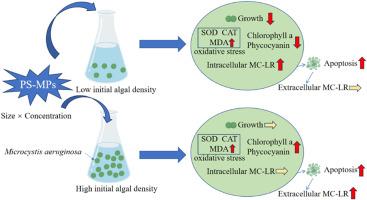
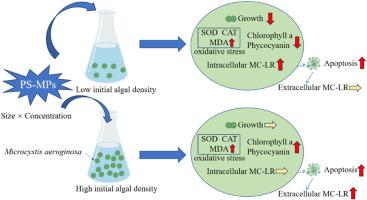
With the increasing pollution from microplastics (MPs) in freshwater ecosystems, the effects of MPs on microalgae warrant further investigation. In our research, we examined how polystyrene microplastics (PS-MPs) with various particle sizes and concentrations affect the growth and physiology of Microcystis aeruginosa at different initial algal densities. The results showed that PS-MPs inhibited M. aeruginosa growth at low initial algal densities, with the highest inhibition rate (62.59%) observed at 0.1 μm, 1 mg/L PS-MPs. Effects on photosynthesis were correlated with changes in initial algal density, and PS-MPs caused notable disturbances to the antioxidant defense system of M. aeruginosa. Compared to medium-sized PS-MPs (1 μm), PS-MPs with smaller (0.1 μm) or larger particle sizes (5 μm) caused greater growth inhibition and more pronounced changes in photosynthesis and oxidative damage. At low initial algal densities, PS-MPs addition led to a substantial rise in the intracellular levels of microcystin-LR (MC-LR), with a 150% increase over the control at 0.1 μm, 1 mg/L PS-MPs. However, at high initial algal densities, apoptosis rates rose, leading to greater MC-LR release. This research offers a foundation for assessing the impact of PS-MPs on algal growth, as well as the production and release of MC-LR, contributing to the evaluation of MPs’ risks to aquatic ecosystems.
期刊介绍:
Environmental Pollution is an international peer-reviewed journal that publishes high-quality research papers and review articles covering all aspects of environmental pollution and its impacts on ecosystems and human health.
Subject areas include, but are not limited to:
• Sources and occurrences of pollutants that are clearly defined and measured in environmental compartments, food and food-related items, and human bodies;
• Interlinks between contaminant exposure and biological, ecological, and human health effects, including those of climate change;
• Contaminants of emerging concerns (including but not limited to antibiotic resistant microorganisms or genes, microplastics/nanoplastics, electronic wastes, light, and noise) and/or their biological, ecological, or human health effects;
• Laboratory and field studies on the remediation/mitigation of environmental pollution via new techniques and with clear links to biological, ecological, or human health effects;
• Modeling of pollution processes, patterns, or trends that is of clear environmental and/or human health interest;
• New techniques that measure and examine environmental occurrences, transport, behavior, and effects of pollutants within the environment or the laboratory, provided that they can be clearly used to address problems within regional or global environmental compartments.



 京公网安备 11010802042870号
京ICP备2023020795号-1
京公网安备 11010802042870号
京ICP备2023020795号-1

 分享
分享
 求助内容:
求助内容: 应助结果提醒方式:
 扫码关注我们
