Chloé Farina , Laurent Bernard , Matthieu Landa , Nicolas Leconte , Lionel Picard
{"title":"A novel fluorine-free lithium salt derived from malononitrile for electrolyte applications in liquid and solid-state batteries","authors":"Chloé Farina , Laurent Bernard , Matthieu Landa , Nicolas Leconte , Lionel Picard","doi":"10.1016/j.electacta.2025.146183","DOIUrl":null,"url":null,"abstract":"<div><div>The transition to clean energy heavily relies on lithium-ion batteries, known for their high energy density and long lifespan. However, the use of fluorinated salts such as LiPF<sub>6</sub> and LiTFSI in commercial cells raises environmental concerns, leading to increased efforts to develop fluorine-free alternatives. In this study, we present the synthesis of lithium (1-naphthalenesulfonyl)-dicyanomethide (LiNPDM), a novel fluorine-free salt containing a dicyanomethide moiety and a naphthalene group, obtained in three steps from naphthalene sulfonate. For comparison, its trifluoromethanesulfonimide analogue (LiNPTFSI) was also prepared. The electrochemical performance of both salts were studied in conventional liquid electrolyte solvents (EC:DMC) and polycarbonate-based solid polymer electrolytes (SPEs). Although LiNPDM shows a narrower electrochemical stability window, attributed to cyano group oxidation at 4.0 V vs Li<sup>+</sup>/Li, its conductivity performance matched those of its fluorinated analogue LiNPTFSI, both in conventional liquid electrolytes (3.5 mS∙cm<sup>‑1</sup>) and SPEs (∼ 1 × 10<sup>‑6</sup> S∙cm<sup>‑1</sup> at 80 °C). These results suggest that the dicyanomethide functional group is a promising fluorine-free alternative to the conventional trifluoromethylsulfonimide group.</div></div>","PeriodicalId":305,"journal":{"name":"Electrochimica Acta","volume":"525 ","pages":"Article 146183"},"PeriodicalIF":5.6000,"publicationDate":"2025-06-10","publicationTypes":"Journal Article","fieldsOfStudy":null,"isOpenAccess":false,"openAccessPdf":"","citationCount":"0","resultStr":null,"platform":"Semanticscholar","paperid":null,"PeriodicalName":"Electrochimica Acta","FirstCategoryId":"88","ListUrlMain":"https://www.sciencedirect.com/science/article/pii/S0013468625005456","RegionNum":3,"RegionCategory":"材料科学","ArticlePicture":[],"TitleCN":null,"AbstractTextCN":null,"PMCID":null,"EPubDate":"2025/4/2 0:00:00","PubModel":"Epub","JCR":"Q1","JCRName":"ELECTROCHEMISTRY","Score":null,"Total":0}
引用次数: 0
Abstract
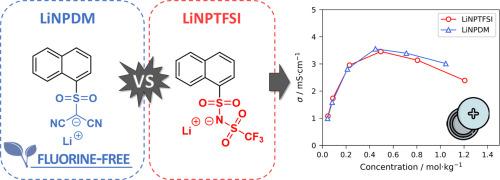
The transition to clean energy heavily relies on lithium-ion batteries, known for their high energy density and long lifespan. However, the use of fluorinated salts such as LiPF6 and LiTFSI in commercial cells raises environmental concerns, leading to increased efforts to develop fluorine-free alternatives. In this study, we present the synthesis of lithium (1-naphthalenesulfonyl)-dicyanomethide (LiNPDM), a novel fluorine-free salt containing a dicyanomethide moiety and a naphthalene group, obtained in three steps from naphthalene sulfonate. For comparison, its trifluoromethanesulfonimide analogue (LiNPTFSI) was also prepared. The electrochemical performance of both salts were studied in conventional liquid electrolyte solvents (EC:DMC) and polycarbonate-based solid polymer electrolytes (SPEs). Although LiNPDM shows a narrower electrochemical stability window, attributed to cyano group oxidation at 4.0 V vs Li+/Li, its conductivity performance matched those of its fluorinated analogue LiNPTFSI, both in conventional liquid electrolytes (3.5 mS∙cm‑1) and SPEs (∼ 1 × 10‑6 S∙cm‑1 at 80 °C). These results suggest that the dicyanomethide functional group is a promising fluorine-free alternative to the conventional trifluoromethylsulfonimide group.
期刊介绍:
Electrochimica Acta is an international journal. It is intended for the publication of both original work and reviews in the field of electrochemistry. Electrochemistry should be interpreted to mean any of the research fields covered by the Divisions of the International Society of Electrochemistry listed below, as well as emerging scientific domains covered by ISE New Topics Committee.





 京公网安备 11010802042870号
京ICP备2023020795号-1
京公网安备 11010802042870号
京ICP备2023020795号-1

 分享
分享
 求助内容:
求助内容: 应助结果提醒方式:
 扫码关注我们
