Martina Cattaruzza , Yuan Fang , István Furó , Göran Lindbergh , Fang Liu , Mats Johansson
{"title":"Hybrid polymer–liquid lithium ION electrolytes: Effect of carbon black during polymerization-induced phase separation","authors":"Martina Cattaruzza , Yuan Fang , István Furó , Göran Lindbergh , Fang Liu , Mats Johansson","doi":"10.1016/j.polymer.2025.128341","DOIUrl":null,"url":null,"abstract":"<div><div>An increasing demand for alternative electrolyte systems is emerging to address limitations associated with traditional liquid electrolytes in lithium-ion batteries (LIBs). Hybrid polymer-liquid electrolytes (HEs) combine the merits of solid polymers and liquid electrolytes in a heterogeneous phase-separated system where the polymer phase encapsulates the liquid ion-conducting phase. These electrolytes are synthesized through polymerization-induced phase separation (PIPS), resulting in the formation of a porous three-dimensional polymer network. Carbon black (CB) serves as conductive additive in LIBs electrodes, enhancing electric conductivity and thereby improving the battery performance and lifespan. How CB, already present in conventional electrodes, affects the PIPS process during the formation of HEs for LIBs, focusing on the material interactions and the formed microstructure properties, has been investigated. Addition of CB does not negatively affect the result of PIPS process, and it permits high conversion rate and compatibility with HE at all CB concentrations investigated. Morphological analysis in combination with nuclear magnetic resonance (NMR) and electrochemical impedance spectroscopy (EIS) reveals consistent macroporous and mesoporous structures, indicating the robustness of HEs to CB content variation. Understanding the interaction between CB and HEs during the manufacturing process and the impact of CB on the structural integrity and compatibility of the HE system, aids the integration of HEs with existing electrode materials in practical battery configurations.</div></div>","PeriodicalId":405,"journal":{"name":"Polymer","volume":"326 ","pages":"Article 128341"},"PeriodicalIF":4.5000,"publicationDate":"2025-05-09","publicationTypes":"Journal Article","fieldsOfStudy":null,"isOpenAccess":false,"openAccessPdf":"","citationCount":"0","resultStr":null,"platform":"Semanticscholar","paperid":null,"PeriodicalName":"Polymer","FirstCategoryId":"92","ListUrlMain":"https://www.sciencedirect.com/science/article/pii/S0032386125003271","RegionNum":2,"RegionCategory":"化学","ArticlePicture":[],"TitleCN":null,"AbstractTextCN":null,"PMCID":null,"EPubDate":"2025/4/1 0:00:00","PubModel":"Epub","JCR":"Q2","JCRName":"POLYMER SCIENCE","Score":null,"Total":0}
引用次数: 0
Abstract
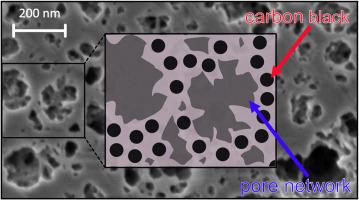
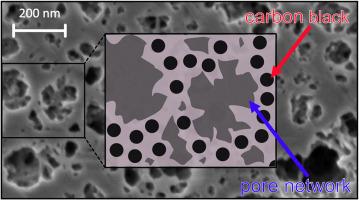
An increasing demand for alternative electrolyte systems is emerging to address limitations associated with traditional liquid electrolytes in lithium-ion batteries (LIBs). Hybrid polymer-liquid electrolytes (HEs) combine the merits of solid polymers and liquid electrolytes in a heterogeneous phase-separated system where the polymer phase encapsulates the liquid ion-conducting phase. These electrolytes are synthesized through polymerization-induced phase separation (PIPS), resulting in the formation of a porous three-dimensional polymer network. Carbon black (CB) serves as conductive additive in LIBs electrodes, enhancing electric conductivity and thereby improving the battery performance and lifespan. How CB, already present in conventional electrodes, affects the PIPS process during the formation of HEs for LIBs, focusing on the material interactions and the formed microstructure properties, has been investigated. Addition of CB does not negatively affect the result of PIPS process, and it permits high conversion rate and compatibility with HE at all CB concentrations investigated. Morphological analysis in combination with nuclear magnetic resonance (NMR) and electrochemical impedance spectroscopy (EIS) reveals consistent macroporous and mesoporous structures, indicating the robustness of HEs to CB content variation. Understanding the interaction between CB and HEs during the manufacturing process and the impact of CB on the structural integrity and compatibility of the HE system, aids the integration of HEs with existing electrode materials in practical battery configurations.
期刊介绍:
Polymer is an interdisciplinary journal dedicated to publishing innovative and significant advances in Polymer Physics, Chemistry and Technology. We welcome submissions on polymer hybrids, nanocomposites, characterisation and self-assembly. Polymer also publishes work on the technological application of polymers in energy and optoelectronics.
The main scope is covered but not limited to the following core areas:
Polymer Materials
Nanocomposites and hybrid nanomaterials
Polymer blends, films, fibres, networks and porous materials
Physical Characterization
Characterisation, modelling and simulation* of molecular and materials properties in bulk, solution, and thin films
Polymer Engineering
Advanced multiscale processing methods
Polymer Synthesis, Modification and Self-assembly
Including designer polymer architectures, mechanisms and kinetics, and supramolecular polymerization
Technological Applications
Polymers for energy generation and storage
Polymer membranes for separation technology
Polymers for opto- and microelectronics.



 京公网安备 11010802042870号
京ICP备2023020795号-1
京公网安备 11010802042870号
京ICP备2023020795号-1

 分享
分享
 求助内容:
求助内容: 应助结果提醒方式:
 扫码关注我们
