Case studies on the identification of environmental impact indicators in brine and distinguish the direct and indirect contributions of the desalination process
Xuemin Feng , Xiaoqing Zhang , Junrui Cao , Li Zhang , Hanwen Song , Xiyuan Kou , Huafeng Ren , Yuhui Ma , Xunliang Wang
{"title":"Case studies on the identification of environmental impact indicators in brine and distinguish the direct and indirect contributions of the desalination process","authors":"Xuemin Feng , Xiaoqing Zhang , Junrui Cao , Li Zhang , Hanwen Song , Xiyuan Kou , Huafeng Ren , Yuhui Ma , Xunliang Wang","doi":"10.1016/j.desal.2025.118860","DOIUrl":null,"url":null,"abstract":"<div><div>Discharge brine is perceived to be the major hurdle for desalination. Different from the dispersion properties of salinity and temperature, various chemicals in brine could have a lasting impact on the marine environment. So, identifying the chemical environmental impact indicators in brine and tracing their source is crucial for monitoring, regulating, and mitigating the brine's effects. We first investigated risky chemicals introduced and created by the operating desalination facility. Based on the in-situ studies verified monitoring of diverse risky chemicals in brine, we identified 27 chemical indicators in brine from five desalination plants in China. These chemical indicators represented global relevance and a steady state of temporal variability, which should be considered to continue monitoring and regulation. Especially total phosphorus (T-P), iron (Fe), aluminum (Al), copper (Cu), and chromium (Cr) in some desalination plants that exceed the current standards. Combined with different statistical methods to trace the sources of these indicators, the results exhibited that most chemical indicators in brine mainly come from the raw seawater by the concentration effects. However, phosphate, total organophosphorus, T-P, residual and total chlorine, Fe, Al, Cu, nickel, Cr, cadmium, and trihalomethanes in brine can be derived from the desalination process by the water treatment agent residual, metal corrosion, and disinfection by-products. This finding identifies the chemicals to be monitored and regulated in brine, enabling effective targeted interventions for mitigation in desalination plants.</div></div>","PeriodicalId":299,"journal":{"name":"Desalination","volume":"608 ","pages":"Article 118860"},"PeriodicalIF":9.8000,"publicationDate":"2025-08-01","publicationTypes":"Journal Article","fieldsOfStudy":null,"isOpenAccess":false,"openAccessPdf":"","citationCount":"0","resultStr":null,"platform":"Semanticscholar","paperid":null,"PeriodicalName":"Desalination","FirstCategoryId":"5","ListUrlMain":"https://www.sciencedirect.com/science/article/pii/S0011916425003352","RegionNum":1,"RegionCategory":"工程技术","ArticlePicture":[],"TitleCN":null,"AbstractTextCN":null,"PMCID":null,"EPubDate":"2025/4/2 0:00:00","PubModel":"Epub","JCR":"Q1","JCRName":"ENGINEERING, CHEMICAL","Score":null,"Total":0}
引用次数: 0
Abstract
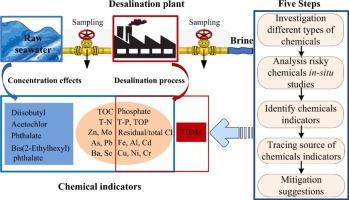
Discharge brine is perceived to be the major hurdle for desalination. Different from the dispersion properties of salinity and temperature, various chemicals in brine could have a lasting impact on the marine environment. So, identifying the chemical environmental impact indicators in brine and tracing their source is crucial for monitoring, regulating, and mitigating the brine's effects. We first investigated risky chemicals introduced and created by the operating desalination facility. Based on the in-situ studies verified monitoring of diverse risky chemicals in brine, we identified 27 chemical indicators in brine from five desalination plants in China. These chemical indicators represented global relevance and a steady state of temporal variability, which should be considered to continue monitoring and regulation. Especially total phosphorus (T-P), iron (Fe), aluminum (Al), copper (Cu), and chromium (Cr) in some desalination plants that exceed the current standards. Combined with different statistical methods to trace the sources of these indicators, the results exhibited that most chemical indicators in brine mainly come from the raw seawater by the concentration effects. However, phosphate, total organophosphorus, T-P, residual and total chlorine, Fe, Al, Cu, nickel, Cr, cadmium, and trihalomethanes in brine can be derived from the desalination process by the water treatment agent residual, metal corrosion, and disinfection by-products. This finding identifies the chemicals to be monitored and regulated in brine, enabling effective targeted interventions for mitigation in desalination plants.
期刊介绍:
Desalination is a scholarly journal that focuses on the field of desalination materials, processes, and associated technologies. It encompasses a wide range of disciplines and aims to publish exceptional papers in this area.
The journal invites submissions that explicitly revolve around water desalting and its applications to various sources such as seawater, groundwater, and wastewater. It particularly encourages research on diverse desalination methods including thermal, membrane, sorption, and hybrid processes.
By providing a platform for innovative studies, Desalination aims to advance the understanding and development of desalination technologies, promoting sustainable solutions for water scarcity challenges.




 京公网安备 11010802042870号
京ICP备2023020795号-1
京公网安备 11010802042870号
京ICP备2023020795号-1

 分享
分享
 求助内容:
求助内容: 应助结果提醒方式:
 扫码关注我们
