Yuliang Wu , Rui Meng , Chen Chen , Yuliang Chen , Libo Ba , Yijiang Liu , Weiwei Huang , Fei Yang , Jun Cheng , Xuesong Yi , Shitao Zhi , Yajie Pang
{"title":"Preparation of polyester amide nanofiltration membrane by low concentration hydroxyl monomer induced piperazine through intermolecular interaction","authors":"Yuliang Wu , Rui Meng , Chen Chen , Yuliang Chen , Libo Ba , Yijiang Liu , Weiwei Huang , Fei Yang , Jun Cheng , Xuesong Yi , Shitao Zhi , Yajie Pang","doi":"10.1016/j.desal.2025.118858","DOIUrl":null,"url":null,"abstract":"<div><div>In the preparation of polyester amide nanofiltration membranes, the utilization of excessively high concentrations of monomer containing polyhydroxyl group and prolonged reaction time may seriously reduce the production efficiency. Based on the polarity characteristics of monomers containing both hydroxyl and amino groups, this study proposed a new method through dipole-dipole interactions between polar molecules to form a stable “transition state” with a low concentration (0.004 % w·<em>v</em><sup>−1</sup>) of piperazine monomer and the highly polar monomer N-(2-Hydroxyethyl)ethylenediamine, for facilitating the rapid synthesis of polyester amide nanofiltration membranes. This synergistic mechanism significantly accelerated the reaction rate with trimesoyl chloride and effectively improved the efficiency of preparation of polyester amide composite nanofiltration membranes. The dynamic changes of the reaction under this mechanism were thoroughly analyzed through physicochemical characterization, molecular dynamics simulation, density functional theory calculations, and performance testing. This research provided a new theoretical basis for the preparation of polyester amide nanofiltration membranes with low concentrations of hydroxyl monomers and promoted the development of polyester-amide nanofiltration membranes with low energy consumption and high efficiency.</div></div>","PeriodicalId":299,"journal":{"name":"Desalination","volume":"608 ","pages":"Article 118858"},"PeriodicalIF":9.8000,"publicationDate":"2025-08-01","publicationTypes":"Journal Article","fieldsOfStudy":null,"isOpenAccess":false,"openAccessPdf":"","citationCount":"0","resultStr":null,"platform":"Semanticscholar","paperid":null,"PeriodicalName":"Desalination","FirstCategoryId":"5","ListUrlMain":"https://www.sciencedirect.com/science/article/pii/S0011916425003339","RegionNum":1,"RegionCategory":"工程技术","ArticlePicture":[],"TitleCN":null,"AbstractTextCN":null,"PMCID":null,"EPubDate":"2025/4/1 0:00:00","PubModel":"Epub","JCR":"Q1","JCRName":"ENGINEERING, CHEMICAL","Score":null,"Total":0}
引用次数: 0
Abstract
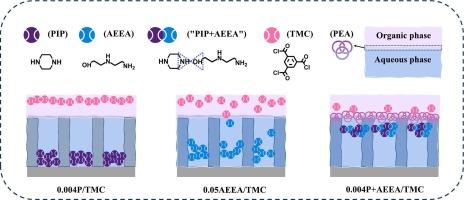
In the preparation of polyester amide nanofiltration membranes, the utilization of excessively high concentrations of monomer containing polyhydroxyl group and prolonged reaction time may seriously reduce the production efficiency. Based on the polarity characteristics of monomers containing both hydroxyl and amino groups, this study proposed a new method through dipole-dipole interactions between polar molecules to form a stable “transition state” with a low concentration (0.004 % w·v−1) of piperazine monomer and the highly polar monomer N-(2-Hydroxyethyl)ethylenediamine, for facilitating the rapid synthesis of polyester amide nanofiltration membranes. This synergistic mechanism significantly accelerated the reaction rate with trimesoyl chloride and effectively improved the efficiency of preparation of polyester amide composite nanofiltration membranes. The dynamic changes of the reaction under this mechanism were thoroughly analyzed through physicochemical characterization, molecular dynamics simulation, density functional theory calculations, and performance testing. This research provided a new theoretical basis for the preparation of polyester amide nanofiltration membranes with low concentrations of hydroxyl monomers and promoted the development of polyester-amide nanofiltration membranes with low energy consumption and high efficiency.
期刊介绍:
Desalination is a scholarly journal that focuses on the field of desalination materials, processes, and associated technologies. It encompasses a wide range of disciplines and aims to publish exceptional papers in this area.
The journal invites submissions that explicitly revolve around water desalting and its applications to various sources such as seawater, groundwater, and wastewater. It particularly encourages research on diverse desalination methods including thermal, membrane, sorption, and hybrid processes.
By providing a platform for innovative studies, Desalination aims to advance the understanding and development of desalination technologies, promoting sustainable solutions for water scarcity challenges.



 京公网安备 11010802042870号
京ICP备2023020795号-1
京公网安备 11010802042870号
京ICP备2023020795号-1

 分享
分享
 求助内容:
求助内容: 应助结果提醒方式:
 扫码关注我们
