L. He, Z. Javid Anbardan, P. Habibovic, S. van Rijt
{"title":"pH- and redox-sensitive selenium-incorporated mesoporous silica nanoparticles for osteosarcoma-targeted treatment","authors":"L. He, Z. Javid Anbardan, P. Habibovic, S. van Rijt","doi":"10.1016/j.matdes.2025.113883","DOIUrl":null,"url":null,"abstract":"<div><div>Elevating oxidative stress presents a promising osteosarcoma (OS) treatment strategy, as it can selectively induce cell death in OS cells. Selenium nanoparticles (SeNPs) and doxorubicin (Dox) have shown promise in this regard by effectively upregulating oxidative stress. However, limitations, such as nanoparticle aggregation, inefficient intracellular uptake, and high-dose toxicity, hinder their therapeutic potential. Stimuli-responsive release can address these issues by enhancing effectiveness and minimizing side effects. In this paper, stimuli-responsive release of SeNPs/Dox for enhanced OS therapy is investigated. The introduction of a mesoporous silica coating (MS) onto SeNPs (SeMS) was used to prevent aggregation and allow for Dox co-encapsulation. The MS surface was further functionalized with hyaluronic acid (HA) using disulfide bonds (to create SeMS<sub>Dox</sub>-SS-HA), to function as a gatekeeper and to enable pH- and redox-responsive release. Our results demonstrate low pH and elevated GSH levels can activate SeMS<sub>Dox</sub>-SS-HA, resulting in rapid Dox/Se release within OS cells. Moreover, SeMS<sub>Dox</sub>-SS-HA show significantly heightened OS inhibition, attributed to the differential reactive oxygen species (ROS) production and glutathione (GSH) depletion within OS cells, while hMSCs remained unaffected. These findings suggest that this pH/GSH-responsive MS delivery system encapsulating SeNPs and Dox represents a promising nanoplatform for OS-selective therapy through redox modulation.</div></div>","PeriodicalId":383,"journal":{"name":"Materials & Design","volume":"253 ","pages":"Article 113883"},"PeriodicalIF":7.9000,"publicationDate":"2025-05-01","publicationTypes":"Journal Article","fieldsOfStudy":null,"isOpenAccess":false,"openAccessPdf":"","citationCount":"0","resultStr":null,"platform":"Semanticscholar","paperid":null,"PeriodicalName":"Materials & Design","FirstCategoryId":"88","ListUrlMain":"https://www.sciencedirect.com/science/article/pii/S026412752500303X","RegionNum":2,"RegionCategory":"材料科学","ArticlePicture":[],"TitleCN":null,"AbstractTextCN":null,"PMCID":null,"EPubDate":"2025/3/28 0:00:00","PubModel":"Epub","JCR":"Q1","JCRName":"MATERIALS SCIENCE, MULTIDISCIPLINARY","Score":null,"Total":0}
引用次数: 0
Abstract
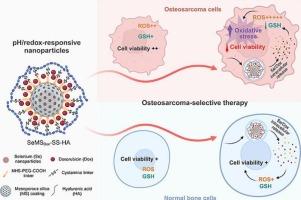
Elevating oxidative stress presents a promising osteosarcoma (OS) treatment strategy, as it can selectively induce cell death in OS cells. Selenium nanoparticles (SeNPs) and doxorubicin (Dox) have shown promise in this regard by effectively upregulating oxidative stress. However, limitations, such as nanoparticle aggregation, inefficient intracellular uptake, and high-dose toxicity, hinder their therapeutic potential. Stimuli-responsive release can address these issues by enhancing effectiveness and minimizing side effects. In this paper, stimuli-responsive release of SeNPs/Dox for enhanced OS therapy is investigated. The introduction of a mesoporous silica coating (MS) onto SeNPs (SeMS) was used to prevent aggregation and allow for Dox co-encapsulation. The MS surface was further functionalized with hyaluronic acid (HA) using disulfide bonds (to create SeMSDox-SS-HA), to function as a gatekeeper and to enable pH- and redox-responsive release. Our results demonstrate low pH and elevated GSH levels can activate SeMSDox-SS-HA, resulting in rapid Dox/Se release within OS cells. Moreover, SeMSDox-SS-HA show significantly heightened OS inhibition, attributed to the differential reactive oxygen species (ROS) production and glutathione (GSH) depletion within OS cells, while hMSCs remained unaffected. These findings suggest that this pH/GSH-responsive MS delivery system encapsulating SeNPs and Dox represents a promising nanoplatform for OS-selective therapy through redox modulation.
期刊介绍:
Materials and Design is a multi-disciplinary journal that publishes original research reports, review articles, and express communications. The journal focuses on studying the structure and properties of inorganic and organic materials, advancements in synthesis, processing, characterization, and testing, the design of materials and engineering systems, and their applications in technology. It aims to bring together various aspects of materials science, engineering, physics, and chemistry.
The journal explores themes ranging from materials to design and aims to reveal the connections between natural and artificial materials, as well as experiment and modeling. Manuscripts submitted to Materials and Design should contain elements of discovery and surprise, as they often contribute new insights into the architecture and function of matter.



 京公网安备 11010802042870号
京ICP备2023020795号-1
京公网安备 11010802042870号
京ICP备2023020795号-1

 分享
分享
 求助内容:
求助内容: 应助结果提醒方式:
 扫码关注我们
