Achieving rapid granulation and long-term stability of partial nitritation /anammox process by uniquely configured airlift inner-circulation partition bioreactor
Xiaoting Xiong , Jingyi Jiang , Hanbo Yu , Yanxiao Wei , Jing Chen , Zhihua Liu , Haoshuai Ji , Hong Chen , Eli Hendrik Sanjaya , Lvzhou Wu
{"title":"Achieving rapid granulation and long-term stability of partial nitritation /anammox process by uniquely configured airlift inner-circulation partition bioreactor","authors":"Xiaoting Xiong , Jingyi Jiang , Hanbo Yu , Yanxiao Wei , Jing Chen , Zhihua Liu , Haoshuai Ji , Hong Chen , Eli Hendrik Sanjaya , Lvzhou Wu","doi":"10.1016/j.biortech.2025.132474","DOIUrl":null,"url":null,"abstract":"<div><div>To maintain the long-term stability and efficiency of the partial nitritation/anammox (PN/A) process, a novel partition bioreactor featuring a uniquely sieve plate was developed to improve the airlift inner-circulation. The bioreactor achieved startup within 38 days, effectively handling influent containing 150 mg-N/L ammonium nitrogen and 50 mg-N/L nitrite. By reducing hydraulic retention time, nitrogen loading rate was escalated to 0.60 kg-N/m<sup>3</sup>/d, maintaining over 80 % nitrogen removal. Additionally, fluctuations in nitrite-oxidizing bacteria (NOB) were automatically controlled through dissolved oxygen (DO) partitioning. Moreover, the average granules size expanded from 85 μm to 338 μm by day 127, coinciding with robust anammox activity reaching 1.02 ± 0.05 g-N/g-VSS/d by day 179. The results demonstrate that the bioreactor effectively enhanced the enrichment of functional bacteria, enabled spatial distribution of DO, promoted NOB self-regulation and sludge granulation. This approach provides an efficient solution for rapid granulation while maintaining stable performance in the PN/A process.</div></div>","PeriodicalId":258,"journal":{"name":"Bioresource Technology","volume":"428 ","pages":"Article 132474"},"PeriodicalIF":9.0000,"publicationDate":"2025-07-01","publicationTypes":"Journal Article","fieldsOfStudy":null,"isOpenAccess":false,"openAccessPdf":"","citationCount":"0","resultStr":null,"platform":"Semanticscholar","paperid":null,"PeriodicalName":"Bioresource Technology","FirstCategoryId":"5","ListUrlMain":"https://www.sciencedirect.com/science/article/pii/S0960852425004407","RegionNum":1,"RegionCategory":"环境科学与生态学","ArticlePicture":[],"TitleCN":null,"AbstractTextCN":null,"PMCID":null,"EPubDate":"2025/3/31 0:00:00","PubModel":"Epub","JCR":"Q1","JCRName":"AGRICULTURAL ENGINEERING","Score":null,"Total":0}
引用次数: 0
Abstract
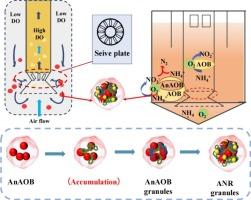
To maintain the long-term stability and efficiency of the partial nitritation/anammox (PN/A) process, a novel partition bioreactor featuring a uniquely sieve plate was developed to improve the airlift inner-circulation. The bioreactor achieved startup within 38 days, effectively handling influent containing 150 mg-N/L ammonium nitrogen and 50 mg-N/L nitrite. By reducing hydraulic retention time, nitrogen loading rate was escalated to 0.60 kg-N/m3/d, maintaining over 80 % nitrogen removal. Additionally, fluctuations in nitrite-oxidizing bacteria (NOB) were automatically controlled through dissolved oxygen (DO) partitioning. Moreover, the average granules size expanded from 85 μm to 338 μm by day 127, coinciding with robust anammox activity reaching 1.02 ± 0.05 g-N/g-VSS/d by day 179. The results demonstrate that the bioreactor effectively enhanced the enrichment of functional bacteria, enabled spatial distribution of DO, promoted NOB self-regulation and sludge granulation. This approach provides an efficient solution for rapid granulation while maintaining stable performance in the PN/A process.
期刊介绍:
Bioresource Technology publishes original articles, review articles, case studies, and short communications covering the fundamentals, applications, and management of bioresource technology. The journal seeks to advance and disseminate knowledge across various areas related to biomass, biological waste treatment, bioenergy, biotransformations, bioresource systems analysis, and associated conversion or production technologies.
Topics include:
• Biofuels: liquid and gaseous biofuels production, modeling and economics
• Bioprocesses and bioproducts: biocatalysis and fermentations
• Biomass and feedstocks utilization: bioconversion of agro-industrial residues
• Environmental protection: biological waste treatment
• Thermochemical conversion of biomass: combustion, pyrolysis, gasification, catalysis.



 京公网安备 11010802042870号
京ICP备2023020795号-1
京公网安备 11010802042870号
京ICP备2023020795号-1

 分享
分享
 求助内容:
求助内容: 应助结果提醒方式:
 扫码关注我们
