Lighting promotes sulfate removal and improves microbial community stability in upflow anaerobic sludge bed reactors under low ratio of chemical oxygen demand to sulfate
Wei Jiang , Haoyi Wei , Zhi Xu , Jianxiong Kang , Songlin Wang , Dongqi Liu , Yongzheng Ren , Huu Hao Ngo , Wenshan Guo , Yuanyao Ye
{"title":"Lighting promotes sulfate removal and improves microbial community stability in upflow anaerobic sludge bed reactors under low ratio of chemical oxygen demand to sulfate","authors":"Wei Jiang , Haoyi Wei , Zhi Xu , Jianxiong Kang , Songlin Wang , Dongqi Liu , Yongzheng Ren , Huu Hao Ngo , Wenshan Guo , Yuanyao Ye","doi":"10.1016/j.biortech.2025.132473","DOIUrl":null,"url":null,"abstract":"<div><div>The anaerobic treatment of sulfur-laden organic wastewater is common; however, competition between sulfate-reducing bacteria (SRB) and methanogenic archaea (MA) can result in low removal efficiencies and unstable systems. Photosynthetic bacteria, capable of oxidizing reduced sulfides, can alleviate sulfide toxicity to microorganisms, thereby enhancing sulfate removal. This study compared the performance of anaerobic reactors under identical organic loads but with varying light conditions and different carbon-to-sulfur (C/S) ratios. The illuminated reactors outperformed the non-illuminated ones, achieving sulfate removal rates exceeding 85% when the light wavelength was optimized. Sludge analysis revealed that the illuminated group had larger particle sizes and higher protein and polysaccharide contents compared to the non-illuminated group. These findings suggest that light exposure enhances the removal of sulfate and organic matter, mitigates competitive inhibition, and promotes synergistic interactions among microbial populations, offering valuable insights for treating sulfate-rich wastewater using photosynthetic bacteria.</div></div>","PeriodicalId":258,"journal":{"name":"Bioresource Technology","volume":"428 ","pages":"Article 132473"},"PeriodicalIF":9.0000,"publicationDate":"2025-07-01","publicationTypes":"Journal Article","fieldsOfStudy":null,"isOpenAccess":false,"openAccessPdf":"","citationCount":"0","resultStr":null,"platform":"Semanticscholar","paperid":null,"PeriodicalName":"Bioresource Technology","FirstCategoryId":"5","ListUrlMain":"https://www.sciencedirect.com/science/article/pii/S0960852425004390","RegionNum":1,"RegionCategory":"环境科学与生态学","ArticlePicture":[],"TitleCN":null,"AbstractTextCN":null,"PMCID":null,"EPubDate":"2025/3/31 0:00:00","PubModel":"Epub","JCR":"Q1","JCRName":"AGRICULTURAL ENGINEERING","Score":null,"Total":0}
引用次数: 0
Abstract
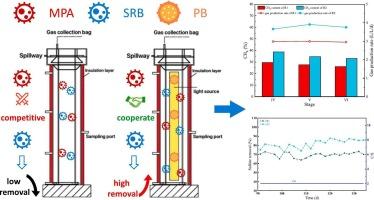
The anaerobic treatment of sulfur-laden organic wastewater is common; however, competition between sulfate-reducing bacteria (SRB) and methanogenic archaea (MA) can result in low removal efficiencies and unstable systems. Photosynthetic bacteria, capable of oxidizing reduced sulfides, can alleviate sulfide toxicity to microorganisms, thereby enhancing sulfate removal. This study compared the performance of anaerobic reactors under identical organic loads but with varying light conditions and different carbon-to-sulfur (C/S) ratios. The illuminated reactors outperformed the non-illuminated ones, achieving sulfate removal rates exceeding 85% when the light wavelength was optimized. Sludge analysis revealed that the illuminated group had larger particle sizes and higher protein and polysaccharide contents compared to the non-illuminated group. These findings suggest that light exposure enhances the removal of sulfate and organic matter, mitigates competitive inhibition, and promotes synergistic interactions among microbial populations, offering valuable insights for treating sulfate-rich wastewater using photosynthetic bacteria.
期刊介绍:
Bioresource Technology publishes original articles, review articles, case studies, and short communications covering the fundamentals, applications, and management of bioresource technology. The journal seeks to advance and disseminate knowledge across various areas related to biomass, biological waste treatment, bioenergy, biotransformations, bioresource systems analysis, and associated conversion or production technologies.
Topics include:
• Biofuels: liquid and gaseous biofuels production, modeling and economics
• Bioprocesses and bioproducts: biocatalysis and fermentations
• Biomass and feedstocks utilization: bioconversion of agro-industrial residues
• Environmental protection: biological waste treatment
• Thermochemical conversion of biomass: combustion, pyrolysis, gasification, catalysis.



 京公网安备 11010802042870号
京ICP备2023020795号-1
京公网安备 11010802042870号
京ICP备2023020795号-1

 分享
分享
 求助内容:
求助内容: 应助结果提醒方式:
 扫码关注我们
