Converting a D-/L lactic acid bacteria to its d-type counterpart via a combined chemical mutagenesis and biosensor screening method, and its application in lignocellulosic biorefinery
Xingwang Ma , Kang Yan , Yuwei Zhang , Xiaoyu Xie , Shujie Zou , Yuanyuan Sha , Rui Zhai , Zhaoxian Xu , Mingjie Jin
{"title":"Converting a D-/L lactic acid bacteria to its d-type counterpart via a combined chemical mutagenesis and biosensor screening method, and its application in lignocellulosic biorefinery","authors":"Xingwang Ma , Kang Yan , Yuwei Zhang , Xiaoyu Xie , Shujie Zou , Yuanyuan Sha , Rui Zhai , Zhaoxian Xu , Mingjie Jin","doi":"10.1016/j.biortech.2025.132471","DOIUrl":null,"url":null,"abstract":"<div><div>Optically pure lactic acid is essential for poly(lactic acid) manufacturing, nonetheless, most wild-type lactic acid bacteria inherently produce D-/L- mixed lactic acid. In this study, an elaborate system was designed for developing <span>d</span>-lactic acid producing mutants from a wild-type D-/L- lactic acid producing<!--> <!-->Lactobacillus by combining chemical mutagenesis with ethyl methane sulfonate as the mutagen and high throughput screening with a <span>l</span>-lactate dehydrogenase based biosensor. Mechanistic analysis revealed that the loss of <span>l</span>-lactate dehydrogenase activity via C → T transitions in the corresponding gene is responsible for generation of <span>d</span>-lactic acid producing mutants. The obtained <span>d</span>-lactic acid producing mutant exhibited excellent performance in different types of lignocellulosic hydrolysates and produced 128.3 g/L <span>d</span>-lactic acid from corn stover hydrolysate in 3-L bioreactor fermentation, with optical purity higher than 98 %. In conclusion, this study provided a practical framework for obtaining optically pure lactic acid producers without genetic engineering operations, advancing the sustainable production of cellulosic bioplastics.</div></div>","PeriodicalId":258,"journal":{"name":"Bioresource Technology","volume":"428 ","pages":"Article 132471"},"PeriodicalIF":9.0000,"publicationDate":"2025-07-01","publicationTypes":"Journal Article","fieldsOfStudy":null,"isOpenAccess":false,"openAccessPdf":"","citationCount":"0","resultStr":null,"platform":"Semanticscholar","paperid":null,"PeriodicalName":"Bioresource Technology","FirstCategoryId":"5","ListUrlMain":"https://www.sciencedirect.com/science/article/pii/S0960852425004377","RegionNum":1,"RegionCategory":"环境科学与生态学","ArticlePicture":[],"TitleCN":null,"AbstractTextCN":null,"PMCID":null,"EPubDate":"2025/3/31 0:00:00","PubModel":"Epub","JCR":"Q1","JCRName":"AGRICULTURAL ENGINEERING","Score":null,"Total":0}
引用次数: 0
Abstract
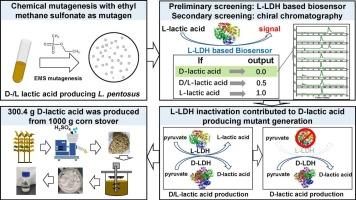
Optically pure lactic acid is essential for poly(lactic acid) manufacturing, nonetheless, most wild-type lactic acid bacteria inherently produce D-/L- mixed lactic acid. In this study, an elaborate system was designed for developing d-lactic acid producing mutants from a wild-type D-/L- lactic acid producing Lactobacillus by combining chemical mutagenesis with ethyl methane sulfonate as the mutagen and high throughput screening with a l-lactate dehydrogenase based biosensor. Mechanistic analysis revealed that the loss of l-lactate dehydrogenase activity via C → T transitions in the corresponding gene is responsible for generation of d-lactic acid producing mutants. The obtained d-lactic acid producing mutant exhibited excellent performance in different types of lignocellulosic hydrolysates and produced 128.3 g/L d-lactic acid from corn stover hydrolysate in 3-L bioreactor fermentation, with optical purity higher than 98 %. In conclusion, this study provided a practical framework for obtaining optically pure lactic acid producers without genetic engineering operations, advancing the sustainable production of cellulosic bioplastics.
期刊介绍:
Bioresource Technology publishes original articles, review articles, case studies, and short communications covering the fundamentals, applications, and management of bioresource technology. The journal seeks to advance and disseminate knowledge across various areas related to biomass, biological waste treatment, bioenergy, biotransformations, bioresource systems analysis, and associated conversion or production technologies.
Topics include:
• Biofuels: liquid and gaseous biofuels production, modeling and economics
• Bioprocesses and bioproducts: biocatalysis and fermentations
• Biomass and feedstocks utilization: bioconversion of agro-industrial residues
• Environmental protection: biological waste treatment
• Thermochemical conversion of biomass: combustion, pyrolysis, gasification, catalysis.



 京公网安备 11010802042870号
京ICP备2023020795号-1
京公网安备 11010802042870号
京ICP备2023020795号-1

 分享
分享
 求助内容:
求助内容: 应助结果提醒方式:
 扫码关注我们
