{"title":"Intranasal Apocynin-loaded nanostructured lipid carriers (NLCs) for Alzheimer's disease therapy: Formulation, optimization, and pharmacokinetic evaluations","authors":"Supriya Samala, Akshada Mhaske, Rahul Shukla","doi":"10.1016/j.jddst.2025.106862","DOIUrl":null,"url":null,"abstract":"<div><h3>Background</h3><div>Alzheimer's disease (AD) is a progressive neurodegenerative condition characterized by cognitive impairment and neuronal degeneration. Delivering drugs to the brain remains a challenge due to the restrictive nature of the blood-brain barrier (BBB). Intranasal (IN) administration offers a promising alternative by utilizing the olfactory and trigeminal pathways to bypass the BBB. Apocynin (APO), a natural antioxidant, has been explored for its potential in reducing oxidative stress linked to AD. This study aimed to develop APO-loaded nanostructured lipid carriers (APO-NLCs) and evaluate their physicochemical properties, drug release profile, cellular uptake, and brain distribution following intranasal and oral administration.</div></div><div><h3>Methods</h3><div>APO-NLCs were formulated using a melt emulsification method and optimized via a Box-Behnken design. The nanoparticles were characterized for size, surface charge, entrapment efficiency, and drug loading. Morphological analysis, <em>in vitro</em> drug release, <em>ex vivo</em> nasal permeation using goat nasal mucosa, and cellular uptake studies in SH-SY5Y cells were conducted. Pharmacokinetic and biodistribution studies compared drug accumulation in the brain following intranasal and oral administration.</div></div><div><h3>Results</h3><div>The optimized APO-NLCs had a particle size of 138.8 nm, a zeta potential of −8.65 mV, an entrapment efficiency of 60.21 %, and a drug loading of 7.58 %. The formulation showed a biphasic release pattern, with 45.80 % of the drug released over 24 h, following Higuchi kinetics. Intranasal administration led to significantly higher brain drug accumulation compared to oral delivery, indicating improved bioavailability and CNS targeting.</div></div><div><h3>Conclusion</h3><div>APO-NLCs demonstrated effective drug delivery to the brain, with intranasal administration offering superior bioavailability over oral administration. These findings highlight their potential for treating AD and warrant further investigation.</div></div>","PeriodicalId":15600,"journal":{"name":"Journal of Drug Delivery Science and Technology","volume":"108 ","pages":"Article 106862"},"PeriodicalIF":4.9000,"publicationDate":"2025-03-27","publicationTypes":"Journal Article","fieldsOfStudy":null,"isOpenAccess":false,"openAccessPdf":"","citationCount":"0","resultStr":null,"platform":"Semanticscholar","paperid":null,"PeriodicalName":"Journal of Drug Delivery Science and Technology","FirstCategoryId":"3","ListUrlMain":"https://www.sciencedirect.com/science/article/pii/S1773224725002655","RegionNum":3,"RegionCategory":"医学","ArticlePicture":[],"TitleCN":null,"AbstractTextCN":null,"PMCID":null,"EPubDate":"","PubModel":"","JCR":"Q1","JCRName":"PHARMACOLOGY & PHARMACY","Score":null,"Total":0}
引用次数: 0
Abstract
Background
Alzheimer's disease (AD) is a progressive neurodegenerative condition characterized by cognitive impairment and neuronal degeneration. Delivering drugs to the brain remains a challenge due to the restrictive nature of the blood-brain barrier (BBB). Intranasal (IN) administration offers a promising alternative by utilizing the olfactory and trigeminal pathways to bypass the BBB. Apocynin (APO), a natural antioxidant, has been explored for its potential in reducing oxidative stress linked to AD. This study aimed to develop APO-loaded nanostructured lipid carriers (APO-NLCs) and evaluate their physicochemical properties, drug release profile, cellular uptake, and brain distribution following intranasal and oral administration.
Methods
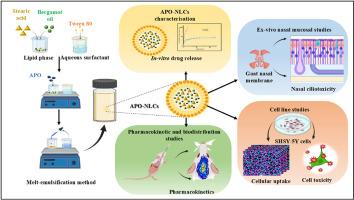
APO-NLCs were formulated using a melt emulsification method and optimized via a Box-Behnken design. The nanoparticles were characterized for size, surface charge, entrapment efficiency, and drug loading. Morphological analysis, in vitro drug release, ex vivo nasal permeation using goat nasal mucosa, and cellular uptake studies in SH-SY5Y cells were conducted. Pharmacokinetic and biodistribution studies compared drug accumulation in the brain following intranasal and oral administration.
Results
The optimized APO-NLCs had a particle size of 138.8 nm, a zeta potential of −8.65 mV, an entrapment efficiency of 60.21 %, and a drug loading of 7.58 %. The formulation showed a biphasic release pattern, with 45.80 % of the drug released over 24 h, following Higuchi kinetics. Intranasal administration led to significantly higher brain drug accumulation compared to oral delivery, indicating improved bioavailability and CNS targeting.
Conclusion
APO-NLCs demonstrated effective drug delivery to the brain, with intranasal administration offering superior bioavailability over oral administration. These findings highlight their potential for treating AD and warrant further investigation.
期刊介绍:
The Journal of Drug Delivery Science and Technology is an international journal devoted to drug delivery and pharmaceutical technology. The journal covers all innovative aspects of all pharmaceutical dosage forms and the most advanced research on controlled release, bioavailability and drug absorption, nanomedicines, gene delivery, tissue engineering, etc. Hot topics, related to manufacturing processes and quality control, are also welcomed.



 京公网安备 11010802042870号
京ICP备2023020795号-1
京公网安备 11010802042870号
京ICP备2023020795号-1

 分享
分享
 求助内容:
求助内容: 应助结果提醒方式:
 扫码关注我们
